Customer Experience
How to Build a Review System for Coaches
March 24, 2026
14 min read

How to Build a Review System for Coaches
Building a review system for coaches can help establish trust, improve client engagement, and drive conversions. Here's a quick breakdown of the process:
- Set Goals and Policies: Define objectives like trust, accountability, and SEO. Use clear submission guidelines and ensure reviews are honest and relevant.
- Design User Experience: Create simple forms with star ratings and guided questions. Display reviews prominently on coach profiles and add filtering options for easy navigation.
- Develop Technical Infrastructure: Use scalable backend solutions, mobile-friendly frontends, and moderation tools to handle growth and maintain review integrity.
- Implement Verification: Verify client-coach relationships using booking tools and fraud detection algorithms. Highlight verified reviews with badges to build trust.
- Test and Optimize: Experiment with review requests, track metrics like submission rates and conversions, and continuously improve based on user feedback.
A well-structured review system not only improves visibility but also helps coaches refine their services based on client insights.
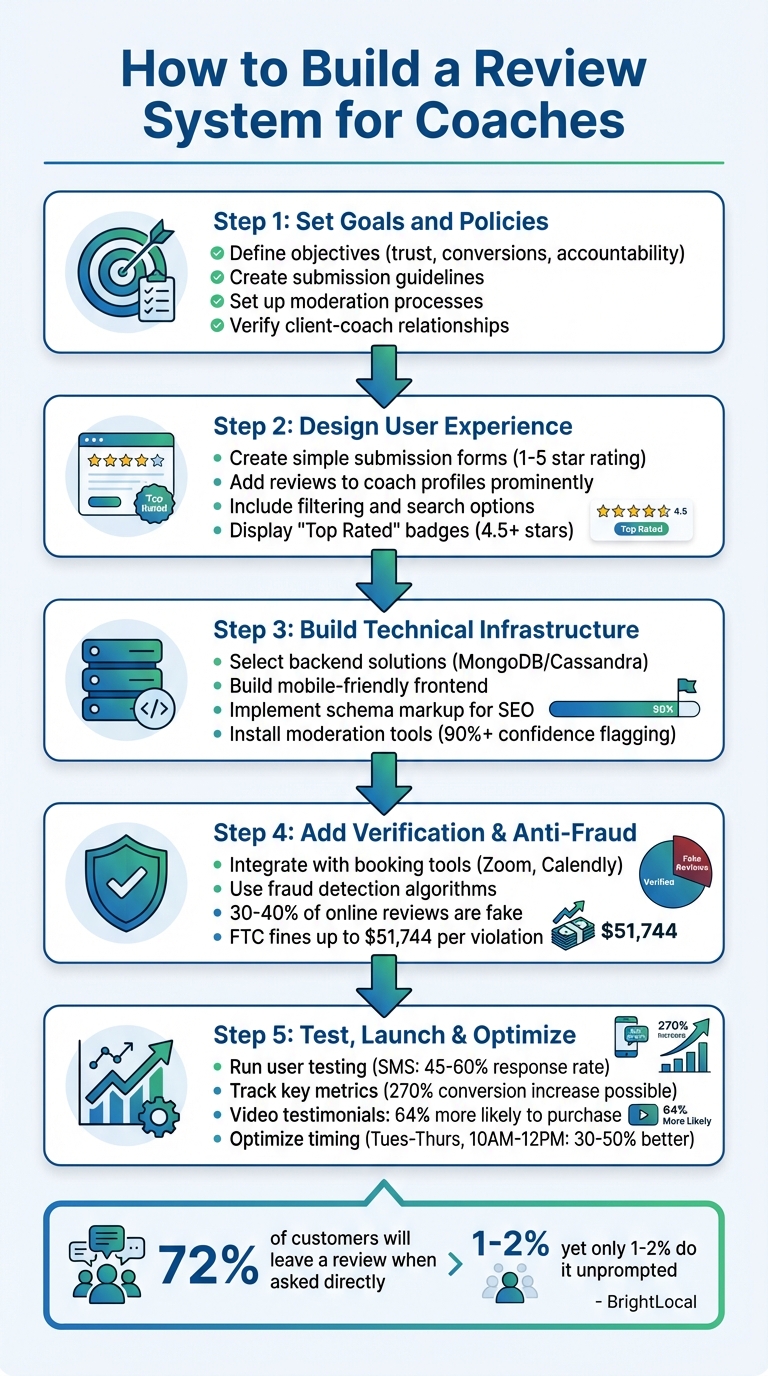
5-Step Process to Build a Coach Review System
Step 1: Set Goals and Review Policies
A dependable review system is the backbone of trust for any coaching platform. Start by defining the purpose of your review system.
Identify Your Main Objectives
Clarify what you want to achieve: build trust, increase conversions, maintain accountability, ensure honesty, and improve search engine visibility. Here’s how you can align your strategies with these objectives:
| Objective | Primary Benefit | Implementation Strategy |
|---|---|---|
| Trust Building | Boosts user confidence | Use verified reviewer badges and include photos |
| Conversion | Drives more signups | Place reviews prominently, such as "above the fold" on profiles |
| Accountability | Improves service quality | Offer private feedback analytics to coaches |
| Transparency | Prevents fraudulent reviews | Verify relationships and use manual moderation |
| SEO | Enhances online visibility | Encourage detailed reviews with relevant keywords |
Once your goals are clear, work on creating submission guidelines to maintain the credibility of your reviews.
Write Review Submission Guidelines
Keep the guidelines straightforward to ensure authenticity. Require reviewers to have verified interactions - like completing at least one session or being three weeks into mentorship - and limit reviews to experiences within the past year.
Avoid offering biased incentives such as discounts or gifts for reviews, as these can compromise the integrity of feedback. Instead, use guided prompts to encourage meaningful responses. For example, ask questions like, "What was your biggest challenge before coaching?" to inspire honest and concise testimonials.
After setting submission norms, focus on building a solid moderation framework.
Set Up Moderation and Verification Processes
Establish clear criteria for removing reviews that violate your standards, such as those containing false claims, privacy violations, or breaches of your code of conduct. Encourage coaches to respond publicly to feedback to address concerns or provide their perspective, rather than pushing for removal of critical reviews.
"Ratings and reviews are essential to trust and quality control... We take mentees' experiences seriously and do not edit or remove any reviews unless... there is a clear violation of this policy." - MentorCruise
Use automated tools to flag suspicious activity, like bulk submissions or offensive language. Pair this with manual oversight, allowing coaches to flag problematic reviews for further review. Finally, be upfront with users about your review collection and moderation practices, including whether any incentives were involved.
This transparency will reinforce the credibility of your platform and the reviews it showcases.
sbb-itb-3c06305
Step 2: Design the User Experience
Once your policies are finalized, it's time to create an interface that makes it easy for clients to submit reviews and for coaches to display them. Here's how to streamline the process and make reviews impactful.
Create Simple Review Submission Forms
Keep your review form short and user-friendly. Combine a 1–5 star rating system with a few guided questions like "What three benefits did you gain?" or "How has your situation changed?" to gather clear, actionable feedback.
For mobile users, consider multi-step forms to make the process feel less overwhelming. Include optional fields for photo or video uploads, and use dropdown menus to tag reviews by specific programs or coaching tiers - this makes organizing feedback much easier.
Timing is everything. Send review requests right after a session or when a client achieves a major goal, as their enthusiasm will likely be at its peak. To minimize barriers, offer a direct link that doesn’t require a login. Aim for testimonials that are concise - around 70 words or fewer - for maximum readability and impact.
Add Reviews to Coach Profiles
Make reviews a central feature of coach profiles. Place them prominently, ideally above the fold, and include key metrics like the average star rating, total review count, and highlighted testimonials. This visibility can help boost signups.
Add a personal touch by including client headshots or short video clips alongside text reviews. To further build trust, introduce "Top Rated" badges for coaches who consistently maintain ratings of 4.5 stars or higher and meet a minimum review threshold. Organize reviews by program or coaching niche so potential clients can quickly find feedback that matches their needs. Don’t forget to display coaches’ responses to reviews - this shows a commitment to client satisfaction and engagement.
Add Search and Filtering Options
Empower users to explore reviews in a way that suits them. Provide a clickable visual breakdown of ratings and options to sort by "Most Recent" or "Most Helpful" reviews. Filters are key - let users narrow down reviews by those with photos or videos, specific coaching programs, service tiers, or tags like "Career Transition" or "ROI."
To encourage community interaction, add a "Was this review helpful?" button. Highlight both the "Most Helpful Positive" and "Most Helpful Critical" reviews to give potential clients a balanced perspective. This transparency can go a long way in building trust and credibility.
Step 3: Build the Technical Infrastructure
Once you've streamlined the user experience, it's time to focus on the technology stack. The choices you make here will determine whether your review system can handle growth without requiring a complete overhaul later.
Select Backend and Storage Solutions
For your MVP, start with a relational database to manage structured review data. As your platform grows, transition to NoSQL databases like MongoDB or Cassandra, which are better suited for handling large volumes of data. If you’re aiming for global scalability, consider building on a microservices architecture using tools like Java microservices or AWS Serverless. This setup ensures your system can handle millions of users simultaneously.
To connect your backend with the frontend, use a headless CMS such as Strapi to create REST or GraphQL APIs. Don’t forget to properly configure API URLs and CORS settings to ensure secure communication between the frontend and backend. Platforms that integrate AI-driven moderation from the beginning see a 40% reduction in fake reviews compared to those relying solely on manual checks.
Once the backend is solid, shift your focus to crafting a user-friendly frontend.
Build Frontend Features
Your frontend should make it easy for users to submit and view reviews. Use hidden fields to automatically capture essential data like userId and coachId, so users only need to provide their rating and feedback. Design mobile-friendly widgets, such as carousels, grids, or sliders, to display reviews dynamically. To improve search visibility, implement schema markup (rich snippets) so star ratings appear directly in Google search results.
Keep your forms straightforward with a 1-to-5 star rating scale and a text box for detailed comments. For more detailed feedback, consider adding multi-dimensional ratings that allow users to score specific aspects, like "Quality" or "Responsiveness".
With your frontend ready, it’s essential to integrate tools that protect the integrity of your reviews.
Install Review Moderation Tools
To maintain trust, combine automated fraud detection with manual review processes. Set new reviews to an "unapproved" status until they’re verified by an admin. Use pattern filtering to track identifiers like Author IDs and Context IDs, and include a "Report" or "Flag" button so users can highlight inappropriate content missed by automated systems.
Configure your moderation tools to flag reviews with confidence scores above 90% for toxicity or fraud. These high-risk reviews should be prioritized for manual review. Additionally, protect your platform from attacks by using SQL prepared statements and sanitizing inputs with functions like htmlspecialchars(). This helps prevent vulnerabilities such as SQL injection and Cross-Site Scripting (XSS) attacks.
Step 4: Add Verification and Anti-Fraud Measures
Once your moderation tools are up and running, the next hurdle is ensuring every review comes from a real client who has genuinely worked with the coach. Studies show that 30% to 40% of online reviews are fake, and nearly half of U.S. consumers will encounter fraudulent reviews in 2024. For coaching platforms, where trust is paramount, these statistics highlight the need for robust verification measures.
Verify Reviewer Identity and Relationships
The first step is to connect your review system with CRM or booking tools like Zoom, Google Meet, or Calendly. This integration ensures that only clients who have completed a session can submit a review. You can also time review requests strategically - such as after a client completes three sessions or achieves a specific goal.
Next, evaluate the digital footprint of reviewers. Legitimate clients typically use established email addresses, active phone numbers, and often have social media profiles or professional accounts. On the other hand, fraudsters rely on disposable email domains or virtual phone numbers that lack proper KYC (Know Your Customer) verification. Implement systems to automatically flag or block reviews submitted through these risky channels. Similarly, watch out for reviews tied to newly created email accounts, as genuine users are likely to have accounts with a longer history.
For premium coaching programs, consider using video testimonials. A 5–10 minute recorded call where clients discuss their outcomes is much harder to fake compared to text-based reviews. You can also prompt clients with high Net Promoter Scores (9 or 10) to share testimonials, ensuring feedback comes from satisfied, verified users.
Once identities are confirmed, the focus can shift to identifying and preventing patterns of fraudulent activity.
Use Fraud Detection Algorithms
With verified identities in place, fraud detection algorithms can help identify unusual behaviors. Look for signs like review bombing or repetitive language, especially from newly created accounts, as these often indicate coordinated manipulation.
Cross-referencing reviewers with internal records - such as appointment logs or transaction histories - can further confirm whether a real coaching relationship existed. And remember, compliance with regulations is critical. The Federal Trade Commission (FTC) can impose fines of up to $51,744 per violation for businesses caught buying or posting fake reviews.
Show Moderation Transparency
Being transparent about your review verification process builds trust. Clearly outline your criteria for review removal, whether it’s due to false claims, privacy violations, or breaches of your platform's code of conduct.
"Fake reviews distort reputations, mislead consumers, and ultimately erode trust in entire digital services." - Uros Pavlovic, Author, Trustfull
Highlight verified reviews with authentication badges to reassure potential clients that the feedback is genuine. This visible effort to maintain authenticity strengthens trust in your platform, ensuring clients feel confident in the reviews they read.
| Signal Type | High-Risk (Fraud) Indicators | Trust Indicators |
|---|---|---|
| Disposable/temporary domains, no social media links, newly created | Linked to social profiles, business domain, history of data breach exposure | |
| Phone | Virtual MNO (no KYC), frequently ported, no connected messaging apps | Tier 1 Carrier (ID required), porting history with paperwork, high info coherence |
| Behavior | Bulk-created accounts, repetitive patterns, AI-generated content | Milestone-triggered, specific "before/after" details, video format |
Step 5: Test, Launch, and Optimize the System
With your review system ready, the next step is making sure it works effectively in real-world conditions. This phase is all about testing, launching, and fine-tuning to ensure the system not only improves review quality but also builds trust - something central to coachtrusted's mission. Testing lets you figure out the best timing for requests, the most effective communication channels, and how to remove obstacles that discourage clients from leaving reviews.
Run User Testing
Timing is everything. Experiment with different intervals to find the perfect moment to ask for a review. For coaching platforms, the sweet spot is right after a client hits a major milestone, like achieving a goal or completing a project.
Next, test how guided prompts compare to open-ended requests. For example, asking specific questions like, "What was your biggest challenge before working with us?" often leads to detailed, story-driven reviews. On the other hand, leaving the feedback form blank might result in vague responses like, "Great coach!". One direct-to-consumer skincare brand saw fewer submissions when they shifted to detailed prompts, but the quality of feedback improved so much that click-through rates tripled.
It’s also essential to evaluate which channels work best for review requests. Here’s a quick breakdown:
- SMS: Response rates range from 45–60%, with replies often coming in just 90 seconds.
- In-app prompts: On mobile, these achieve about a 36.14% response rate.
- Email: Generally, response rates fall between 6–15%.
"72% of customers will leave a review when asked directly, yet only 1-2% do it unprompted." - BrightLocal
When testing where to display reviews, consider this: placing testimonials at the top of a page increased signups by more than 64% during one trial.
After nailing down the timing, messaging, and placement, shift your focus to tracking measurable results.
Track Key Metrics After Launch
Once your system is live, keep a close eye on the numbers. Monitor submission rates, response rates, and how reviews influence conversions. For example, reviews can boost conversion rates on certain pages by as much as 270%.
Compare the impact of text reviews versus video testimonials. While text reviews have a higher completion rate (30–40%), video testimonials - despite only completing at 10–15% - can increase landing page conversions by up to 34%. Plus, customers are 64% more likely to make a purchase after watching a video review. If you're using pre-written drafts for reviews, note that more than 50% of clients typically approve them.
Don’t forget to track SEO performance. User-generated reviews naturally add fresh keywords to your site, which can improve search rankings and increase click-through rates. Tools like Net Promoter Score (NPS) and Customer Satisfaction (CSAT) can help you identify satisfied clients (those scoring 9 or 10). Direct these promoters to your testimonial forms while their satisfaction is at its peak. Lastly, analyze retention and referral rates to see if your review system plays a role in building client loyalty.
Improve Over Time
As your review system grows, consider automating parts of the process. For instance, automatically route NPS promoters to testimonial forms or set up triggers to send review requests 5–10 days after a major client milestone. Timing matters here too - requests sent on Tuesdays through Thursdays between 10:00 AM and 12:00 PM tend to perform 30–50% better.
Organize testimonials by categories like industry, coach expertise, or common client concerns. This way, prospects can easily find reviews that feel relevant to their needs. AI tools can also help by analyzing feedback to highlight the most impactful quotes for display.
"A company with 200 generic testimonials will lose to a company with 15 specific, story-driven ones." - Credibly Team
Focus on quality over quantity. Use guided prompts that follow a Before → After → How format to encourage clients to share transformation stories. In your final follow-up email, include an option to opt out by replying with "pass." This simple addition can increase response rates for the final touch by 10–15%.
Finally, keep testing. Try different channels for specific client segments. With 95% of people reading online reviews before committing to a service, keeping your system fresh and relevant ensures that your prospects see reviews that speak directly to their needs.
Conclusion
Building a reliable review system for coaches involves five essential steps: setting clear goals and policies, creating an intuitive user experience, establishing solid technical infrastructure, implementing verification processes, and continuously testing and improving the system. Each of these steps works together to foster trust, transparency, and credibility.
From defining clear policies to ensuring smooth technical execution, every phase contributes to a platform where coaches and clients can interact with confidence. A well-thought-out review system turns client feedback into measurable proof of a coach's impact. Research shows that clients heavily rely on authentic reviews when making decisions. Platforms like coachtrusted uphold this trust by banning incentives such as discounts or gifts, ensuring reviews reflect genuine client experiences. As the coachtrusted team explains: "Creating a coach account on coachtrusted marks your entry into a community where truth and integrity are the foundation of shared experiences".
A strong review system also highlights real client transformations. Reviews that showcase before-and-after stories - detailing the initial challenges, the achieved results, and the methods that led to success - offer tangible evidence of a coach's effectiveness. Beyond enhancing reputation, these transformation-focused reviews can significantly increase conversion rates. Adding video testimonials can amplify this effect, as potential clients are 64% more likely to make a purchase after watching one.
Transparency and responsiveness are equally important. Coaches who handle both positive and negative feedback with professionalism demonstrate accountability and a willingness to improve. Including a balanced range of reviews - not just glowing five-star ones - helps set realistic expectations and builds lasting credibility. As Wyrloop puts it: "A trustworthy review system is more than a UX feature - it's a cornerstone of credibility".
Finally, regular testing and updates ensure your review system stays effective over time. Launching the system is just the beginning. By incorporating automated updates, fresh testimonials, and ongoing moderation, you keep it relevant and impactful. Treating review collection as a core feature rather than an afterthought creates a feedback loop that not only attracts new clients but also helps coaches improve their services based on real-world experiences.
FAQs
What should I verify before allowing someone to post a review?
To ensure reviews are reliable, make sure the feedback is genuine, recent (within the last 12 months), and stems from real interactions. Reviews should not be influenced by incentives or involve any conflicts of interest. The reviewer’s experience must be real and verifiable to uphold trust and accuracy on the platform.
How do I prevent fake or biased coach reviews without hurting review volume?
To keep reviews genuine and balanced while still encouraging participation, focus on verification and clarity. Make sure reviewers' credentials and experiences are checked to confirm their reliability. Avoid offering perks like discounts in exchange for reviews, as this can skew opinions. Instead, encourage users to share detailed feedback that reflects their most recent experiences. Building an open and honest environment helps maintain trust in the review process, without discouraging authentic contributions.
Which metrics best prove the review system is increasing signups?
Metrics that reveal how reviews shape client decisions are essential. Pay close attention to conversion rates, trust levels, and testimonials that resonate with your audience. Reviews that are detailed and directly address client concerns - like “Does this solve my problem?” - carry more weight than sheer volume. By monitoring how reviews enhance credibility and boost signups, you can effectively gauge the success of your approach.