Career Development
Case Studies: Mentorship in Business Growth
April 20, 2026
13 min read

Case Studies: Mentorship in Business Growth
Mentorship is a proven driver of business growth, helping entrepreneurs and professionals overcome challenges, refine strategies, and achieve measurable results. Key takeaways:
- Entrepreneurs with mentors are 5x more likely to launch businesses and 3x more likely to sustain them.
- Real-world examples, like Vicki Hebert's 300% revenue growth with mentorship, show how guidance boosts performance.
- Structured mentorship in startup accelerators leads to higher funding success and faster scaling.
- Internal corporate mentorship programs improve employee retention (up to 78%) and career mobility.
- Programs like Goldman Sachs' 10,000 Women empower entrepreneurs in emerging markets with skill-building and networking.
Mentorship works by addressing specific challenges, offering guidance in leadership, financial planning, and scaling operations. Whether through accelerators, corporate programs, or online platforms, mentorship delivers clear, actionable results for businesses and individuals.
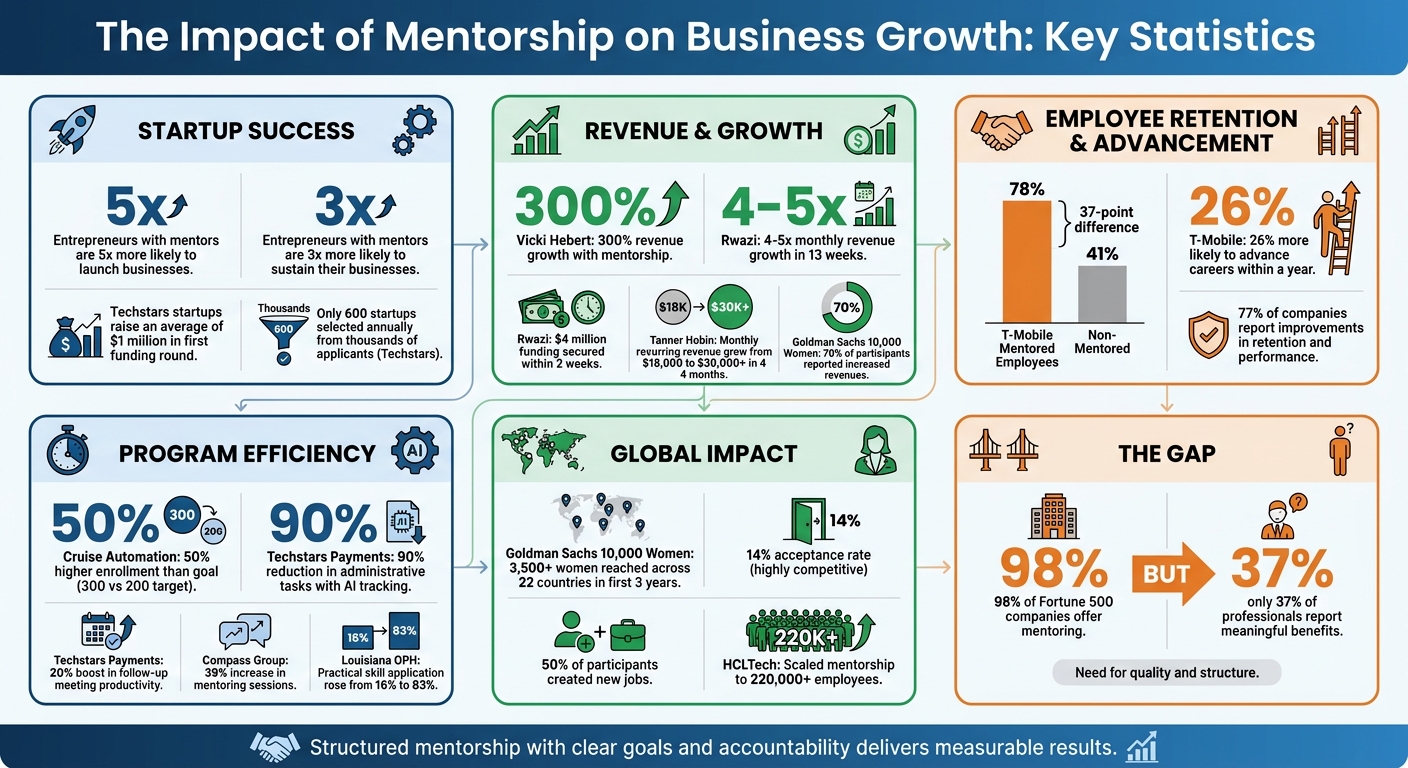
Key Statistics: How Mentorship Drives Business Growth and Success
Case Study 1: Mentorship in Startup Accelerators
How Mentors Help Startups Succeed
Startup accelerators are designed to transform raw business ideas into fully developed, investor-ready ventures through intensive mentorship. Founders who complete programs like Techstars often achieve impressive results, raising an average of $1 million in their first funding round after graduation. These programs are highly competitive - Techstars, for example, selects only 600 startups annually from thousands of applicants across more than 50 global locations.
Mentors play a crucial role in these programs by helping founders refine their value propositions, develop solid financial models, and scale their operations. Take Rwazi, a marketing intelligence platform founded by Joseph Rutakangwa and Eric Sewankambo. They joined the 13-week Techstars LA program in March 2022. Before the program, they were manually tracking sales using Excel. With guidance from their mentors, they transitioned to scalable tools like HubSpot. By the end of the program, Rwazi's monthly revenue had grown by 4 to 5 times. On demo day, they secured $4.5 million in investment bids and closed a $4 million funding round with Bonfire Ventures within just two weeks.
"You have someone to talk to when you're stuck or having doubts or struggling to get past something - someone who is deeply experienced to help you with any problem you're facing."
– Matt Kozlov, Managing Director, Techstars LA
Mentorship also helps founders avoid trial-and-error approaches that can waste time and resources. For example, Jessica Flynn, founder of The YOU Power Project, entered the GB Accelerator's Launch Program in 2024 with an unfocused strategy and poor financial planning. Over two months, mentors Erin Maechler and Alex Schwertner helped her create a structured financial model to validate pricing and determine the best times to hire. This clarity allowed Flynn to streamline her B2C sales cycle and focus her marketing efforts on profitable customer segments.
"I am no longer throwing spaghetti. Our day-to-day decisions are now rooted in clarity and confidence."
– Jessica Flynn, Founder, The YOU Power Project
These stories highlight how structured mentorship in accelerators can refine strategies and drive measurable growth.
Examples of Accelerator Programs
Techstars operates with a "Give First" philosophy, offering founders access to a network of over 3,000 companies, including Fortune 500 giants. One of its standout features is the Mentor Madness event, where startups engage in a series of rapid 20-minute meetings with dozens of mentors. For example, 12 startups once met with 62 mentors to identify the best matches for their specific needs. In 2023, the Techstars Payments Accelerator introduced AI-driven mentorship tracking, which reduced post-meeting administrative tasks by 90% and boosted follow-up meeting productivity by 20%.
Another example is PitchBob's mentorship program, which helped solo founder Sofia refine her AI career assistant, Foundly, aimed at Gen Z users. Over an 8-week period ending in 2024, Sofia worked with mentor Dima Maslennikov to simplify her 17-slide pitch deck into 10 concise slides, shifting the focus from technical features to compelling user stories. By the end of the program, Foundly had secured over 50 pilot users and received two formal invitations to pitch to venture capital investors.
"I didn't need cheerleading. I needed clarity, structure, and honest feedback."
– Sofia, Founder, Foundly
sbb-itb-3c06305
Case Study 2: Internal Mentorship Programs in Large Corporations
Cross-Department Knowledge Sharing
In large corporations, departmental silos often hinder communication and limit the exchange of valuable insights. Internal mentorship programs can break down these barriers by fostering structured connections across teams and business units.
Take the example of one global tech company. A Lead Program Admin observed a lack of communication between departments before launching a formal mentorship initiative. "I'm not sure departments were even speaking with each other that often. This meant brands weren't sharing knowledge and experience that could be valuable to their own projects and the company's processes at large", shared the Senior Talent Management and Learning Specialist. The mentorship program helped bridge these gaps, enriching the flow of shared insights.
Boeing’s mentorship program is another great example. It pairs seasoned professionals with fresh STEM talent, offering students unique exposure to roles such as aerospace engineers, data scientists, and security architects. Baris Paraskeva, Lead Security Architect at Boeing, highlighted the benefits: "I think that bringing fresh STEM talent into the company will help us to challenge what we do and move forward". This approach not only prevents stagnation in critical areas like cybersecurity but also drives innovation across the company.
HCLTech took this concept further by implementing mentorship software to support upskilling and innovation for its workforce of over 220,000 employees. Sarah Fayard, Global Mentorship Lead at HCLTech, explained, "We needed a platform that could scale seamlessly across our more than 220,000 employees, and Chronus had a track record of successfully supporting large enterprises like ours". The software uses advanced matching algorithms to connect high-potential employees - particularly women - with mentors who can guide their career growth and leadership development.
Amazon’s Mentoring Program (AMP) adds another layer of structure. Participants receive detailed connection plans, including resources, training, and actionable steps to help them achieve their goals. Melony Menard, Senior Program Manager at Amazon, emphasized this structured approach: "The program provides all users with structured plans featuring resources, training, and actionable steps". This clarity helps employees map their career paths and unlock new professional opportunities within the company.
By fostering cross-departmental synergy, these mentorship programs deliver measurable improvements in both retention and productivity.
Impact on Employee Retention and Productivity
The benefits of structured mentorship go beyond collaboration, significantly improving employee retention and career mobility. T-Mobile, for instance, reported that employees in their mentorship program had a 78% retention rate, compared to just 41% for those not involved. This 37-percentage-point difference translates into substantial savings in recruitment and training costs for their workforce of over 70,000 employees.
T-Mobile also found that mentorship participants were 26% more likely to advance their careers - either through promotions or lateral moves - within a year. This shows that mentorship creates clear pathways for internal mobility and career advancement.
Daimler Trucks North America revamped its mentoring program to support 4,000 employees across the U.S. and Mexico. By replacing manual spreadsheet tracking with an automated system, the company gained real-time transparency for managers and trainers to monitor participant progress. Suz Hahn, Learning Architect at Daimler Trucks North America, shared, "We have an automated system that functions very well while providing an excellent user experience. We're now able to scale this program across all U.S. locations. Today there is mentoring buzz at all levels, and Daimler realizes mentoring is key to the health of our organization".
Mentorship programs also accelerate onboarding by connecting new hires with experienced peers and leaders. For employees in retail or field-based roles, mentorship provides insights into corporate functions and opens doors to roles they might not have previously considered. This cross-functional exposure not only enhances productivity but also helps employees see how their work aligns with the company’s broader goals.
Case Study 3: Supporting Entrepreneurs in Emerging Markets
Overcoming Challenges in Emerging Markets
Entrepreneurs in emerging markets often face hurdles like limited access to capital, underdeveloped networks, and skill gaps. These challenges can significantly hinder their growth. To address these issues, mentorship programs have become an effective tool for empowering business owners, often found through vetted review platforms.
The Goldman Sachs 10,000 Women program is a standout example of how structured mentorship can change the game for entrepreneurs. This initiative, designed to support women business owners in emerging markets, combines business education with professional mentoring in areas like accounting, marketing, HR management, and finance. In its first three years, the program reached over 3,500 women across 22 countries, with a highly competitive 14% acceptance rate - a clear indicator of the demand for such resources in developing economies.
Online mentorship platforms have further expanded opportunities in these regions by breaking down geographical barriers and offering cost-efficient options for entrepreneurs with tight budgets. Mentors provide more than just skill-building; they also offer credibility and access to networks that can open critical doors. As Patrik Schulcz and Andrey Kostyuk explain, "Mentoring empowers the mentee to take independent action and make important decisions".
The nonprofit organization Score takes this concept further by offering free mentoring through a network of over 10,000 volunteers. These mentors help entrepreneurs navigate challenges and expand their professional connections.
Such mentorship models are creating pathways for transformative success.
Success Stories from Women Entrepreneurs
The power of mentorship in emerging markets is best illustrated through individual success stories. Take Ayodeji, a Nigerian entrepreneur who started with a small, home-based catering business. In April 2011, she joined the Goldman Sachs 10,000 Women program, where she received training in business management and professional mentorship. With this support, Ayodeji transitioned her operations to a commercial kitchen, purchased a delivery van, and hired 25 new employees.
The program’s broader impact is equally impressive: 70% of participants reported increased revenues, and half created new jobs, showcasing the scalability of mentorship’s benefits.
Dina Habib Powell, Managing Director and President of the Goldman Sachs Foundation, highlighted the program’s vision:
"We realized there was enormous opportunity in finding those owners in emerging economies, equipping them with business and management education, mentoring from people in our firm and the local community, and linking them to capital".
She added:
"They demonstrate the unique potential that women offer in emerging markets and throughout the world".
A Mentorship Match: Unleashing entrepreneur success
Strategies for Using Mentorship to Drive Business Growth
Case studies highlight several strategies behind successful mentorship programs. The most effective ones begin by pinpointing a specific business challenge - whether it’s high employee turnover, skill shortages, or slowed growth - and tailoring the mentorship program to address it. Jennifer Taylor, Deputy Director of Workforce at the Louisiana Department of Health, explained, "A mentorship program began as a solution for retention and quickly proved its value in closing skill gaps and boosting engagement".
Technology-driven scaling has made mentorship programs more efficient and accessible. For example, Cruise Automation initially aimed to enroll 200 engineers in its mentorship program but ended up with nearly 300 participants - a 50% jump - thanks to automated matching that cut administrative time from days to minutes. Similarly, The Forum, a Canadian non-profit supporting female entrepreneurs, quadrupled its program size to support over 900 participants while maintaining quality through a "Health Monitor Dashboard" that tracked progress.
Peer-to-peer learning is another impactful approach, offering an alternative to traditional top-down mentorship. Compass Group implemented two tracks: a "Connect" program for managers to collaborate on daily challenges and a "Grow" track for career coaching. Their "New Year, New Mentor" campaign led to a 39% increase in scheduled sessions. This horizontal exchange of knowledge allows participants to both teach and learn, offering diverse perspectives on complex business issues.
Storytelling and journey sharing deepen the mentor-mentee connection. Mentors who share their personal experiences provide practical guidance and inspire mentees. Tanner Hobin, CEO of Headway Marketing, shared how mentorship transformed his mindset from fear of failure to confidence:
"I used to be paralyzed by the thought of losing a client. Now I kind of want to lose one - just to prove we can take it."
During just four months of mentorship, Hobin’s agency grew its monthly recurring revenue from $18,000 to over $30,000 by adopting systems like Asana, Loom, and HubSpot. These strategies demonstrate how mentorship can directly influence business outcomes.
Comparing Mentorship Program Features
| Program/Company | Primary Format | Key Strategy | Reported Outcome |
|---|---|---|---|
| Louisiana OPH | 1-on-1 & Peer | Skill gap targeting | 83% practical skill application |
| Avison Young | 1-on-1 & Group | ERG-based inclusion | 98% satisfaction; lower turnover |
| Cruise Automation | 1-on-1 | Automated matching | 50% higher enrollment than goal |
| New York Life | 1-on-1 | Cross-ERG pairing | 53% diverse pairings |
| Compass Group | Peer & Career | Promotional campaigns | 39% increase in sessions |
| The Forum | 1-on-1 | Automated scaling | 4x program participation |
These examples emphasize the need for thoughtful program design. While 98% of Fortune 500 companies offer mentoring, only 37% of professionals report meaningful benefits. This gap underscores the importance of clear goals, structured frameworks like SMART-ER (Specific, Measurable, Achievable, Relevant, Time-bound, Evaluated, and Readjusted), and consistent outcome tracking. For instance, at the Louisiana Office of Public Health, employees reporting "practical application" of new skills rose from 16% to 83% after launching a structured mentorship initiative.
Digital tools make it even easier to implement and scale these strategies.
Using Platforms Like Coachtrusted
Digital platforms have revolutionized mentorship by removing geographic barriers and reducing administrative burdens. Coachtrusted connects businesses and individuals with verified mentors across various fields, offering features like smart search, quiz-based recommendations, and user reviews to ensure a good match. This streamlines the mentorship process, allowing businesses to focus on growth.
For companies adopting mentorship programs, platforms like Coachtrusted provide several key benefits. Their verification processes ensure mentors bring proven expertise, while built-in messaging tools and customizable dashboards enable progress tracking and accountability. These tools are particularly valuable for remote and hybrid teams, as they integrate virtual communication with structured mentorship to maintain company culture and facilitate knowledge sharing.
The secret to success lies in seamlessly integrating mentorship into existing workflows. Programs that connect with tools like Slack, Zoom, or Google Workspace make participation effortless. For small businesses and startups, combining mentorship with operational tools creates a framework for accelerated growth. Reflecting on his own mentorship journey, Tanner Hobin remarked:
"Looking back at that time… I don't really think I was running an agency. It was kind of a glorified freelance operation... If I hadn't joined [the mentorship program], it would've taken me 18–24 months to get where I am now."
To encourage participation, businesses can introduce incentives such as milestone rewards or challenges that focus on personal branding or networking. Paired with measurable tracking, these efforts ensure mentorship programs deliver concrete results. The data speaks for itself: 77% of companies with mentoring programs report improvements in employee retention and overall performance. For businesses aiming to grow sustainably, investing in structured mentorship is a strategic move that pays off.
Conclusion: The Impact of Mentorship on Business Success
The examples shared earlier reveal a consistent theme: mentorship can profoundly influence business success. From Vicki Hebert's inspiring turnaround to Tanner Hobin's impressive revenue growth, these stories highlight how mentorship can reshape business paths. With the right guidance, progress that might take years can happen in a fraction of the time. As Tanner Hobin aptly put it:
"Most people don't realize - it's not about the money. It's about shrinking the time to failure, so you can scale faster".
Mentorship helps tackle the challenges that often hinder growth. Whether it’s overcoming the fear of losing clients, transitioning from freelancer to business owner, or setting up SOPs to enable scaling, mentors provide both the technical know-how and emotional encouragement needed for long-term success. Nate Rodriguez of Fresh Coat Marketing summed this up well:
"The right mentor doesn't just answer your questions - they challenge you to think and grow beyond what you think is possible".
For mentorship to be truly effective, it needs structure, clear objectives, and accountability. Platforms like Coachtrusted are making this process easier by connecting businesses with experienced mentors. With features like smart matching, progress tracking, and integrated communication tools, these platforms ensure that finding and working with the right mentor is a streamlined and productive experience.
If you’re serious about growing your business, the real question isn’t whether mentorship is worth it - it’s how soon you can start. Whether you’re a startup founder making your first hire or a seasoned business owner aiming to scale, the right mentor can make all the difference. The stories shared here are part of a larger trend: mentorship-driven growth leads to tangible, transformative results.
FAQs
How do I know if I need a mentor or just more experience?
To figure out whether you need a mentor or more experience, start by evaluating where you are now and what you're aiming for. If you're feeling stuck or unsure about your direction, a mentor could provide tailored advice and share their knowledge to guide you. On the other hand, if you already have a solid base and are looking to sharpen particular skills or hit specific targets, coaching might be the way to go. Think about whether you're seeking general guidance (mentor) or targeted skill development (coach).
What should I measure to prove mentorship is driving growth?
Tracking important growth metrics like revenue, user engagement, product adoption, retention rates, and even successful pivots or recoveries shaped by mentorship can provide clear insights into its impact. These metrics serve as concrete evidence of how mentorship contributes to improving business performance.
How can I find the right mentor match on Coachtrusted?
To discover the ideal mentor on Coachtrusted, take advantage of its tools to connect with verified professionals who match your specific goals. Explore detailed profiles to assess their expertise, experience, and areas of focus. This approach helps you select a mentor who aligns with your personal or career development objectives.