Career Development
Avoiding Fake Coaching Programs: Tips for Clients
March 23, 2026
19 min read

Avoiding Fake Coaching Programs: Tips for Clients
Want to avoid wasting money on fake coaching programs? Here's what you need to know:
- Red Flags: Beware of promises like "6 figures in 30 days", vague credentials, high-pressure sales tactics, and testimonials that seem unverifiable.
- Verify Credentials: Legitimate coaches often have certifications from reputable bodies like the International Coaching Federation (ICF). Always check their qualifications using official registries.
- Transparent Pricing: A trustworthy coach will clearly outline fees, deliverables, and refund policies. Avoid programs with hidden costs or constant upsells.
- Progress Tracking: Look for structured methods like S.M.A.R.T. goals or Key Performance Indicators (KPIs) to measure success. If they can't explain how they'll track your progress, that's a red flag.
- Avoid Pyramid Schemes: Be cautious of programs focused on recruiting others rather than delivering real skills or results.
Pro Tip: Use verified platforms like CoachTrusted to find pre-screened, reliable coaches.
If something feels off - like unrealistic promises or rushed decisions - dig deeper before investing. A legitimate coach will prioritize your growth, not their profit.
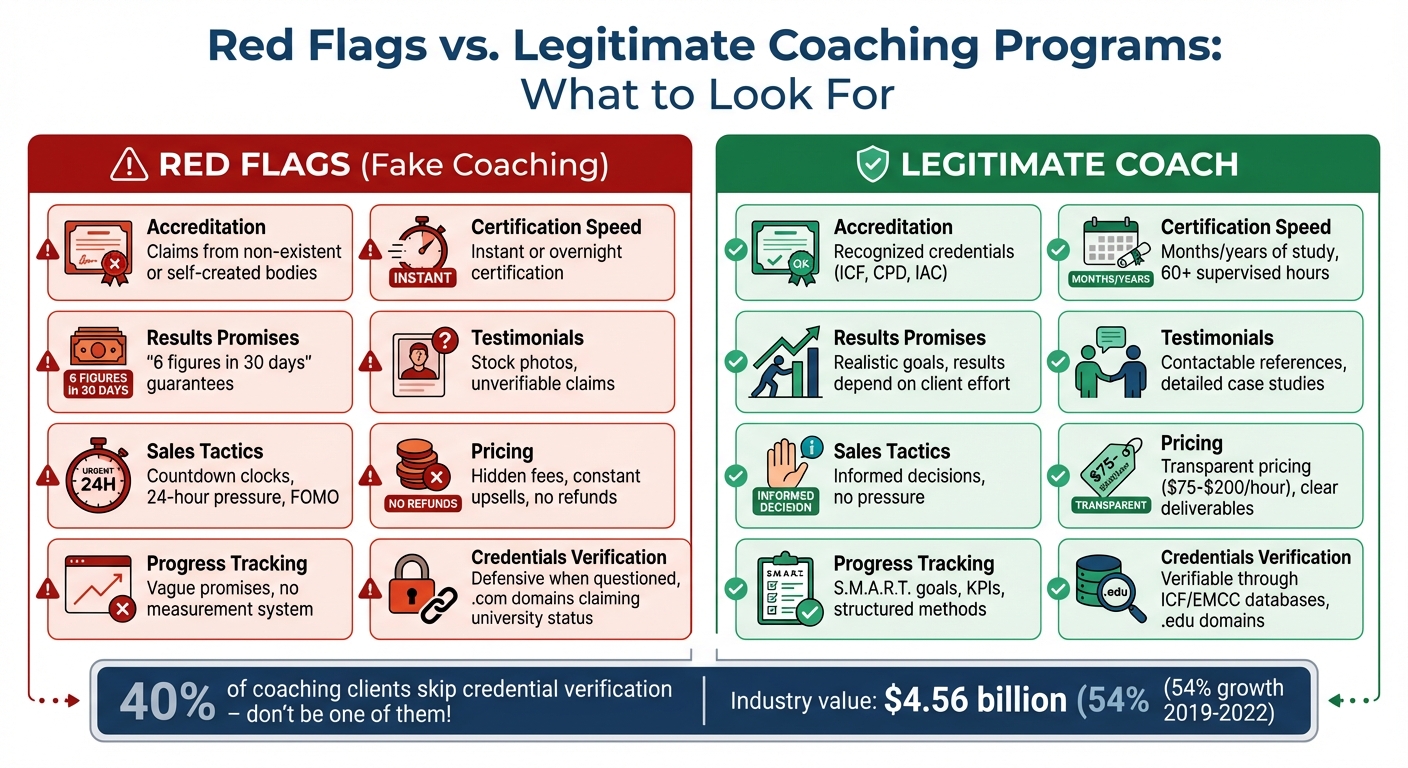
Red Flags vs Legitimate Coach Characteristics Comparison Chart
1. Check Coach Credentials and Qualifications
Verified Credentials and Qualifications
One of the most important steps to avoid falling for fake coaching programs is to verify a coach's credentials. Surprisingly, 40% of coaching clients skip this step before starting sessions, which leaves them open to scams. Don’t make this mistake.
Start by asking direct questions like: "Which professional organizations accredit you?" and "How many hours of accredited training have you completed?" A legitimate coach will answer these questions openly. The International Coaching Federation (ICF) is often considered the gold standard worldwide, offering three levels of accreditation: Associate Certified Coach (ACC), Professional Certified Coach (PCC), and Master Certified Coach (MCC). To earn an ICF credential, a coach must complete at least 60 hours of supervised training and pass a rigorous exam.
Other respected accrediting bodies include:
- European Mentoring and Coaching Council (EMCC)
- Association for Coaching (AC)
- Center for Credentialing and Education (CCE)
Ask for certification details, such as numbers and issue dates, and verify them using official registries like the ICF's Credentialed Coach Finder, EMCC's Find a Coach database, or the AC's Coach Directory. If a coach claims to hold a university degree, you can confirm its validity through the U.S. Department of Education Database of Accredited Postsecondary Institutions. Accredited institutions typically use websites ending in .edu or .org.
This verification process does more than confirm a coach’s legitimacy - it can also reveal warning signs. For instance, be cautious of credentials based solely on "life experience" or programs that don’t require formal coursework or supervised coaching hours. Quality certifications often take a year or more to earn and usually require renewal every three years, backed by continuing education credits.
"A qualified coach will welcome these questions and respond transparently without defensiveness",
says Louisa Savva, Founder of Savva Coaching.
If a coach becomes evasive or defensive when asked about their qualifications, consider it a red flag.
To make things easier, platforms like CoachTrusted can connect you with pre-verified coaches across various specialties.
sbb-itb-3c06305
2. Ask for Proof of Progress Tracking Methods
Transparent Business Practices and Pricing
When working with a coach, it's essential to know how they'll measure your progress. Promises of "transformation" or "breakthroughs" aren't enough - you need to see their actual tracking methods. A professional coach should use frameworks like S.M.A.R.T. goals to set measurable and clear strategies for your growth. Within the first 30 days, they should establish a baseline - your starting point - so any progress can be objectively tracked over time.
A structured, transparent workflow is a hallmark of legitimate coaching. Business consultant Gilberto Herrera explains: "If your provider can't show that flow: diagnose → design → implement → measure, you're probably looking at motivation, not management". Real coaches rely on specific Key Performance Indicators (KPIs) such as revenue growth, conversion rates, or operational efficiency, providing weekly updates on these metrics. If a coach can't share concrete examples of past results, complete with numbers and timelines, consider it a red flag.
To ensure clarity, ask for a written Scope of Work (SOW). This document should outline deliverables, meeting schedules, and the success metrics you'll track together. Serious professionals often use tools like goal-tracking dashboards, session summaries, and assessments - ranging from self-reflections to 360-degree feedback - to keep tabs on your progress. As Lisa Fain, an International Executive Coach, points out:
"Establishing clear goals and objectives laid out from the start of the coaching journey ensures alignment in the coaching process, helping both coach and client measure progress".
Be wary of anyone who dismisses your need to understand the tracking process by saying they'll "handle everything." This often signals a lack of real tracking systems. Instead, ask them to demonstrate their framework using a scenario that aligns with your goals.
For added protection, consider structuring payments around milestones - 30% upfront, 40% midway, and 30% upon completion. This approach safeguards your investment and holds the coach accountable for delivering measurable outcomes. Platforms like CoachTrusted can simplify your search by connecting you with professionals who already use verified tracking systems. Transparent progress tracking isn't just a bonus - it's essential for avoiding scams and ensuring you're working with a true professional.
3. Be Wary of Quick or Guaranteed Results
Realistic Program Promises and Goals
If a coach claims you'll earn "$100,000 overnight" or drop "25 pounds in the first week", walk away immediately. According to the Federal Trade Commission, while quick earnings might happen, no one can guarantee lasting success. Your results depend on your effort, market conditions, and how effectively you apply what you learn. Setting realistic expectations goes hand-in-hand with verifying credentials and tracking progress, protecting your time and money.
Legitimate coaching focuses on gradual skill development. Instead of promising instant results, a good coach will help you build abilities like communication, decision-making, or handling objections. True growth takes time - executive coaching, for example, often spans six to twelve months with regular sessions to test and refine strategies. Be cautious of anyone offering shortcuts or quick fixes; these are often red flags for scams.
Unrealistic promises can lead to costly mistakes. Scammers may lure you in with claims like a "50% to 100% return on investment" within a year. Certified Life Coach Bijan Kholghi advises:
If a life coach is promising to tell you what to do with your life, or a life of happiness without you having to put in the work, they may well be a scam artist.
Before committing, make sure to clarify session details, costs, and a reasonable timeline for progress.
Beware of high-pressure tactics like countdown timers, "act now" prompts, or no-refund policies. Reputable coaches will allow you time to research, ask questions, and consult trusted advisors before making a decision.
If you're still unsure after reviewing the program, seek advice from a trusted third party, such as a friend or the Small Business Administration, before investing. Resources like CoachTrusted can connect you with verified professionals who focus on skill-based growth instead of empty guarantees. Remember, if something sounds too good to be true, it probably is.
4. Recognize High-Pressure Sales Tactics
Transparent Business Practices and Pricing
Fake coaching programs often rely on urgency and fear to push you into quick decisions. Think about those countdown clocks or phrases like "limited spots available" - their goal is to rush you before you can fully evaluate the offer. The Federal Trade Commission puts it simply:
"Honest business opportunities don't need to use high-pressure sales tactics - an offer that's good today should be good tomorrow, too."
Scammers also use emotionally charged events to distract you from their true intentions. For example, they might host free or low-cost seminars filled with high energy, designed to encourage impulsive decisions. Attendees are sometimes pressured to skip meals or rush to registration tables, all to short-circuit logical thinking. These aggressive strategies have caused countless people to lose thousands of dollars.
A common trick is starting with a low-cost offer and then pressuring you to spend tens of thousands more for "expert mentoring" or "proven secrets." In 2026, many scams target beginners, often demanding investments in the four- to five-figure range.
When faced with high-pressure calls or pitches, don’t rely on verbal promises alone. Always insist on a written contract that details everything - deliverables, call durations, and refund policies. A trustworthy coach will use secure payment systems and never ask for sensitive credit card details via email. Take the extra step to verify their business history through official registries.
Here’s a simple rule to follow: if the offer is legitimate, it will still be there tomorrow. Use that time to research the coach’s name along with terms like "review", "scam", or "complaint." Platforms like CoachTrusted can help you find verified professionals who focus on your growth rather than pressuring you into impulsive commitments.
5. Check if Testimonials Are Real
Authenticity of Testimonials and Reviews
When evaluating a coach, authentic testimonials are a critical factor to consider. They can heavily influence your decision, but it’s important to remember that not all testimonials are trustworthy. As the FTC notes:
"glowing stories of success could be fake or misleading, and positive online reviews may have come from made-up profiles."
Some red flags to watch for include testimonials featuring stock photos, vague first names, or descriptions that lack any verifiable details. On the other hand, genuine testimonials often outline a specific issue, detail the coach's solution, and steer clear of generic praise. Video testimonials can be even more reliable since they tend to capture real emotions and experiences, making them harder to fake.
Certified life coach Bijan Kholghi offers this insight:
"An experienced life coach won't hesitate to provide references from previous students."
If a coach seems unwilling to connect you with past clients, that’s a major warning sign.
Before committing to a program, take some time to investigate independently. Search the coach’s name along with terms like "scam", "review", or "complaint" to uncover any potential issues. Look for trust marks from respected organizations, such as the Better Business Bureau or the International Coach Federation, and verify them through official databases. It’s also helpful to review the coach's free content - like blogs, videos, or social media posts - to see if their expertise matches the claims made in their testimonials. For business coaches, you can go a step further by checking their success claims through official business registries.
Platforms like CoachTrusted can also provide verified client feedback, adding another layer of transparency and protection against questionable coaching programs.
6. Research the Coach's Background and Approach
Verified Credentials and Qualifications
Before committing to a coach, it's crucial to verify their credentials. Skipping this step can lead to wasted time and money. Ask for specific details like their certification number, issue date, and certification level (e.g., ACC, PCC, or MCC for coaches accredited by ICF). Dive deeper by checking their history and whether they’ve consistently maintained their certifications. You can confirm these details through official directories such as the ICF's Credentialed Coach Finder or the EMCC's Find a Coach database. If a coach claims affiliation with a university, ensure the institution uses a .edu domain - this indicates it’s a legitimate U.S. post-secondary institution that awards recognized degrees or certificates, not dubious "diplomas".
ICF accreditation, for instance, isn't handed out lightly. It requires at least 60 hours of supervised coaching, passing a final exam, and completing additional supervised coaching every three years to retain the certification. Certified life coach Bijan Kholghi highlights the rigorous nature of this process:
"Obtaining an ICF accreditation takes a long time and it isn't easy. But that's why you can be sure an ICF-accredited coach isn't a scammer."
Once you’ve verified their formal qualifications, take it a step further by examining their personal track record to ensure their experience aligns with your goals.
Realistic Program Promises and Goals
The coaching industry lacks regulation, meaning anyone can call themselves a coach without formal licensing requirements. This makes it even more important to confirm that a coach has achieved the results they claim to teach. A coach should be able to demonstrate tangible success in their area of expertise. Entrepreneur magazine offers straightforward advice:
"A coach who promises to teach you how to make seven figures a year but can't make it him- or herself, keep looking."
During an initial consultation or discovery call, ask direct questions like:
- "What exactly will I be doing?"
- "How does the business generate income?"
- "What are the specific expenses I will incur?"
A genuine coaching session should feel collaborative. Ideally, you should be speaking about 70% of the time, with the coach using the remaining 30% to ask insightful questions and provide observations. If a coach tries to pressure you into upgrading to an expensive "top tier" program right after a low-cost introductory session, consider it a red flag.
Thoroughly researching a coach's background and approach will help you make an informed decision. Tools like CoachTrusted can connect you with coaches whose qualifications and reputations have already been vetted, giving you extra peace of mind when navigating the coaching landscape.
7. Review Program Pricing and What You Get
Transparent Business Practices and Pricing
After confirming a coach's credentials and methods, take a close look at their pricing. A reputable coaching program should spell out all costs upfront. This includes a breakdown of what you’re paying for - such as course materials, live sessions, support services, or any extras you’ll receive. If a coach avoids explaining how your money will be used, consider it a major red flag.
Be cautious of the cost escalation trap. Some programs lure clients in with a free or low-cost offer, only to bombard them with pricey upsells later. There are countless stories of people who’ve spent thousands of dollars on such schemes, often ending up in debt rather than seeing any real returns. Avoid programs that create fake urgency or scarcity to push you into making quick decisions. The Federal Trade Commission warns: "No one can guarantee that you'll make money in business". If a program pressures you with countdown timers or insists on immediate four- or five-figure investments, it’s best to walk away.
Transparency in pricing is just as important as verifying a coach’s qualifications. Before committing, ensure all fees and timelines are clearly outlined. Stick to secure, verified payment methods, and make sure refund policies are explicitly stated. Legitimate programs will also give you enough time to review contracts and make thoughtful decisions without rushing you.
To further protect yourself, check if the coach is associated with trusted third-party organizations like the Better Business Bureau or the International Coach Federation. Platforms such as CoachTrusted can also help by connecting you with coaches whose pricing and business practices have already been vetted. Transparent pricing, combined with verified credentials, is a cornerstone of any legitimate coaching program.
8. Look for Reasonable Training Plans
Realistic Program Promises and Goals
When evaluating a coaching program, look for a structured roadmap that lays out how the coach plans to help you reach your objectives. If the coach can't clearly explain their methods or curriculum, consider it a red flag. Legitimate programs focus on teaching actionable skills like consultative selling, active listening, objection handling, and goal setting - not just offering vague motivational advice.
The best training plans emphasize that your results depend on your effort. These programs require active participation and dedication from you. Beware of any plan that suggests the coach will "handle everything" for you.
Effective programs also take time and depth. Real growth doesn't happen overnight. Genuine training often spans a year or more. Be cautious of any program promising "instant certification" or claiming you’ll make six figures in just 30 days - these are often too good to be true.
Before committing, ask for a detailed, itemized curriculum. Look for programs that include live practice opportunities, such as role-playing sessions or monitored coaching calls, rather than relying solely on video content. Jenn Graf from ActionCOACH Tampa Bay highlights this point:
If a coach cannot outline how they will work with you to achieve your goals or provide a roadmap of their methods, it's a sign that they might not have a reliable approach.
Additionally, a good coach should offer a "deep dive" into actionable steps through their free content, rather than just recycling generic advice. This level of detail in both free and paid content underscores the importance of choosing a program with a clear and realistic training plan.
9. Find Coaches Through Verified Platforms
Verified Credentials and Qualifications
Using trusted platforms to find a coach simplifies the process and ensures you're working with someone credible. Organizations like the International Coach Federation (ICF) offer searchable databases where you can confirm a coach's credentials and training level. As Bijan Kholghi, a Certified Life Coach, points out:
ICF accreditation is rigorous, ensuring only qualified coaches earn this credential.
Platforms such as Coachtrusted (https://coachtrusted.com) connect you with verified coaches across various fields like health, fitness, trading, and design. These platforms pre-screen professionals and include user reviews. For added peace of mind, you can cross-check certification numbers through official directories like the ICF's Credentialed Coach Finder or the European Mentoring and Coaching Council's (EMCC) Find a Coach directory. This process not only confirms a coach's qualifications but also allows you to compare options side by side with confidence.
Authenticity of Testimonials and Reviews
Verified platforms go beyond just credentials - they ensure coaches meet documented experience requirements and maintain their skills through periodic recertification, typically every three years. Julia Stewart, Founder of the School of Coaching Mastery, highlights a useful tool:
Use the ICF's Training Program Search Service (TPSS). They have a huge number of approved and accredited coaching schools to choose from that they have already vetted for you.
When browsing testimonials on verified platforms, you'll notice they often link directly to official registries for verification. Legitimate platforms also display "trust marks" or confirmation links that connect back to accrediting organizations' websites. This level of transparency helps protect you from coaches who might falsify credentials or use fake reviews to lure clients. By combining verified testimonials with credential checks, you can avoid potential scams and make a more informed decision.
Transparent Business Practices and Pricing
Verified platforms uphold professional standards that random searches on Google or social media often lack. Coaches on these platforms follow a strict Code of Ethics and adhere to Core Coaching Competencies. Unlike unverified practitioners, they avoid high-pressure tactics and are held accountable through monitored coaching sessions to maintain their accreditation.
For business coaching, resources like the Small Business Administration (SBA) and its SCORE program provide free, vetted advice. Reputable organizations will never request sensitive payment information through unsecured methods like email. To safeguard your investment, stick with platforms that offer clear pricing, verified credentials, and transparent business practices. These measures ensure you're working with a trustworthy professional while avoiding unnecessary risks.
10. Watch for Pyramid Scheme Warning Signs
Realistic Program Promises and Goals
When evaluating coaching programs, it’s crucial to spot tactics that resemble pyramid schemes. Be wary of programs promising "easy money" or "passive income" with little effort. According to the Federal Trade Commission, nearly 99% of participants in pyramid schemes end up losing money. In 2022 alone, these schemes caused losses of over $1.3 billion. Genuine coaching programs focus on skill-building and personal effort - not recruitment-based incentives.
Avoid any program that ties your financial success directly to recruiting others. Adam Cerra, a sales coach, emphasizes:
Any coaching program that guarantees specific income from high ticket sales should raise immediate concern. Legitimate sales training improves skills, not outcomes.
Programs that pressure participants to recruit new members and reward enrollment fees over actual service delivery are a major warning sign of a pyramid scheme.
Transparent Business Practices and Pricing
Another red flag is deceptive pricing and unclear business practices. The Federal Trade Commission puts it plainly:
If the real focus is on recruiting others, not on selling the company's products, that business offer is a scam.
Pyramid schemes often use vague compensation models that obscure how money is made. A striking example is the Rex Venture Group, which ran Zeekrewards.com. In 2012, the SEC shut down this $600 million scheme that misled nearly one million people. The company promised bonuses for monthly subscriptions and recruiting new members, but investigations revealed that funds from new participants were used to pay bonuses to existing members - there were no legitimate product sales involved.
Legitimate programs, on the other hand, generate income from actual services, not from recruitment commissions or recurring fees. They offer clear, written contracts detailing pricing, deliverables, and refund policies. Before committing to any program, ask for audited financial statements. This ensures the company’s revenue comes from genuine coaching services rather than recruitment fees. Taking the time to scrutinize promises and pricing carefully will protect your investment and align with the broader advice shared in earlier sections.
Online Business Coaching Scams! 8 HUGE RED FLAGS to Avoid!
Comparison Table: Red Flags vs. Legitimate Coach Characteristics
The table below highlights the differences between warning signs of fake coaching programs and the traits of a legitimate coach. Use it as a handy guide to make informed decisions.
| Feature | Red Flags (Fake Coaching) | Legitimate Coach Characteristics |
|---|---|---|
| Accreditation | Claims from non-existent or self-created official bodies | Recognized credentials from organizations like ICF, CPD, or IAC |
| Certification Speed | Promises instant or overnight certification | Requires months or years of study, including at least 60 hours of supervised coaching |
| Website Domain | Uses .com, .net, or .us while posing as a university | Uses .edu for university-affiliated programs |
| Credentials | Lacks verifiable instructor details or relies on "life experience" | Offers verifiable digital certificates and detailed instructor backgrounds |
| Results Promises | Guarantees six-figure earnings in 30 days or a "proven system" | Focuses on realistic goals, emphasizing that results depend on client effort |
| Testimonials | Features stock photos, first names only, or unverifiable claims | Provides contactable client references and detailed case studies |
| Sales Approach | Relies on countdown clocks, 24-hour pressure tactics, and FOMO | Encourages informed decision-making without pressure |
| Pricing | Includes hidden fees, constant upselling, or no-refund policies | Offers transparent pricing with clear deliverables and fair refund terms |
| Curriculum | Provides vague "proven systems" or mostly motivational content | Delivers clear frameworks, structured roadmaps, and specific methodologies |
This comparison underscores the key points mentioned earlier and serves as a quick reference to help during your research. Bijan Kholghi emphasizes the importance of proper credentials:
Obtaining an ICF accreditation takes a long time and it isn't easy. But that's why you can be sure an ICF-accredited coach isn't a scammer.
Julia Stewart, Founder of the School of Coaching Mastery, also cautions against fake accreditations:
A hallmark of fake schools is the claim of being accredited by official-sounding organizations that don't exist.
Before enrolling in any program, take the time to verify credentials through trusted sources like the ICF Training Program Search Service or the U.S. Department of Education Database of Accredited Postsecondary Institutions. Platforms such as CoachTrusted can streamline the process by connecting you with pre-vetted, verified coaches - saving you time and helping you avoid scams.
Conclusion
Thorough research is your strongest tool when it comes to finding a legitimate coach. With the coaching industry valued at $4.56 billion and growing by 54% between 2019 and 2022, the lack of regulation has unfortunately opened the door for scammers to take advantage of unsuspecting clients. Many victims have faced significant financial losses from fraudulent programs that promise "proven systems" but fail to deliver.
By applying the ten tips outlined earlier, you can confidently distinguish between genuine professionals and scams. The key lies in meticulous research. Look for credentials from recognized organizations like the ICF, ensure pricing is transparent (legitimate coaches typically charge $75 to $200 per hour), and avoid anyone using high-pressure sales tactics. As the Federal Trade Commission wisely advises:
Honest business opportunities don't need to use high-pressure sales tactics - an offer that's good today should be good tomorrow, too.
Platforms such as CoachTrusted can be invaluable. These services connect you with pre-vetted, ethical coaches, filtering out self-proclaimed "gurus" and ensuring you're working with professionals who are certified and transparent in their practices.
Taking the time to verify a coach's background can save you from unnecessary stress and financial loss. A qualified coach won't make unrealistic promises or push you into rushed decisions. Instead, they focus on building a partnership centered on achievable, long-term goals. By following these steps, you can ensure your investment leads to meaningful and lasting results.
FAQs
What should I ask on a first call to spot a fake coach fast?
To spot a fake coach quickly, start by asking about their qualifications, certifications, and any affiliations with respected organizations like the International Coaching Federation (ICF). These credentials can help confirm their legitimacy. Also, request references or testimonials to check their track record and hear directly from past clients.
Take time to discuss their coaching methods and approach. A genuine coach will clearly explain their process and how it aligns with professional standards. Be wary of responses that feel vague or overly focused on sales pitches - credible coaches are usually upfront, clear, and well-informed.
How do I verify a coach’s ICF credential is real?
To verify a coach's ICF credential, start by visiting the official ICF directory. Simply search for their name or certification details to confirm their credentials. Make sure the credential type - such as ACC, PCC, or MCC - matches the information provided.
For added assurance, you can reach out to ICF directly or ask the coach for their credential ID. This helps confirm that the coach adheres to ICF's standards for training, ethics, and ongoing professional development.
What’s a fair way to structure payments to reduce risk?
To minimize risk, make sure to set up clear, written agreements that outline expectations and penalties for non-compliance. Start with an initial payment that covers a specific portion of the work, then schedule additional payments based on reaching clearly defined milestones. Stay cautious of high-pressure sales tactics, double-check credentials, and keep an eye out for hidden fees or unexpected upsells. These measures promote transparency and help safeguard you from potential scams.