Career Development
How to Build Emotional Intelligence as a Coach
February 5, 2026
16 min read

How to Build Emotional Intelligence as a Coach
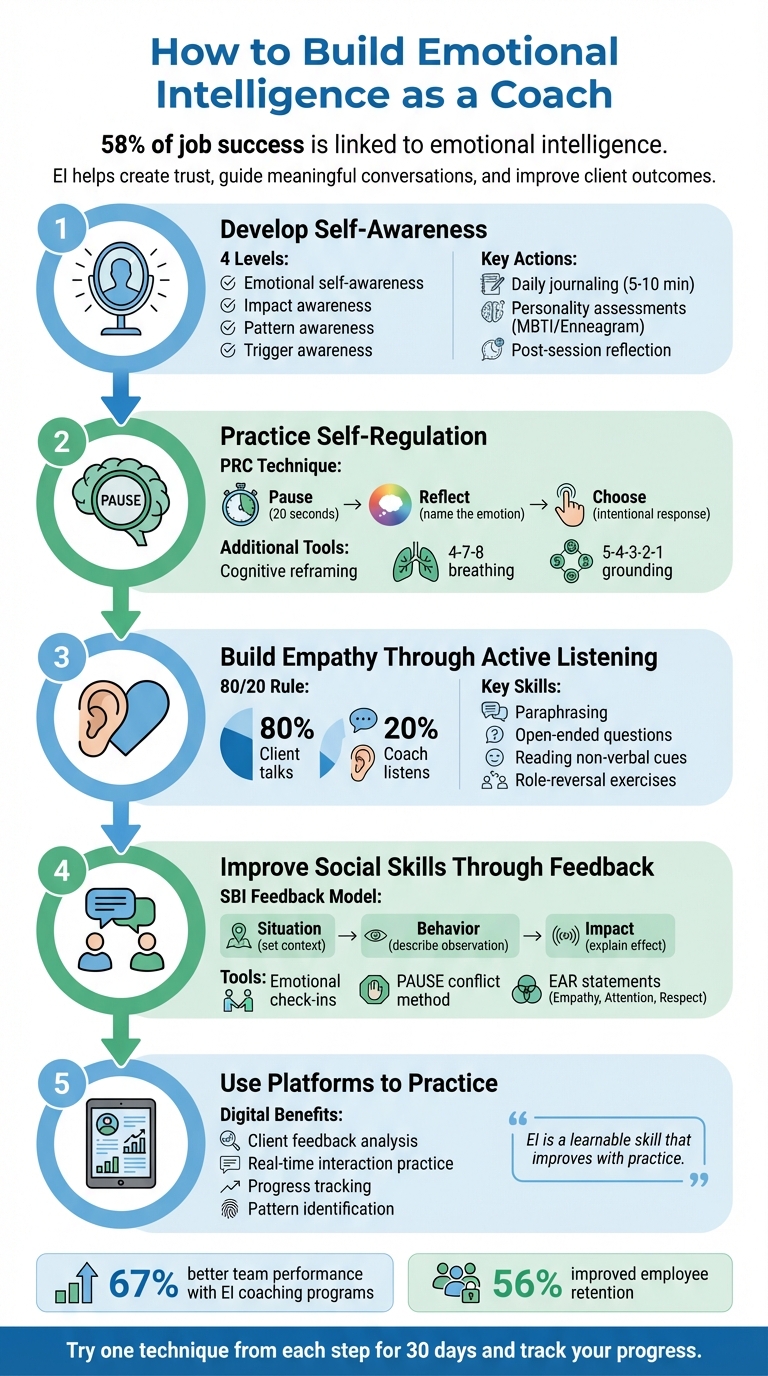
Emotional intelligence (EI) is the ability to recognize, understand, and manage your emotions while effectively responding to others' emotions. For coaches, EI is critical - it helps create trust, guide meaningful conversations, and improve client outcomes. Research shows EI accounts for 58% of job success and is more impactful than IQ in leadership.
Here’s how you can strengthen your EI as a coach:
- Self-Awareness: Recognize your emotions and patterns. Journaling, personality assessments, and session reflections can help identify triggers and improve emotional clarity.
- Self-Regulation: Manage your reactions under stress. Techniques like the PRC method (Pause, Reflect, Choose), reframing, and mindfulness exercises can help you respond thoughtfully instead of reacting impulsively.
- Empathy: Deepen your ability to understand clients’ feelings. Active listening, role-reversal exercises, and reading non-verbal cues can help you connect more effectively.
- Social Skills: Build trust and manage interactions. Use structured feedback methods (e.g., SBI model), emotional check-ins, and conflict resolution strategies like the PAUSE method.
EI is a skill that improves with practice. By focusing on these steps, you can enhance your ability to connect with clients and lead impactful coaching sessions.
5 Steps to Build Emotional Intelligence as a Coach
The #1 Skill Every Coach Needs? Emotional Intelligence Tips by Kashish Soran
Step 1: Develop Self-Awareness
Self-awareness acts as the guiding force behind emotional intelligence. Without it, managing emotions and showing empathy becomes a challenge. For coaches, this skill is essential - it determines whether you approach tough conversations with curiosity instead of judgment and whether you leave sessions feeling energized rather than drained. Interestingly, there's often a noticeable gap between how you think you come across and how clients actually perceive you. Studies reveal that emotional intelligence accounts for 58% of job success, and self-awareness is the starting point for building it.
"Self-awareness forms the main structure of emotional intelligence in coaching because you can't regulate unidentified emotions, show empathy when overwhelmed, or build effective relationships."
- Vanja Radic, Coach
Self-awareness involves four main levels:
- Emotional self-awareness: Recognizing your emotions as they arise.
- Impact awareness: Understanding how those emotions influence your behavior.
- Pattern awareness: Identifying recurring emotional responses.
- Trigger awareness: Pinpointing what sparks strong emotional reactions.
Here are some practical ways to enhance self-awareness before stepping into coaching sessions.
Keep a Daily Journal
Journaling is a great way to untangle vague feelings. For instance, instead of just feeling "off" after a session, you can identify whether it was a client’s tone or a sensitive topic that affected you. Dedicate 5–10 minutes after each session to jot down your emotions. As you write, try linking physical sensations to your feelings. Did your chest tighten when a client pushed back on your advice? Or did you feel a rush of energy when they had a major insight?
For added clarity, try the "Timer Exercise": set an alarm every 15–30 minutes to jot down your current emotion in a single word. Over time, you’ll spot patterns - like feeling anxious before morning calls or fatigued after a packed schedule. You could also create a "Trigger Journal" to document moments when your body reacts strongly. Write down what happened, how you felt, and your reaction. This helps you recognize recurring triggers and adjust your responses.
Use Personality Assessment Tools
Personality assessments such as the Myers-Briggs Type Indicator (MBTI) or the Enneagram can provide structured insights into your emotional tendencies. These tools don’t box you in; instead, they reveal patterns you might not have noticed. For example, MBTI tests, which take about 45 minutes (or less for shorter versions), can highlight whether you’re more introverted or extroverted.
These insights can explain why some coaching scenarios feel natural while others drain your energy. If you’re introverted, you might need breaks between sessions. If you lean toward perfectionism, slow client progress might frustrate you. Combine these assessments with your journal entries to get a fuller picture of your tendencies. You can even record a session and watch it back to see how stress or triggers affect your natural behavior.
Reflect After Each Session
Reflection is where observation meets analysis. During a session, you can take mental notes of your thoughts, emotions, and physical sensations without judging them. Afterward, review these observations to identify areas for improvement.
One quick and effective method is the "Start-Stop-Continue" exercise: after each session, identify one thing to start doing, one to stop, and one to continue. This 10-minute activity can lead to actionable changes, like pausing before responding to charged comments, minimizing distractions, or consistently summarizing client takeaways.
Ask yourself targeted questions: What was I feeling during the toughest part of the session? When did I feel most at ease? What did I need in that moment that I didn’t get?
For a more objective view, try video analysis. With client permission, record your sessions and review your tone, body language, and facial expressions. This external perspective can help you see the gap between how you feel internally and how you come across to clients.
Step 2: Practice Self-Regulation
Self-awareness helps you recognize your emotions, but self-regulation determines how you respond to them. This skill is what sets intentional coaches apart from reactive ones. Imagine a client cancels at the last minute or challenges your feedback - your brain's amygdala might flood your system with cortisol and adrenaline, triggering an "amygdala hijack." This can lead to impulsive reactions like snapping back or shutting down. However, with practice, self-regulation can become second nature.
"Self-regulation is the ability to recognize and manage one's emotional responses in real time. It's not about suppressing emotion. It's about slowing down the automatic response long enough to choose a better one."
- Dan Docherty, Braintrust Growth
Self-regulation isn't about pretending to stay calm; it's about creating a pause between a trigger and your response. This pause is the key to moving from reaction to deliberate action. Here's how to make it happen.
Apply the PRC Technique: Pause, Reflect, Choose
The PRC method offers a simple framework to handle emotionally charged situations:
- Pause: Stop the automatic reaction. Even a 20-second pause or a single deep breath can help your body process the adrenaline spike, allowing your thoughts to catch up.
- Reflect: Identify what's happening. Pinpoint the specific trigger and the story you're telling yourself about it. Naming your emotion - whether it's frustration, defensiveness, or disappointment - creates distance and helps you think more clearly.
- Choose: Decide on an intentional response that aligns with your values and your client's needs. Ask yourself, "What does this situation need from me right now?" This question shifts your mindset from reactive to thoughtful.
Try Cognitive Reframing and Grounding Exercises
Cognitive reframing helps you see situations from a different perspective. For instance, if a client resists your advice, you could interpret it as disrespect - or as fear of change. Choosing the latter view allows you to stay empathetic and grounded. When faced with a trigger, ask yourself questions like, "What else might be true here?" or "How would I respond if I assumed positive intent?". This shift in narrative helps you regulate your emotions and focus on the bigger picture.
"Reframing doesn't excuse behavior. It expands perspective. And with perspective comes control."
- Dan Docherty, Braintrust Growth
Grounding exercises, on the other hand, help calm your amygdala by sending safety signals to your brain. One popular method is the 5-4-3-2-1 technique: identify five things you see, four you hear, three you can touch, two you can smell, and one you can taste. Another option is using a tactile anchor - like touching your watch, pressing your feet into the floor, or squeezing your hands together. These physical actions bring your focus back to the present.
If your nervous system needs calming, try the 4-7-8 breathing technique: inhale for 4 seconds, hold for 7, and exhale for 8. This activates your parasympathetic nervous system, reducing feelings of panic or anger. Alternatively, use diaphragmatic breathing with a "4-6" rhythm - inhale for 4 seconds, exhale for 6 - to signal safety to your body.
Practice Mindfulness for Emotional Stability
Mindfulness is a powerful way to regulate your nervous system, helping you notice emotional triggers before they escalate into impulsive reactions. The principle is straightforward: calm first, reflect later. You need to stabilize your emotions before diving into deeper analysis.
Start with an arrival practice: take 90 seconds before each session to close your eyes, feel your feet on the ground, and take five slow breaths. This quick check-in helps you tune into your emotional state and increase your mental clarity.
Throughout your day, incorporate micro-practices to maintain emotional balance. Pair short mindful breaths or body scans with routine activities like opening your laptop, walking into a meeting, or wrapping up a call. These moments help prevent "emotional carryover", where unresolved stress from one interaction spills into the next. For busy coaches, doing three to five micro-practices daily is often more manageable than setting aside time for a longer meditation session.
If you feel overwhelmed during a session, deep breathing can calm your nervous system in under two minutes. The goal isn't to eliminate stress entirely but to stay grounded enough to support your client effectively.
Step 3: Build Empathy Through Active Listening
Once you've grounded yourself with self-regulation, the next step is building empathy through active listening. This means going beyond just hearing words - it's about tuning into both what’s being said and what’s left unsaid. It’s about connecting with their emotional experience while maintaining your own balance. This approach bridges your calm state with a deeper, more meaningful connection.
For coaches, this skill is invaluable. When clients feel genuinely heard, their satisfaction and understanding soar compared to when they're simply acknowledged or given advice [22, 24].
"Active listening can be summed up as entailing 'not only accurately understanding speaker's communication but also showing that understanding.'"
- Richard Nelson-Jones, Author and Psychologist
Empathy starts with stepping into your client’s shoes - seeing the world through their eyes and understanding their unique perspective.
Master Active Listening Techniques
Start with the 80/20 rule: let your client do most of the talking while you focus on listening. This gives them space to process their thoughts. Paraphrasing is a key tool here. Phrases like, "What I hear you saying is…" or "It sounds like…" validate their feelings and clarify your understanding. Use open-ended questions, such as, "What was going through your mind when that happened?" to encourage deeper reflection and self-awareness.
Pay close attention to changes in vocal tone or body language. A sudden drop in volume or a faster pace of speech can reveal emotions that words might not. Non-verbal cues are just as important - maintain an open posture, steady eye contact, and use brief affirmations to show you’re fully engaged.
Practice Role-Reversal Exercises
Role-reversal exercises are a great way to step out of your perspective and into your client’s. Instead of asking yourself, "How would I feel in this situation?" think, "How would this person, with their unique values and experiences, feel?" After a session, try writing about the situation from your client’s point of view in the first person. This can help you uncover their feelings and deepen your understanding.
Another technique is physically switching positions. Sit where your client was and voice their concerns out loud. This simple act can offer fresh insights and enhance your empathy.
Read Non-Verbal Cues
Words only tell part of the story. Body language, facial expressions, and tone often reveal much more. Look for key signals like facial expressions, gestures, posture, and how close they are physically (in the U.S., about four feet is typical for coaching). Pay attention to whether their movements are relaxed or tense and notice defensive behaviors like crossed arms.
Energy levels and posture shifts can also provide clues. For instance, if their posture changes when discussing a topic, you might ask, "I noticed your posture shifted when we started talking about your team. What are you feeling right now?"
"Empathy is more than understanding someone - it’s feeling with them. It’s reading between the lines, noticing what’s unsaid, and staying attuned without losing yourself."
When you notice a non-verbal cue that stirs an emotional reaction, take a moment to breathe and let your rational mind catch up before responding. If a client seems disengaged or distant, avoid jumping to conclusions. They could be processing emotions, dealing with personal challenges, or expressing themselves in a way influenced by their cultural background.
To sharpen these skills, practice observing people in everyday settings or during video calls. Try to guess their emotions based on body language and tone, then validate your observations with your clients. Over time, these exercises will help you refine your ability to connect with and understand others on a deeper level.
sbb-itb-3c06305
Step 4: Improve Social Skills Through Feedback
Once you’ve built a foundation of empathy, it’s time to refine your social skills. These skills are essential for building trust, offering constructive feedback, and managing conflicts effectively. They allow coaches to handle interpersonal challenges while guiding clients toward their goals through collaboration and influence. Consider this: 58% of job success is linked to high emotional intelligence. Plus, organizations that invest in coaching and emotional intelligence programs report 67% better team performance and 56% improved employee retention.
"Emotional intelligence is critical in building and maintaining relationships and influencing others - key skills that help people throughout their career and wherever they sit in an organizational structure." - Margaret Andrews, Instructor of Emotional Intelligence in Leadership at Harvard University
Use the SBI Method for Feedback
The SBI model - Situation, Behavior, Impact - is a great tool for delivering feedback in a clear, non-confrontational way. It focuses on facts rather than opinions, reducing defensiveness. Here’s how it works:
- Situation: Set the context by specifying the time and place. For example, “During yesterday’s 2:00 p.m. meeting.”
- Behavior: Describe what you observed without jumping to conclusions. For instance, “When you interrupted Sam while he was presenting his idea.”
- Impact: Explain the effect of the behavior. For example, “The team lost his input.”
This approach keeps feedback actionable and avoids vague statements like, “You need to be more respectful.” Instead, you might say, “During yesterday’s meeting, when you interrupted Sam, the team lost his input.” It’s clear, specific, and focused on improvement.
Start Sessions with Emotional Check-Ins
Kicking off a session with a quick emotional check-in can set the tone for open communication. It signals that emotions are an important part of the coaching process and helps clients articulate their feelings. Simple prompts like, “Share one word that describes how you’re feeling today,” or, “What emotions came up for you since our last session?” work well.
Lead by example - share your own feelings when appropriate to foster trust and mutual respect. Keep these check-ins brief to stay on track with your session agenda. During this time, show you’re fully present: maintain eye contact, nod to show you’re listening, and allow moments of silence for reflection. These small actions create a safe space for your clients to open up.
Resolve Conflicts with the PAUSE Method
Conflict is inevitable, but the PAUSE method can help you handle it with composure and care:
- Pause: Take a moment to slow down and assess the emotional dynamics of the situation. This helps you stay calm and thoughtful.
- Acknowledge: Use simple “EAR” (Empathy, Attention, Respect) statements like, “I understand why this is upsetting for you,” to validate emotions without taking sides.
- Understand: Practice active listening. Pay attention to tone, pauses, and underlying emotions. Ask open-ended questions like, “What’s beneath that feeling?” to uncover deeper insights.
- Seek Solutions: Guide your client to think through options. For example, “Here are a few choices; what do you think might work best?”.
- Express Appreciation: Recognize their effort by saying something like, “I respect how committed you are to resolving this”.
If the conversation becomes too heated or unproductive, don’t hesitate to set boundaries. Pause the discussion and agree on a time to revisit it later. When responding, use the BIFF Response - Brief, Informative, Friendly, and Firm - to avoid escalating tensions. This structured approach helps maintain trust and keeps the focus on resolution.
Step 5: Use Platforms to Practice Emotional Intelligence
Digital platforms can be incredibly effective for developing emotional intelligence (EI). They provide real-time feedback, structured interactions, and measurable insights that can enhance your EI skills in ways traditional methods may not. Here's how these tools can elevate your emotional intelligence journey.
Create a Coachtrusted Profile

By setting up a profile on Coachtrusted, you gain an external perspective on how clients perceive your coaching. Client reviews act as a "mirror", offering feedback on your emotional presence, communication style, and ability to build trust. This feedback can help you uncover blind spots - those emotional triggers or patterns you might not notice on your own.
Reviewing this feedback regularly can reveal trends. For instance, if multiple clients mention feeling rushed, or frequently commend your calm demeanor under pressure, these patterns provide valuable insights. Understanding how your emotional state impacts others is a key aspect of social awareness. The platform's digital tools can take this even further.
Use Premium Features for Client Interaction
Coachtrusted's premium tools allow you to practice and refine EI skills in real-world scenarios. Features like messaging tools and customizable dashboards offer opportunities to enhance social skills and self-regulation. For example, messaging gives you a moment to pause and reflect before responding, which is an excellent way to practice self-control.
You can also use messaging to develop digital active listening skills. Before replying to a client, take a moment to reflect on their message. Try restating their concern in your response to ensure you've understood them correctly. The dashboard features can also help you track client progress, allowing you to align your coaching with their personal values and goals.
Learn from Client Feedback
Client feedback is a powerful tool for continuous growth. After sessions, use the platform's messaging feature to ask simple follow-up questions like, "How did you feel during today's session?" or "Was there a moment when you felt particularly heard or misunderstood?" These prompts can uncover areas where your emotional attunement needs fine-tuning.
When reviewing feedback, label the emotions clients express. For example, if a client mentions feeling frustrated or disappointed, acknowledge it in your reflection: "The client felt frustrated when I redirected the conversation." This practice helps you create psychological distance, allowing for a more objective response. Comparing your perception of a session with the client's actual experience can sharpen your empathy and improve your coaching presence.
"Trust is the foundation of any successful coaching relationship. Without it, even the most skilled coach will struggle to effect meaningful change." - Daniel Goleman
Track recurring themes in feedback using the dashboard. If clients often mention feeling supported during difficult conversations or express uncertainty about next steps, these patterns can highlight areas for growth, such as empathy, self-regulation, or social skills.
Conclusion
Developing emotional intelligence is an ongoing journey that turns everyday interactions into opportunities for growth. Its four key components - self-awareness, self-regulation, empathy, and social skills - work together to help you connect deeply with others and handle challenges with grace. In fact, studies indicate that emotional intelligence contributes to 58% of job success and stands out as a top predictor of workplace performance.
Simple, daily habits like journaling or applying the PRC technique can make a noticeable difference in how you approach situations. Over time, these practices help reinforce your emotional intelligence.
Tools like Coachtrusted can also support this growth. Their messaging feature allows you to practice crafting thoughtful responses, while the dashboard lets you monitor your progress and adjust based on real interactions with clients.
Remember, growth happens step by step. As CoachHub puts it:
"Emotional intelligence isn't something you're born with or without. It's a learnable skill - one that coaching can help you unlock and strengthen over time." - CoachHub
Try focusing on one technique from each pillar for 30 days. Pay attention to how your clients react and how you evolve. Every interaction is a chance to build your emotional intelligence further.
FAQs
How does journaling help coaches improve self-awareness?
Journaling offers coaches a practical way to deepen their self-awareness. By setting aside time to reflect and write about their emotions, thoughts, and behaviors, coaches can uncover patterns and pinpoint emotional triggers that might otherwise go unnoticed. This process helps them better understand how their feelings influence their approach to coaching.
Over time, journaling becomes a valuable tool for tracking emotional responses, which can lead to better emotional regulation. This not only strengthens the coach's ability to manage their own emotions but also enhances their ability to build meaningful connections with clients. Incorporating journaling into a daily or weekly routine supports ongoing personal and professional growth, fostering emotional insight and resilience.
How can coaches effectively manage their emotions during sessions?
To handle emotions effectively during coaching sessions, start by focusing on self-awareness. Pay attention to your emotional triggers and how they might influence your responses. This understanding allows you to stay composed and respond thoughtfully, even when clients express challenging emotions like anger, fear, or frustration.
In addition, practicing self-regulation techniques can make a big difference. Strategies such as mindfulness, deep breathing, or grounding exercises can help you stay calm and centered during emotionally intense moments. Over time, these techniques enhance your ability to remain present and empathetic, enabling you to support your clients without feeling overwhelmed.
By honing these skills, you create a supportive and compassionate environment where clients feel safe to open up. This approach builds trust and strengthens your connection, making emotional intelligence an essential tool for any coach aiming to have a meaningful impact.
Why is empathy important for building trust with your coaching clients?
Empathy plays a key role in building trust, as it helps coaches genuinely understand and connect with their clients' emotions. When coaches demonstrate real care and attentiveness, they create a safe space where clients feel heard, valued, and supported.
This emotional bond encourages open and honest communication, making it easier for clients to share their struggles and aspirations. By fostering this connection, empathy not only strengthens the coach-client relationship but also sets the stage for meaningful progress and teamwork.