Career Development
How to Get the Most Out of Coaching Sessions
January 10, 2026
14 min read

How to Get the Most Out of Coaching Sessions
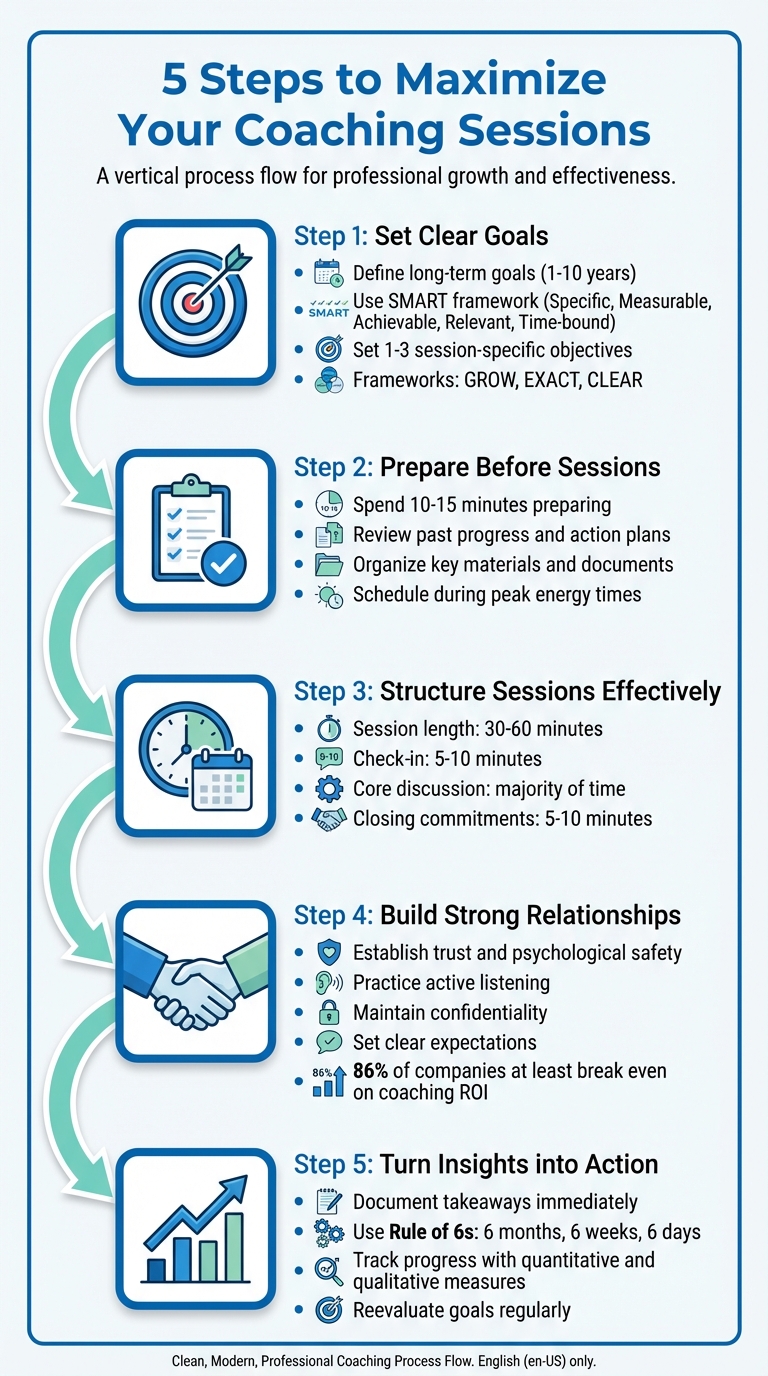
Coaching works best when you come prepared, set clear goals, and actively engage in the process. Here's how you can maximize your coaching experience:
- Set Clear Goals: Define long-term and session-specific objectives using frameworks like SMART (Specific, Measurable, Achievable, Relevant, Time-bound). Clear goals provide focus and make tracking progress easier.
- Prepare Before Sessions: Reflect on past progress, organize key materials, and identify specific topics or challenges to discuss. Preparation ensures productive and focused conversations.
- Structure Sessions Effectively: Start with a check-in, set session goals, and close with actionable commitments. A clear structure keeps the session on track and results-oriented.
- Build a Strong Relationship with Your Coach: Trust and open communication are essential. Active listening and clear expectations foster a collaborative partnership.
- Turn Insights into Action: Document key takeaways, track progress regularly, and adjust goals as needed to ensure lasting growth.
5 Steps to Maximize Your Coaching Sessions Effectiveness
The 5 Steps of Great Coaching | Executive Coaching Process Explained
sbb-itb-3c06305
Set Clear Goals for Your Coaching Journey
Without clear goals, coaching sessions can easily veer off course, turning into unstructured conversations. Defining your goals gives each session purpose and direction, helping you stay focused and motivated. It’s like Jane Wagner famously quipped:
I always wanted to be somebody, but I should have been more specific.
When your goals are measurable and visible, tracking progress becomes straightforward. You can celebrate milestones and hold yourself accountable for the steps you and your coach outline. This collaborative process also builds trust and sets the stage for productive coaching. Start by mapping out a strategic, long-term vision for your journey.
Define Long-Term Goals
Long-term goals establish the overarching direction for your coaching experience. These could include aspirations like stepping into a leadership role, switching careers, or creating a lasting professional impact. Achieving these ambitions often requires sustained effort over months or even years. To clarify your vision, ask yourself what you want to accomplish in one, five, or even ten years.
The SMART framework is a great tool to ensure your goals are clear and actionable. SMART stands for Specific, Measurable, Achievable, Relevant, and Time-bound. For instance, instead of saying, "I want to improve my leadership skills", a SMART goal would look like this: "Complete a leadership development program and successfully lead two cross-functional projects by December 31, 2026." This framework, introduced by George T. Doran in 1981, removes ambiguity and makes objectives easier to track.
To make your goals measurable, ask yourself, "How will I know I’ve achieved this?" You can also create tiers for each goal - minimum, target, and stretch levels - to balance ambition with practicality.
Set Session-Specific Goals
While long-term goals keep you focused on the bigger picture, session-specific goals ensure each meeting with your coach is productive. Before a session, identify one to three clear objectives. Ask yourself, "What do I want to walk away with today?" or "What outcome would make this conversation feel worthwhile?" Sharing these objectives with your coach ahead of time helps set the tone for a focused and impactful session.
For example, if your long-term goal is to improve time management, a session-specific goal could be: "Identify three strategies to reduce meeting overload this week." This approach ensures that each session contributes to meaningful progress and avoids aimless discussions.
Use Goal-Setting Frameworks
Goal-setting frameworks can provide structure and clarity to your coaching journey. One popular model is GROW, which involves four steps:
- Goal – Define what you want to achieve.
- Reality – Assess your current situation.
- Options – Explore potential strategies.
- Will – Commit to taking action.
In this model, your coach acts as a guide, using thoughtful questions to help you uncover your own solutions. Other frameworks, like EXACT (Explicit, eXciting, Assessable, Challenging, Time-framed), are great for goals that require strong internal motivation. For team-oriented or collaborative goals, the CLEAR model works well. The important thing is to choose a framework that aligns with your needs and apply it consistently to structure your goal-setting process.
Prepare Effectively for Coaching Sessions
Once you've set clear goals, preparing effectively for your coaching sessions can turn them into moments of real progress.
Walking into a session unprepared is like heading to the gym without a workout plan - you might put in the effort, but the results will be lackluster. Deborah Grayson Riegel captures this perfectly:
Leadership coaching is a lot like joining a gym: Just paying for it doesn't make you stronger.
Preparation elevates coaching from a casual chat to a focused, productive experience. With most sessions lasting 30 to 60 minutes, taking just 10–15 minutes beforehand to mentally prepare can make a world of difference.
Review Past Progress
Start by reflecting on your progress since the last session. Look back at your notes and action plans from the previous one or two weeks. This helps maintain momentum and ensures you're building on prior discussions. Celebrate small victories - they matter. At the same time, take note of areas where you fell short. For instance, if you committed to three action steps but only completed one, use that as an opportunity to explore what got in the way. Were there unexpected challenges, or did personal issues divert your focus?.
If you find yourself hesitating to take action, rating your likelihood below a 7 on a 0–10 scale, bring that into the session. It could be a chance to uncover what's holding you back and address it head-on.
Organize Key Materials
Keep track of questions, challenges, or topics that come up between sessions. Gather any relevant documents, data, or visuals that can help clarify your current situation. For example, if you’re focusing on delegation, bring along an overview of your team’s workload. If you’re exploring a career change, have your updated resume handy. Sending your coach a brief note about your focus area ahead of time can help you dive right into the session.
Allegra M. Sinclair, a certified professional coach, emphasizes:
You 'own' the direction of your coaching sessions, so it makes sense to be as clear as possible about what you want to achieve.
Coaches, too, should come prepared with tools like handouts, visual aids, or tailored resources to support your goals. By preparing "pocket questions" in advance, they can focus more on listening and less on figuring out their next move.
Optimize Logistics
With your materials ready, make sure the logistics set you up for success.
Schedule sessions during times when your energy is at its peak. Avoid back-to-back scheduling, especially after intense meetings - it’s hard to be fully present when your mind is still elsewhere.
For virtual sessions, take a few minutes to check your tech setup beforehand. Ensure everything is working, turn off distractions, and give yourself a moment to reset your mindset. Ask yourself if you’re feeling resistant, overwhelmed, or defensive - these emotions can be valuable topics to explore during the session. Use centering techniques like deep breathing or a quick meditation to shift from a busy mind to a focused state.
Finally, think about what you want to achieve by the end of the session. What do you want to feel, learn, or understand better? Having a clear intention can help guide the conversation.
Structure Coaching Sessions for Maximum Impact
Once you've prepared, a well-organized session turns that groundwork into meaningful progress. A structured approach helps maintain focus while allowing enough flexibility to adapt to the client’s needs. As professional coach Annamaria Nagy puts it:
A repeatable coaching session structure is the best way to keep the conversation focused. It lets you balance a goal-oriented approach with the necessary fluidity to address your client's needs.
Most successful coaches allocate 5–10 minutes for check-ins and closing commitments, dedicating the majority of the session to deeper exploration. This flow allows for both genuine connection and actionable progress, building on your preparation to guide the session toward clear outcomes.
Begin with a Check-In
The opening minutes are critical for setting the tone of the session. A check-in helps establish psychological safety and ensures both you and your client are fully present. A simple question like, "What's on your mind today?" encourages clients to share their immediate concerns. Some coaches enhance this moment by incorporating a brief breathing exercise or guided meditation to help everyone relax and focus. This is also a great time to reflect on progress since the last session, discussing what worked well and what could improve.
Collaboratively Set Session Goals
After the check-in, spend about 5 minutes defining what success looks like for the session. While the overall coaching journey has broader objectives, each session should have its own specific focus that ties back to those larger goals. Questions like, "What would make this a powerful conversation for you today?" or "How will you know you achieved what you wanted to accomplish today?" help create a clear, actionable target aligned with the GROW framework. If a client gives a vague answer like, "I just want to talk this through," follow up with, "By talking through this, what do you hope to achieve?" This ensures clarity and sets the stage for a productive session.
Close with Commitments and Next Steps
Reserve the final 5–10 minutes to turn insights into action. Start by asking the client to summarize their key takeaways - this reinforces what they’ve learned. Then, focus on concrete commitments by asking, "What exactly are you going to do, and by when?" To gauge their readiness, use a confidence scale: "On a scale of 1 to 10, how confident are you that you'll complete this step by the deadline?" If their confidence falls below an 8, collaborate to adjust the plan. Be mindful of hesitation or signs of uncertainty, often referred to as "the wiggle", which may indicate the need for a more realistic goal. Before ending, discuss potential obstacles with questions like, "What could stand in your way?" Finally, confirm how they’ll stay accountable and schedule your next session.
Build a Strong Coach-Client Relationship
When structuring sessions and setting goals, the foundation of success lies in a solid coach-client relationship. A well-planned session framework becomes even more effective when trust and connection are prioritized. In fact, trust and safety are considered cornerstones of effective coaching, as they enable clients to engage deeply and commit to meaningful progress. By actively listening and fostering an open environment, coaches encourage clients to address challenges head-on.
Establish Trust and Psychological Safety
Trust isn’t built overnight - it grows through consistent actions. Active listening plays a key role here, requiring attention to not just words but also tone and body language. Coaches who show empathy by acknowledging emotions without rushing to solve problems create a space where clients feel safe to be vulnerable. Confidentiality is another critical element. As Lindsay Deacon and Angela Scotto Harkness emphasize:
Without trust, there could be no coaching.
Clients need to feel absolutely confident that their personal struggles remain private. Simple measures - like holding sessions in private spaces, using "do not disturb" signs, or even playing white noise to ensure privacy - can make a big difference. Additionally, asking "Can I share an observation with you?" before offering feedback shows respect and ensures clients are ready to engage. Once trust is established, setting clear expectations becomes the next step in building a productive relationship.
Set Clear Expectations
Clear communication prevents misunderstandings. Start with a coaching agreement that outlines session details, scheduling, payment terms, and cancellation policies. Specify the communication methods you'll use - whether email, video calls, or messaging - and agree on realistic response times. As Tara Butler Floch, founder of Broadview Coaching, wisely notes:
We can't hold people to expectations we aren't sure they know about.
Be upfront about roles: clients are responsible for taking action, while coaches provide guidance and challenges. If you make a one-time exception to a policy, clearly state it to avoid future confusion. Companies that monitor coaching ROI reveal that 86% at least break even, but this success hinges on mutual understanding from the start. With clear expectations in place, ongoing feedback becomes the glue that strengthens the relationship.
Use Feedback to Strengthen the Relationship
Feedback should be a two-way street. Clients should feel comfortable speaking up when something feels off or when a topic deserves more attention. Tools like brief check-in surveys between sessions can help gather valuable client input. Deborah Grayson Riegel, MSW, PCC, encourages clients to embrace feedback, even when it’s uncomfortable:
squirm.
Rather than avoiding it, clients can use such feedback as an opportunity to grow. Dedicate time at the end of each session to reflect on key takeaways and confirm the conversation’s effectiveness. When both coach and client listen to understand - rather than simply to respond - they uncover hidden challenges and work toward stronger solutions together.
Turn Coaching Insights into Lasting Progress
A solid coach-client relationship lays the groundwork, but real change happens when insights are turned into action. While clear strategies and structured sessions are key, taking steps to cement those insights is what drives lasting progress. Studies reveal that clients often forget session details quickly, so it's crucial to document and act on them without delay.
Document Key Takeaways
Make it a habit to jot down your key takeaways right after each session. As Ajit Nawalkha explains:
We know that once a client leaves a session, they'll forget most of the conversation. So the takeaway and wrapup is a great point for your client to write down what they want to remember and the action steps they will take ahead of the next session.
Using a simple template can help. Include sections for session summaries, newly uncovered values, limiting beliefs, and specific action steps. Reflective questions like "What has become clearer?" or "How will this support me moving forward?" can guide your notes. If you find it hard to capture everything during the session, consider recording it (with your coach's consent) or ask for a follow-up email summarizing key points. Always store these notes securely - password-protected digital files are a good option to maintain confidentiality. Once documented, the next step is tracking your progress effectively.
Track and Measure Progress
Tracking your progress helps identify patterns and celebrate achievements. After documenting your insights, measure them with clear benchmarks. Try the "Rule of 6s" to structure your tracking: set long-term goals spanning 6 months to a year, short-term goals for 6 weeks, and immediate action steps for the next 6 days. Lisa Fain, an International Executive Coach, highlights:
Establishing clear goals and objectives laid out from the start of the coaching journey ensures alignment in the coaching process, helping both coach and client measure progress, including when objectives should be revised.
Combine quantitative data (like rating scales or completion rates) with qualitative insights (such as mindset shifts or behavior changes). A simple tracking sheet can work wonders - record how often or how much you're working toward goals, like "walk 30 minutes every Tuesday". Digital tools can also send reminders to keep you on track between sessions. As you track, be ready to tweak your approach to ensure your goals evolve alongside your progress.
Reevaluate Goals Over Time
Regularly reviewing your goals keeps you aligned with your long-term vision. Check in on your progress during each session to make sure your objectives remain relevant. As Julie Rohovit, PhD, notes, consistent feedback allows both coach and client to adjust strategies when needed. The "Rule of 6s" framework works well here too - evaluate major goals every 6 months to a year, short-term progress every 6 weeks, and individual tasks every 6 days. Stay adaptable. If something isn’t working, don’t hesitate to adjust your strategy. Regular reevaluation ensures your coaching journey stays meaningful and aligned with your changing priorities.
Conclusion
Clear goals, thoughtful preparation, and well-structured sessions are the backbone of effective coaching. To get the most out of your coaching experience, start by setting specific, actionable goals using frameworks like SMART, which help transform broad aspirations into clear, achievable steps. Take time to prepare by reviewing past progress and organizing any essential materials. During sessions, follow a consistent structure that encourages open communication, fosters trust, and ends with actionable commitments. Building psychological safety is key to creating an environment where meaningful breakthroughs can happen. Finally, ensure that insights gained are translated into measurable progress by documenting, tracking, and revisiting your goals regularly.
Choosing the right coach is just as important as your approach. Platforms like Coachtrusted connect you with verified professionals, offering tools like streamlined scheduling and secure portals to keep session notes and action plans in one place.
As Deborah Grayson Riegel, MSW, PCC, explains:
Coaching is a collaborative process where the client does the thinking, growing, and decision-making.
FAQs
What are the best ways to make my coaching sessions productive and goal-focused?
To make your coaching sessions more productive and focused, start by setting a clear, actionable goal for each meeting. Use the SMART framework - Specific, Measurable, Attainable, Relevant, Time-bound - to define what you want to accomplish. For instance, you might aim to “Identify three strategies to improve my sales pipeline by May 15, 2026.” This approach ensures that both you and your coach are on the same page right from the start.
Preparation makes all the difference. Before your session, draft a simple agenda that outlines the session's goal, any pre-work, and how time should be divided. You might also include a brief check-in or mindfulness exercise at the beginning to help set the tone. During the session, keep the discussion focused on practical takeaways, and use open-ended questions - like “What does success in this area look like?” - to encourage meaningful dialogue.
Wrap up each session by agreeing on specific next steps with clear deadlines. For example, you might decide to “Submit a draft proposal by January 20, 2026.” Adding accountability measures, such as a quick follow-up email or a scheduled check-in, can help maintain progress. Finally, take time to gather feedback to fine-tune your approach for future sessions, ensuring steady improvement over time.
What’s the best way to prepare for a coaching session?
To make the most of your coaching session, start by setting a clear goal. Ask yourself what you want to accomplish by the end - whether it’s tackling a specific issue or creating a step-by-step plan. Taking a moment to review notes or progress from previous sessions can also help highlight areas to focus on and give your coach valuable context.
Before the session, list the key topics or questions you want to cover. Stick to 2–3 priorities to keep the discussion focused and productive. It’s also important to create a distraction-free space - find a quiet spot, mute notifications, and gather any materials or data you might need to reference or share. By approaching the session with a clear plan and full attention, you’ll get the most out of your time with your coach.
How can I build a strong and effective relationship with my coach?
Building a strong partnership with your coach begins with open communication and aligning expectations. Right from the first session, take time to discuss your goals, how you prefer to communicate, and the ways you’ll track progress together. Approach each session with a clear purpose - whether it’s improving a specific skill or tackling a challenge - to make the most of your time.
Trust is the cornerstone of this relationship. To nurture it, create an environment where you feel comfortable being honest and sharing your experiences without fear of judgment. Starting each session with a quick check-in can help establish a connection and set a positive tone. Stay open to exploring different perspectives and actively participate in the process.
Accountability plays a big role in maintaining momentum. Follow through on any action steps you’ve agreed upon between sessions. Take time to reflect on your progress, share updates, and be ready to discuss what’s working and what might need adjustment. This collaborative effort ensures a meaningful and productive relationship with your coach.