Career Development
How Mentors Help Build Problem-Solving Skills
February 17, 2026
12 min read

How Mentors Help Build Problem-Solving Skills
Mentors don’t just give answers - they teach you how to think critically, solve problems, and build confidence. Here’s how they do it:
- Ask Open-Ended Questions: Instead of saying “Do this,” mentors ask, “What do you think?” This approach encourages independent thinking.
- Share Challenges: By discussing their own setbacks, mentors create a safe space for you to learn and take risks.
- Build Trust: Strong relationships develop through open communication, active listening, and mutual respect.
- Teach Problem-Solving Frameworks: Tools like the GROW Model or Five Cs help you tackle challenges step by step.
- Reframe Failures: Mistakes are treated as learning opportunities, fostering resilience and a growth mindset.
- Track Progress: Regular check-ins and feedback sessions ensure you’re developing skills and gaining confidence.
Mentorship isn’t just about solving one problem - it’s about equipping you with lifelong tools to navigate challenges.
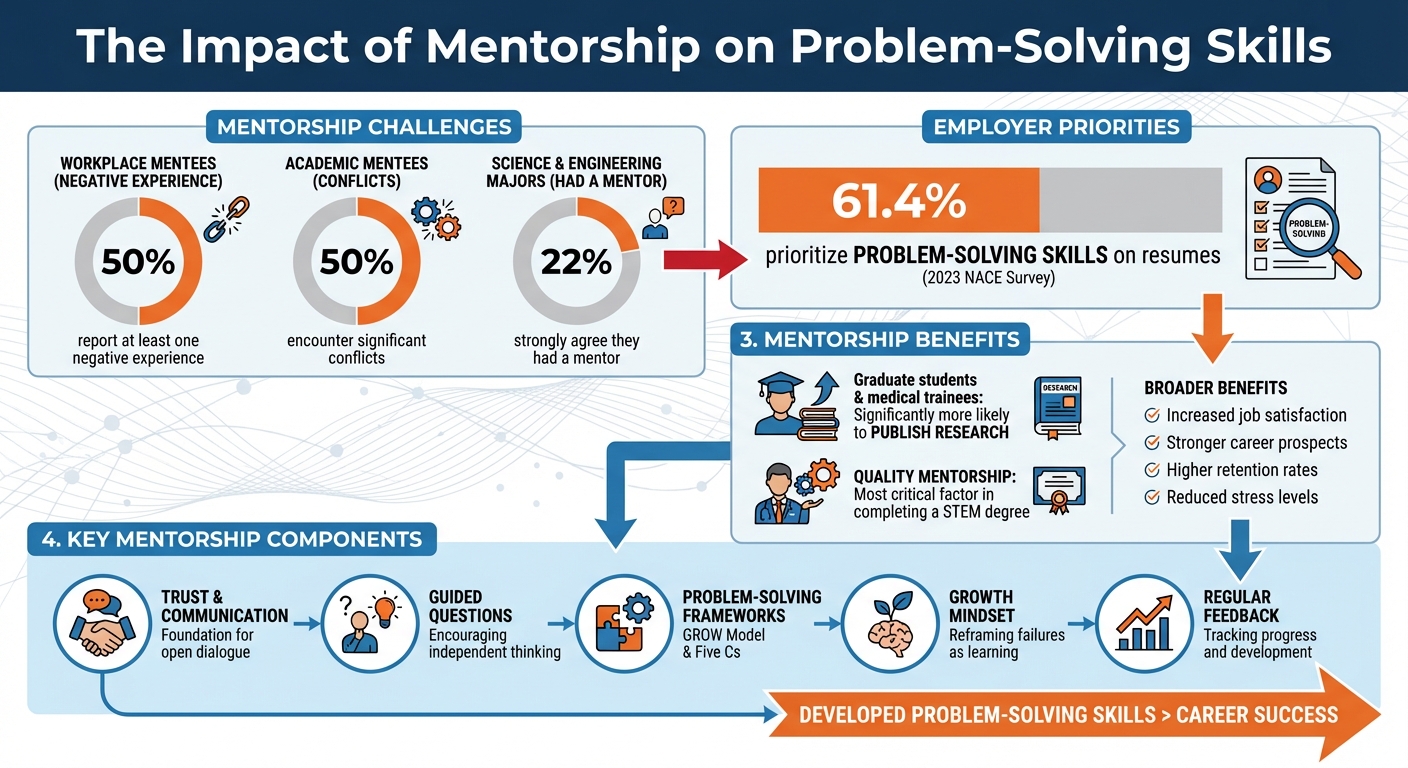
Mentorship Impact Statistics: Problem-Solving Skills and Career Success
Making a mentor | Ralph Reid | TEDxUSFSM

sbb-itb-3c06305
Creating a Strong Mentor-Mentee Relationship
Building a solid mentor-mentee relationship is essential for fostering problem-solving skills. Without trust and open communication, mentees may hesitate to share their struggles or ask questions they fear might come across as "silly." Establishing mutual responsibility through intentional trust-building is key. Research highlights the importance of this: 50% of workplace mentees report at least one negative mentoring experience, and a similar percentage of graduate and undergraduate mentees encounter significant conflicts with mentors in academic settings. These numbers underscore the need to lay a strong foundation from the very beginning, as it sets the stage for open dialogue and mutual trust - cornerstones of effective mentorship.
Building Trust and Open Communication
Trust doesn’t develop overnight; it requires consistent effort from both mentor and mentee. According to the National Academies of Sciences, Engineering, and Medicine, mentorship thrives on three pillars: goal alignment, task assignment, and emotional connection. For mentees to feel comfortable sharing their ideas and challenges, they need to trust that they won’t face judgment or repercussions. Mentors can help foster this sense of safety by sharing their own experiences and struggles. When mentees see their mentors as relatable individuals who have overcome obstacles, they’re more likely to open up about their own challenges.
One effective way to establish trust early is through a mentorship compact - a written agreement that sets clear expectations, commitments, and boundaries for both parties. This compact might include specifics like response times for emails, guidelines for phone and social media use, and confidentiality agreements. Another helpful tool is an Individual Development Plan (IDP), which allows mentees to outline both short- and long-term goals while providing a framework for regular progress reviews.
Practicing Active Listening and Empathy
Active listening is a cornerstone of successful mentorship. It involves understanding not just the words a mentee says but also the emotions and intentions behind them. Two types of empathy play a role here: cognitive empathy, which is the ability to recognize what someone else is feeling, and emotional empathy, which involves connecting with those feelings on a personal level.
Mentors can use strategies like paraphrasing and reflective pauses to show they’re truly listening. For example, they might say, "It sounds like you’re asking... Is that right?" to clarify a mentee’s thoughts. Allowing pauses of at least ten seconds gives mentees time to process their thoughts and articulate their concerns. Non-verbal cues like body language and eye contact also play a big role in understanding a mentee’s feelings. Validating emotions is equally important - simple statements like "That sounds really frustrating" can make mentees feel heard and supported.
"The quality of the mentoring relationship is dictated by the quality of the relationship between the mentor and the mentee." - University of Edinburgh
Rather than solving problems for the mentee, mentors should work with them to identify challenges and brainstorm solutions. Asking open-ended questions like "What do you think would happen if...?" or "How are you feeling about...?" encourages deeper reflection and problem-solving. Sharing personal stories of past challenges can also help mentors connect with mentees on a more personal level, creating a safe space for honest conversations.
Setting Up Regular Check-ins and Feedback
Regular feedback sessions are crucial for tracking progress and reinforcing problem-solving skills. These check-ins create opportunities to evaluate whether chosen solutions are working and to make any necessary adjustments. Frequent interactions also help humanize the mentor, making it easier for mentees to share struggles without fear of judgment.
Scheduling consistent check-ins - whether weekly, biweekly, or monthly - ensures accountability and keeps the relationship on track. During these sessions, mentors can use techniques like restating a mentee’s question as a statement to ensure clarity and probing questions to deepen the discussion. The goal is to establish a feedback loop where mentees feel supported while also being encouraged to think critically and independently.
Methods for Teaching Problem-Solving Skills
Once a strong foundation of trust and communication is established, mentors can introduce techniques that help mentees sharpen their problem-solving abilities. These approaches don’t just provide answers - they encourage mentees to think critically and build skills they can use in future challenges.
Using Guided Discovery and Questions
Guided discovery is an approach where mentors lead mentees toward solutions by asking strategic questions. This method helps mentees work within their "zone of proximal development", encouraging them to explore ideas and uncover gaps in their understanding.
"If you ask the wrong questions, you'll probably get the wrong answer, or at least not quite what you're hoping for!" – OLCreate: Mentoring Matters
One effective technique for this is the Funnel Technique. Start with broad, open-ended questions, then gradually narrow down to more specific ones, and finally confirm key details. This method helps mentees articulate their thought process while giving mentors insight into areas that might need improvement.
Allowing moments of silence for reflection is just as important. After a task, reflective questions like, "What would you do differently if you had to tackle this again?" or "What did you take away from this experience?" reinforce learning. Predictive questions like "What do you think would happen if…?" can further develop analytical and deductive reasoning.
While guided questioning is invaluable, structured frameworks can add another layer of systematic problem-solving.
Teaching Problem-Solving Frameworks
Once mentees have explored solutions through questioning, mentors can introduce structured frameworks to provide a clear roadmap for tackling challenges. One such tool is the Five Cs Model, which breaks problem-solving into five stages: Challenge (identifying the issue), Choices (brainstorming options), Consequences (weighing pros and cons), Creative Solutions (developing ideas collaboratively), and Conclusion (summarizing next steps).
Another popular framework is the GROW Model, which focuses on goal-setting and accountability. This method involves defining a clear Goal with SMART objectives, assessing the current Reality, exploring various Options, and committing with strong Will to actionable steps. A 2023 survey by the National Association of Colleges and Employers revealed that 61.4% of employers prioritize problem-solving skills on resumes, highlighting the importance of teaching these frameworks.
For more technical or academic challenges, Woods' Model offers a five-step process: define the problem, gather and analyze relevant information, plan a solution, execute that plan, and reflect on the outcome. These frameworks provide mentees with the structure and confidence to approach problems methodically.
Promoting Different Thinking Approaches
To help mentees think beyond conventional methods, mentors can introduce diverse problem-solving strategies. One effective approach is using contrast cases, which highlight key patterns and deepen understanding.
Another strategy is productive failure, where mentees are encouraged to tackle complex, open-ended problems that challenge their current skill set. This method activates prior knowledge, identifies areas for growth, and provides just enough guidance to keep them progressing without becoming overwhelmed.
Encouraging creativity is also essential. Mentors can ask mentees to reframe problems in their own words or define key terms before brainstorming solutions. Identifying analogous problems from other contexts can also help mentees recognize patterns and apply solutions in new ways. FIRST Robotics emphasizes the importance of creating a safe space for creativity, advising mentors to "resist any impulse to judge ideas" and treat all contributions equally. These strategies not only inspire creativity but also empower mentees to approach challenges with confidence and adaptability.
Developing Resilience and a Growth Mindset
Problem-solving thrives on emotional resilience. A strong mindset isn’t just helpful - it’s essential for applying the strategies we’ve discussed. Mentors play a key role in fostering this resilience by teaching mentees that struggle isn’t failure; it’s where growth takes root. Let’s dive into how reframing setbacks can turn them into stepping stones for progress.
Reframing Failures as Learning Experiences
When faced with challenges, it’s common for mentees to think, “I can’t do this” or “I’m just not smart enough.” This self-doubt can be redirected by showing them that intelligence isn’t static - it evolves. Research confirms that when people believe their intelligence can grow, they’re more likely to embrace challenges and persist through difficulties.
Encourage mentees to see mistakes as opportunities instead of roadblocks. As the Mindset Kit puts it:
"Mistakes are not just inevitable side-effects, they are actually clues for learning." – Mindset Kit
A practical way to shift this perspective is through the Strategy Box exercise. Help mentees reflect on what worked in past successes and apply those methods to current obstacles. This builds a custom toolkit they can use to tackle future problems. Teaching them about neuroplasticity - the brain’s ability to rewire and strengthen through effort - further reinforces the link between hard work and capability.
Building Confidence Through Feedback
Real confidence grows from constructive feedback that focuses on effort, strategy, and persistence - not just results. Instead of saying, “You’re so smart,” try highlighting their process: “I noticed you tried multiple approaches before solving this - that’s exactly how great problem-solving happens.”
The “Power of Yet” is another simple but effective tool. Transforming “I can’t” into “I haven’t yet” reminds mentees that their abilities can grow with time and effort [27,33]. This mindset shift keeps them open to learning and improvement. Work alongside your mentee to brainstorm solutions rather than solving problems for them. This collaborative approach reinforces their ownership of the process and builds trust in their abilities.
| Mindset Type | Response to Failure/Mistakes | Mentor's Reframing Strategy |
|---|---|---|
| Fixed Mindset | Sees failure as proof they aren’t “smart”; avoids challenges to avoid embarrassment. | Teach that intelligence grows with effort; explain neuroplasticity. |
| Growth Mindset | Views mistakes as necessary for mastery; persists through adversity. | Reinforce that even top performers study their errors to improve. |
If frustration becomes overwhelming, suggest a short break or switching to a different task to regain focus. Breaking complex problems into smaller, manageable steps can also help build momentum and prevent burnout.
Strengthening Resilience for Continued Growth
Resilience grows through consistent exposure to challenges in a supportive environment. Mentors provide this support by being reliable, honest, and nonjudgmental. When mentees trust their mentor, they’re more willing to take risks and face tough problems head-on.
Sharing your own experiences with challenges can also help. By showing vulnerability, you strengthen your connection with your mentee and demonstrate that setbacks are part of the journey. Encourage them to analyze mistakes like high-level performers do - studying what went wrong and how to improve.
"The real learning and growth happens when things get hard. Help your mentee understand that they should relish the times when they are challenged: that's when they are learning the most." – Mindset Kit
Using tools like Individual Development Plans (IDPs) can help mentees set both short- and long-term goals. This reinforces the idea that problem-solving is a skill honed over time, not an innate talent. By consistently framing struggles as opportunities for growth, you’ll help your mentee develop the resilience they need to tackle increasingly difficult challenges throughout their career.
For expert guidance in building resilience, consider connecting with verified mentors on coachtrusted.
Measuring Progress and Results
Mentorship isn't just about guiding someone through challenges - it's also about tracking growth in ways that are clear and measurable. One way to gauge progress is by identifying shifts in your mentee's behavior, particularly as they move from relying on you to acting independently. These changes don't just reflect immediate growth; they also hint at long-term career benefits.
Recognizing Signs of Improvement
A strong mentor-mentee bond sets the stage for measurable progress. One way to assess this is by paying attention to the kinds of questions your mentee asks. Early on, their questions might be straightforward or surface-level. Over time, you should notice them asking deeper, more thoughtful questions that tie together their current challenges, future goals, and the hurdles in between. For example, a question like, "What are the key factors, and how do they interact?" signals a deeper level of understanding and growth.
Another key marker is increased confidence in their abilities. When mentees start suggesting solutions before seeking your input or take the initiative to evaluate their own methods, it's a strong sign of self-efficacy. This confidence often correlates with a greater likelihood of staying committed to their field.
Tools like the Mentoring Competency Assessment (MCA) and Individual Development Plans (IDPs) can help document these changes. These tools track skill development and milestone achievements, offering a structured way to measure progress. Research even shows that postdoctoral scientists who use IDPs experience higher satisfaction and productivity.
Understanding the Long-Term Benefits
The problem-solving skills mentees build through mentorship can have a lasting impact on their careers. For example, graduate students and medical trainees who receive mentorship are significantly more likely to publish their research compared to those without mentors. Beyond academia, these skills translate into better workplace performance, adaptability, and leadership potential.
Mentorship also brings a host of broader benefits, including increased job satisfaction, stronger career prospects, higher retention rates, and even reduced stress levels. The National Academies of Sciences, Engineering, and Medicine highlights this point:
"A successful mentor will be one with the skills and knowledge to support mentees' development by helping them gain the competencies, knowledge, and confidence they will need to reach their educational and career goals."
In fact, quality mentorship is often considered the most critical factor in completing a STEM degree. By helping someone develop systematic problem-solving skills, you're equipping them with tools like decision-making, collaboration, and self-reflection - skills that will serve them throughout their career.
Platforms like coachtrusted can further enhance this process by offering tools for tracking progress and setting clear, measurable goals. These resources ensure that your mentorship remains focused and effective, benefiting both mentor and mentee.
Conclusion
Mentors play a key role in helping you become a more independent problem-solver. Throughout this guide, we've looked at how effective mentors build trust through open communication, ask guided questions instead of giving direct answers, and help you create frameworks that work in practical, everyday situations. They also reframe setbacks as lessons and provide the kind of support that encourages you to take risks without fearing judgment.
Despite the importance of mentorship, only 22% of science and engineering majors strongly agree that they had a mentor during their undergraduate years. When mentors guide you to identify problems, brainstorm solutions, and evaluate outcomes - essentially working "with, not for" you - they help develop skills that go far beyond solving a single issue.
The National Academies of Sciences, Engineering, and Medicine offers this perspective:
"Mentorship is a professional, working alliance in which individuals work together over time to support the personal and professional growth, development, and success of the relational partners through the provision of career and psychosocial support."
This collaborative approach strengthens your ability to tackle professional challenges. Whether you're managing complex projects, making tough decisions, or handling unexpected obstacles, the problem-solving skills you gain through mentorship become tools you can rely on throughout your career.
FAQs
How do I find the right mentor for my goals?
To find the right mentor, start by considering their expertise, experience, and mentoring style. Look for someone whose background aligns with your goals, has navigated challenges similar to yours, and complements your way of learning. Networking events or platforms like coachtrusted can be great resources for connecting with verified mentors across different industries. The key is to choose a mentor whose skills and approach resonate with your aspirations and can genuinely support your growth.
What if my mentor just gives me answers instead of helping me think?
If a mentor simply hands you all the answers, it might hold back your ability to grow as a problem-solver and could lessen your ownership of the solutions. Instead, a great mentor steers the conversation by posing thoughtful questions. This method pushes you to uncover your own insights and craft strategies, helping to sharpen your critical thinking and develop skills that stick with you for handling challenges on your own.
How can I measure my problem-solving progress over time?
To gauge how well you're improving your problem-solving skills, start by setting specific benchmarks and monitoring how you tackle challenges. Take time to reflect on your methods - how you break down problems, develop solutions, and put them into action. Regularly evaluate the results, identify areas where you can improve, and get feedback from mentors or trusted peers. Tools like the GROW framework can also be useful for setting clear goals and tracking progress over time.