Career Development
How to Give Constructive Feedback to Mentees
March 26, 2026
15 min read

How to Give Constructive Feedback to Mentees
Giving clear feedback to mentees is essential for their growth, but it can be tricky to balance honesty with care. Here’s how you can do it effectively:
- Prepare first: Understand your mentee’s goals, use specific examples, and choose the right time and place.
- Focus on behaviors, not personality: Highlight actions that can be improved instead of making it personal.
- Use structured methods: Try the Sandwich Method (positive-critique-positive) or SMART goals (Specific, Measurable, Achievable, Relevant, Time-bound).
- Make it a conversation: Ask open-ended questions, listen actively, and collaborate on next steps.
- Avoid common mistakes: Don’t be vague, overload with feedback, or criticize character.
Constructive feedback builds trust and helps mentees improve without feeling discouraged. Tools like Coachtrusted can simplify mentorship by streamlining communication and tracking progress.
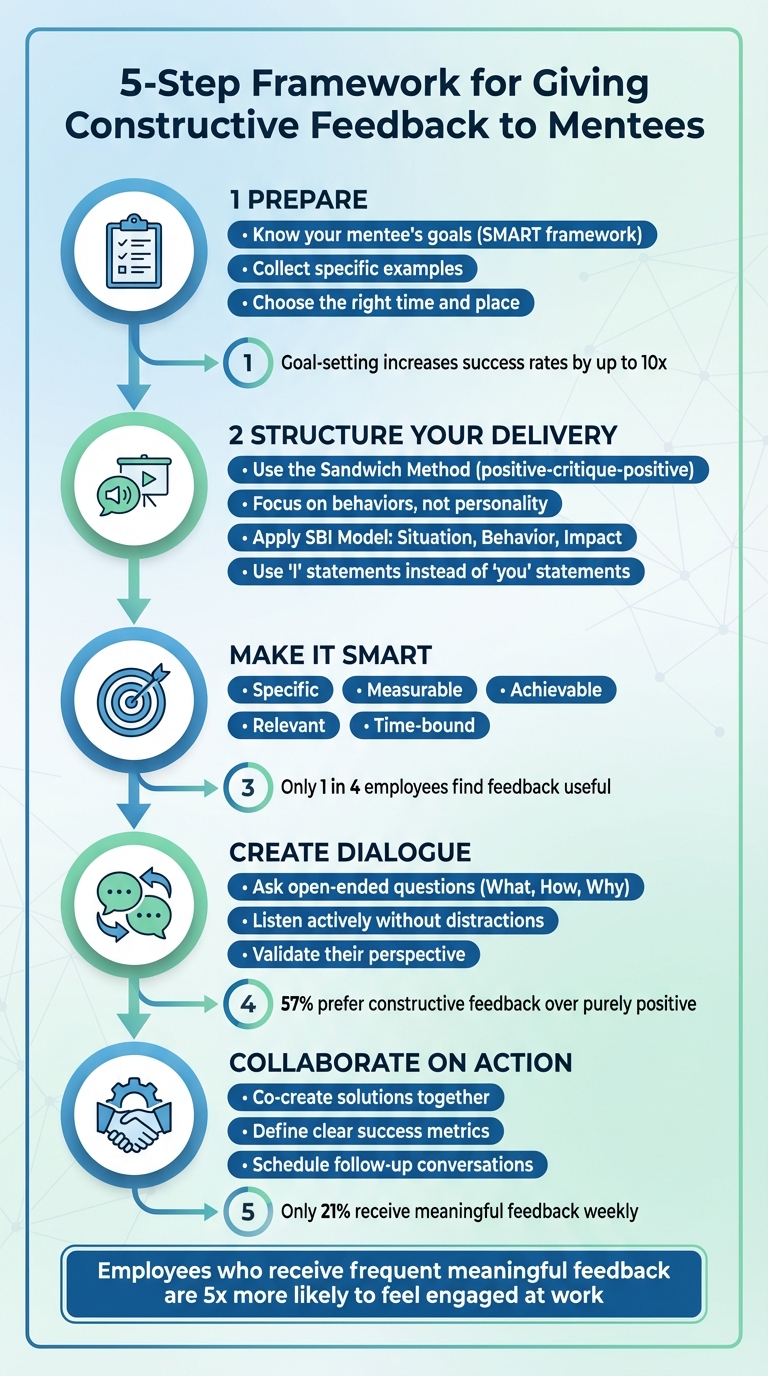
5-Step Framework for Giving Constructive Feedback to Mentees
Sharing Constructive Feedback With Your Mentor or Mentee
sbb-itb-3c06305
How to Prepare Before Giving Feedback
When it comes to feedback, preparation is everything. Thoughtful planning ensures that what you share truly supports your mentee's growth and aligns with their personal and professional goals.
Preparation is what separates meaningful feedback from vague critiques. To make your feedback impactful, start by digging into your mentee's objectives. Studies show that clear goal-setting can increase success rates by up to 10 times. This means your feedback should directly tie into their aspirations to be effective.
Know Your Mentee's Goals and Needs
The first step is understanding what your mentee is striving for. Collaborate with them to set clear goals, and consider using the SMART framework (Specific, Measurable, Achievable, Relevant, Time-bound) to make those goals actionable. This approach helps you both define what success looks like - whether it's improving a key skill like learning to code, securing a promotion, or broadening their professional network.
"Goal-setting is the compass that guides mentees throughout their mentoring journey." - Raja Khan, Author
It's also important to observe how your mentee reacts to feedback early on. Some people respond best to a mix of encouragement and gentle critique, while others appreciate more direct comments. Interestingly, research suggests that 57% of individuals prefer constructive feedback over purely positive remarks.
Once you understand their goals and feedback preferences, you can gather specific examples to illustrate your points clearly.
Collect Specific Examples and Observations
Vague statements like "you need to improve your communication" rarely help. Instead, focus on gathering concrete examples that your mentee can act on. For instance, instead of saying, "you need to communicate better", you might say, "During Tuesday's presentation, you rushed through the data analysis, which left the team confused." This level of detail makes your feedback actionable.
Using tools like a baseline assessment or a goal-setting quiz at the start of your mentoring relationship can also be helpful. These tools establish benchmarks, making it easier to measure progress and provide constructive feedback that’s grounded in specific examples.
Pick the Right Time and Place
Timing matters just as much as the content of your feedback. Address issues promptly, but also be mindful of your mentee’s current mental and emotional state. Are they overwhelmed with work or dealing with personal stress? Their ability to process feedback will depend on their readiness to hear it. Notably, only 21% of U.S. employees report receiving meaningful feedback in the past week.
"It is always best to give constructive feedback soon after the event leading up to it, but empathy will allow you to use wise discernment in choosing the best time and the best way to give it." - Try A Mentor
Choose a private and comfortable setting where your mentee feels safe and open to discussion. Whether it’s a quiet office, a meeting room, or even a casual café, the right environment can turn what might feel like a formal critique into a supportive conversation that inspires growth.
Methods for Delivering Constructive Feedback
After preparing your thoughts, the way you deliver feedback can make all the difference. The goal is to encourage growth without triggering defensiveness.
The Sandwich Method
The feedback sandwich - also known as the compliment sandwich - is a widely used technique where constructive criticism is "sandwiched" between two layers of positive feedback. Start with a genuine compliment, follow with constructive feedback, and end with an encouraging remark. The key here is specificity. For example, instead of saying, "You're doing great", try something like, "Your research on the client's background was thorough and gave the pitch a solid foundation." When moving to the critical part, steer clear of words like "but" or "however", as these can unintentionally undermine your earlier praise.
"Having a feedback sandwich end on a positive note means that team members leave the meeting or conversation happy and pleased with themselves and feel overall confident in their performance." - Emily Kensley, Product Marketing Manager, Fellow
While this method can leave the recipient feeling motivated, some experts warn that overusing it might make people suspicious, expecting criticism to follow every compliment. If your mentee prefers a more direct approach, straightforward feedback might work better. Tailoring your delivery to their preferences is key.
Focus on Specific Behaviors, Not Personality
When giving feedback, it's important to address actions rather than personality traits. For instance, instead of saying, "You're disorganized", you could point out, "The project timeline wasn't updated last week." This approach shifts the focus to something that can be changed, rather than making the feedback feel like a personal attack. Criticism targeting character often triggers defensiveness, which can make it harder to foster improvement.
A helpful tool here is the SBI Model: Situation, Behavior, Impact. For example: "During yesterday's client call (Situation), you interrupted the client twice (Behavior), which left them frustrated (Impact)." This structure lays out the issue clearly and offers a path for improvement.
"The word 'constructive' comes from the Latin 'construere,' meaning 'to build.' That's exactly what good feedback should do: build someone up while helping them improve." - Science of People
Another tip is to use "I" statements rather than "you" statements. For example, say, "I felt the introduction lost the audience", instead of, "You lost the audience." This subtle change can reduce defensiveness and keep the focus on the behavior, not the person.
Once you've addressed specific behaviors, connect your feedback to clear objectives using the SMART framework.
Make Feedback SMART
The SMART framework - Specific, Measurable, Achievable, Relevant, and Time-bound - helps turn vague feedback into actionable steps. For instance, instead of saying, "You need to communicate better", you could set a SMART goal like: "Aim to speak up at least once during our weekly team meetings for the next month." This method ensures the feedback is clear and actionable, outlining exactly what needs to be done, how progress will be measured, and within what timeframe.
"The SMART framework is a practical tool for making your message more actionable." - Madeline Miles, Writer and Storyteller, BetterUp
Studies reveal that employees who receive meaningful feedback several times a week are five times more likely to feel engaged at work. Yet, only one in four strongly agree that the feedback they receive is genuinely useful. By involving your mentee in setting SMART goals, you create a collaborative process that feels less like a directive and more like a partnership. This shared effort increases the chances of success.
Creating a Two-Way Feedback Conversation
Once you've nailed down how to deliver feedback effectively, the next step is to make it a two-way street. A feedback conversation that feels like a collaborative exchange, rather than a one-sided critique, can transform the entire mentoring experience.
Feedback works best when both mentor and mentee feel comfortable sharing openly. Unfortunately, many feedback sessions still miss the mark when it comes to fostering mutual growth. The key difference? Whether the conversation feels like a partnership or a top-down directive.
"How you invite, receive, and act on feedback sets the tone for your whole mentoring relationship." - CodeSignal
To create this kind of open environment, start by establishing psychological safety. Your mentee should feel free to voice their concerns without fear of judgment. You can set the tone by inviting feedback on your own approach. Try asking questions like, "Is there anything about my communication style that could be more helpful for you?" or "Was the pace of our last session comfortable?". Showing this kind of vulnerability signals that growth is a shared journey, not a one-sided effort.
Before jumping into feedback, ask if it’s a good time to talk. A simple, "Is now a good time to discuss some observations from last week's presentation?" ensures your mentee is in the right mindset. When sharing your thoughts, use inclusive language like "we" instead of "you." For instance, say, "How can we approach this challenge differently?" instead of "You need to change your approach". This reinforces the idea that you’re working together toward their success.
Ask Questions That Encourage Reflection
Instead of immediately offering solutions, focus on asking open-ended questions that encourage your mentee to reflect. Questions starting with "What", "How", or "Why" often lead to deeper insights than simple yes-or-no queries. For example, you might ask, "How do you feel you've grown since we started?" or "What has been your biggest learning so far?". These kinds of prompts help mentees think critically and often lead to self-discovery.
A structured approach like the 5 Cs framework can also guide problem-solving conversations:
- Challenges: Identify hurdles.
- Choices: Explore possible strategies.
- Consequences: Discuss potential outcomes.
- Creative Solutions: Brainstorm new ideas.
- Conclusions: Commit to a plan of action.
Take the example of a real estate company that implemented a mentoring program in July 2025 using Chronus software. By incorporating guided conversation prompts from the 5 Cs framework, 82% of participants described their dialogues as "breakthrough" in quality, and 84% felt these conversations directly contributed to their professional success.
When asking questions, specificity is your friend. Instead of a broad "How is it going?", try something like, "Was the pace of our last code review comfortable for you, or would you prefer a different approach?". Specific questions make it easier for mentees to provide honest, actionable feedback. You can also encourage gratitude reflection by asking what they’re most grateful for or who has influenced them. This helps them recognize their growth and the support they've received.
Once you’ve invited reflection, the next step is to truly listen.
Listen Actively to Your Mentee
Active listening is crucial during feedback conversations. Eliminate distractions - put away your phone, close your laptop - and give your mentee your full attention. Instead of planning your response while they’re talking, focus on understanding their perspective. Reflect back what you’ve heard to confirm you’re on the same page. For example, summarize their points and say, "So what I’m hearing is...".
"Feedback is the compass that guides us toward improvement. It's the mirror that reflects our strengths and blind spots." - Gustavo Razzetti, CEO of Fearless Culture
Validation is another critical element. Even if you don’t fully agree with your mentee’s perspective, acknowledge their feelings and viewpoints as valid. This builds trust and confidence in the relationship. After they share, thank them for their honesty, whether the feedback is positive or critical. A simple, "I really appreciate you being honest about that", can go a long way.
It’s also important to consider external factors like your mentee’s stress levels, sleep, and emotional state. If they seem overwhelmed, it might be better to reschedule the conversation for a time when they’re more receptive.
Once you’ve actively listened, it’s time to move forward together.
Work Together on Next Steps
After exchanging feedback, focus on turning insights into action. Collaborative goal-setting is key here. Instead of dictating solutions, ask questions like, "How would you use these techniques in a more direct manner?". This approach gives your mentee ownership of the process, increasing their commitment to follow through.
"The best mentors do not necessarily tell their mentees what to do or give them explicit advice on how to handle an issue; they listen carefully and help guide their mentees to find the answer on their own." - Best Practices for Mentors, University of Texas at Arlington
Work together to brainstorm multiple potential solutions and evaluate them before deciding on a path forward. If your mentee suggests a change - like incorporating more visuals into your sessions - implement it next time to show that their input matters. Define clear success metrics to track progress. For example, identify three key indicators that will help you both measure improvement.
To ensure the feedback doesn’t get lost, establish a feedback loop. Schedule a specific time to revisit the action plan and discuss progress. This mutual accountability keeps both parties engaged and allows for adjustments as needed.
Here’s a quick breakdown of shared responsibilities during action planning:
| Step in Action Planning | Mentor's Role | Mentee's Role |
|---|---|---|
| Goal Setting | Ensure goals are SMART and relevant | Define specific areas for growth |
| Solutioning | Facilitate and explore alternatives | Develop and propose the solution |
| Tracking | Support without being intrusive | Identify metrics to track progress |
| Follow-up | Provide regular support and feedback | Communicate progress and obstacles |
"Receiving feedback is just the first step; taking action on it is where the real growth happens." - Mentorloop
Common Mistakes to Avoid When Giving Feedback
Delivering feedback effectively requires more than just preparation; it also involves steering clear of common missteps that can derail a mentoring relationship. Even experienced mentors can unintentionally weaken their feedback by falling into these traps. Being mindful of these errors helps maintain a productive and supportive dynamic while addressing areas for growth.
Avoid Being Vague or Overly General
General feedback often leaves mentees puzzled rather than enlightened. Phrases like "be more proactive" or "improve your leadership" are too broad to be actionable. Instead, focus on specific examples and observed behaviors. For instance, rather than saying, "your presentation skills need work", you could say, "during yesterday's client meeting, the unclear slide headings caused confusion among the audience." This kind of clarity gives the mentee a clear direction for improvement.
Similarly, avoid using absolutes like "always" or "never", as they can provoke defensiveness. For example, saying "you always miss deadlines" disregards instances where they succeeded and can make the mentee feel attacked. A better approach would be to cite a specific example, such as, "the March 15th report was submitted two days late, which delayed the team's review process." This keeps the conversation focused on facts rather than feelings.
Don't Overload with Feedback
Bombarding someone with too much feedback in one sitting can be overwhelming and counterproductive. Instead, prioritize and focus on the most critical issues.
"What are the top 3 issues I want to discuss to avoid confusing the receiver?" - Gustavo Razzetti, Founder and CEO, Fearless Culture
Before giving feedback, identify the top three points you want to address. This keeps the conversation clear and manageable. If you’re providing corrective feedback, save unrelated positive comments for a separate discussion to ensure your main message isn’t diluted. Research shows that employees who receive frequent, meaningful feedback are five times more likely to feel engaged and connected to their work. So, aim for regular, focused conversations rather than overwhelming feedback sessions.
Steer Clear of Personal Criticism
Critiquing someone’s character instead of their actions can erode trust and hinder growth. Personal attacks often breed resentment and shut down meaningful dialogue.
"Impact feedback is the most effective to start with because it informs a person about the results of their behavior without dissecting the details, assuming motivation, or placing blame." - Center for Creative Leadership
Focus on behaviors and their outcomes. For example, instead of saying "you're sloppy", opt for "this report contained three calculation errors that confused the finance team." The former feels like a personal attack, while the latter highlights a specific, fixable issue. Interestingly, research shows that employees actually prefer receiving more negative feedback (35%) than they typically do (23%), but only when it’s framed constructively and targets actions they can change.
How Coachtrusted Improves Feedback and Mentorship
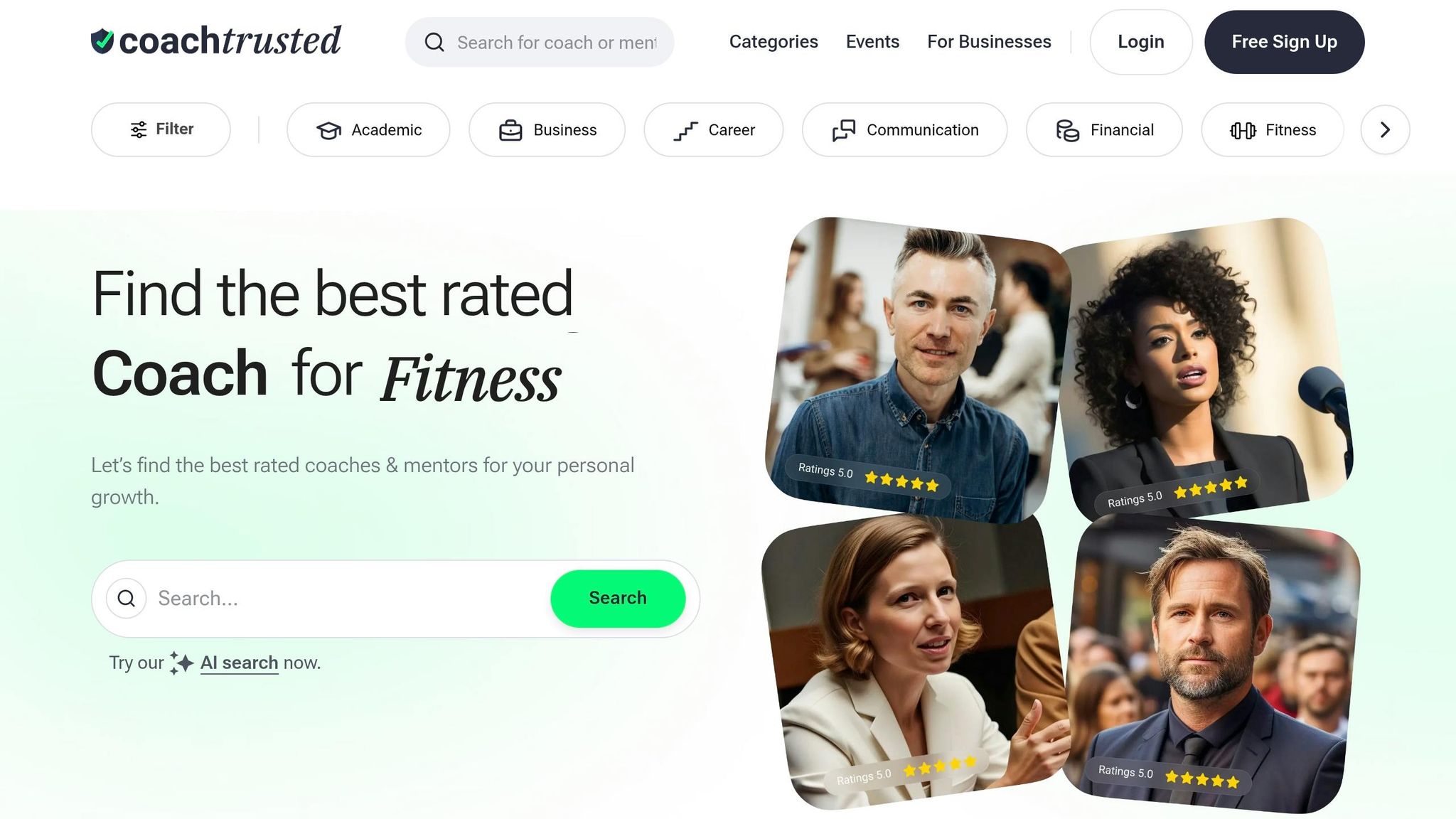
The right tools can transform the mentoring experience. While mastering feedback techniques is crucial, having a platform like Coachtrusted simplifies mentorship, making communication smoother and accountability stronger. Coachtrusted provides tools that enhance the mentor–mentee connection, aligning with best practices to ensure meaningful and productive interactions.
Finding the Right Match with Verified Profiles
A successful mentorship starts with the right pairing. Studies reveal that only 1 in 3 mentorships succeed when compatibility isn't prioritized. Coachtrusted tackles this issue with automated matching that aligns users based on their goals, needs, and personality traits. With more than 8,000 verified experts who have passed an "Expert Check", the platform guarantees mentor credibility. Mentees can use a smart search tool or answer quick questions to receive tailored recommendations. This personalized approach ensures mentees are matched with mentors who truly understand their aspirations, making feedback more relevant and actionable.
Using Communication Tools for Regular Feedback
Regular feedback thrives on consistent communication. Coachtrusted's Message Center facilitates ongoing conversations between mentors and mentees. Premium users gain access to advanced features like custom folders and live chat. Dashboards allow mentors to track engagement and manage feedback cycles effectively, ensuring check-ins are well-timed and impactful. Additionally, direct contact buttons eliminate delays, enabling immediate feedback when it matters most.
Building Trust with Reviews and Ratings
Transparency is key to effective mentorship. Coachtrusted’s platform includes a database of over 0.9 million reviews from real clients, creating accountability for both mentors and mentees. Each review undergoes manual verification to ensure authenticity, and incentivized feedback is strictly prohibited.
"All reviews come from real clients and are manually reviewed before being published to ensure authenticity and quality." - Coachtrusted
This system allows mentees to select mentors with proven track records, while mentors gain insights into their own feedback practices. Reviews highlight sessions that provide "actionable advice" and help in "setting achievable goals", fostering continuous improvement for both parties.
Conclusion
Giving meaningful feedback is a powerful way to help mentees grow. It starts with preparation: understanding their goals, gathering specific examples, and choosing the right time to share your thoughts. Use structured methods like SMART goals and the Sandwich approach to focus on observable behaviors.
But feedback shouldn't feel like a lecture. Instead, turn it into a conversation. Ask reflective questions and practice active listening to help mentees uncover their own solutions. This approach not only builds their confidence but also encourages a sense of ownership. With so few people receiving quality feedback, every conversation becomes an opportunity to make a difference.
To make feedback even more effective, avoid common pitfalls. Stay away from vague comments, information overload, or personal criticism. Use "I" statements and confirm understanding to keep the dialogue productive and positive.
Tools like Coachtrusted can streamline this process by connecting mentors and mentees, offering communication features, and creating accountability with verified reviews. When strong feedback practices are paired with the right tools, mentoring relationships become more engaging and beneficial for both parties.
Clear and constructive feedback lays the foundation for a successful mentor–mentee partnership.
FAQs
How do I give tough feedback without hurting trust?
To deliver tough feedback while maintaining trust, center your comments on specific actions or behaviors, not the individual. This keeps the conversation constructive and avoids making it personal. Use an empathetic tone that blends honesty with positive reinforcement - acknowledge strengths while addressing areas needing improvement. Be clear in your message and provide actionable steps they can take to grow. When framed as an opportunity for development, feedback becomes a tool for building trust and fostering a supportive mentoring dynamic.
What if my mentee gets defensive or shuts down?
If your mentee reacts defensively or withdraws, it’s crucial to respond with empathy and patience. Focus on creating an environment where they feel safe to express themselves. Make it clear that your feedback is intended to support their development, not to criticize them personally. Regularly checking in, actively listening, and providing honest but kind feedback can help ease their defensiveness and strengthen trust. Highlight the collaborative nature of the mentorship to keep the relationship constructive and positive.
How often should I give feedback to a mentee?
Feedback works best when it’s given regularly and tailored to the mentee’s growth. Scheduling private meetings on a consistent basis creates a reliable space for open communication. The key is to offer feedback that’s timely, precise, and directly tied to their progress. Rather than sticking to rigid schedules, adapt the timing to match their unique development needs, ensuring your guidance stays relevant and actionable.