Career Development
Coach vs Mentor: What's the Difference?
December 23, 2025
13 min read

Coach vs Mentor: What's the Difference?
Coaches help you improve specific skills or achieve short-term goals, while mentors guide your overall career and personal growth over time.
- Coaching is structured, time-limited, and performance-focused. It’s ideal for mastering a skill like public speaking or preparing for a leadership role. Coaches ask questions, provide feedback, and hold you accountable for measurable results.
- Mentoring is informal, flexible, and long-term. Mentors share their experiences to help you navigate career paths, workplace dynamics, and big-picture decisions. They’re a sounding board for personal and professional development.
Quick Comparison
| Feature | Coaching | Mentoring |
|---|---|---|
| Focus | Specific skills, performance goals | Long-term career and personal growth |
| Structure | Formal and scheduled | Informal and flexible |
| Duration | Short-term (weeks to months) | Long-term (months to years) |
| Expertise | Skill-focused techniques | Experience-based advice |
| Agenda | Coach-guided or co-created | Mentee-led |
| Outcome | Measurable improvements | Broader development |
Choose a coach for immediate challenges or skill gaps. Opt for a mentor to shape your long-term career journey. Many professionals benefit from using both at different stages of their growth.
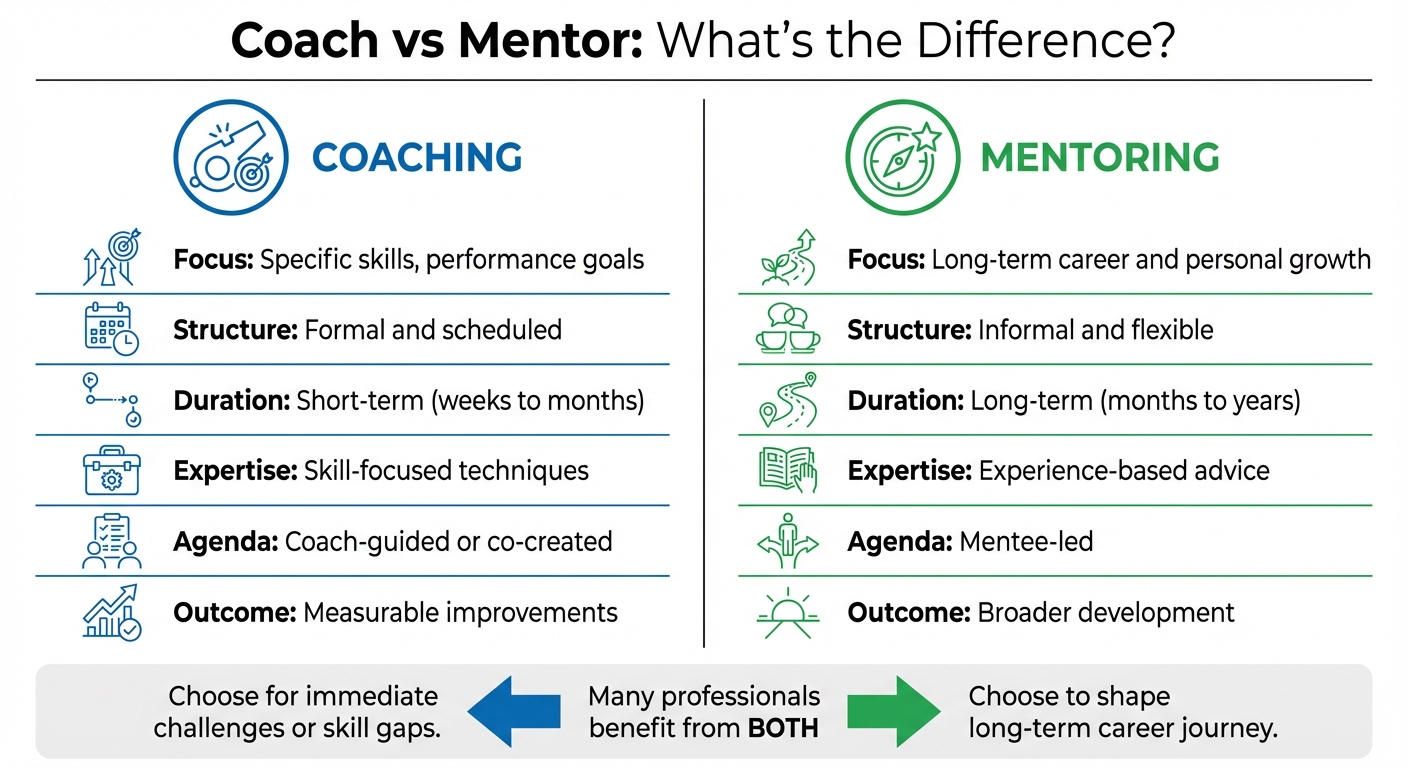
Coach vs Mentor: Key Differences Comparison Chart
What Is a Coach?
Coaching Definition
Coaching is a focused, results-oriented process aimed at improving job performance and skill development. Unlike broader mentorship or guidance, coaching hones in on specific, measurable outcomes, typically achieved within a set timeframe ranging from a few weeks to a year. The International Coach Federation defines coaching as:
"partnering with clients in a thought-provoking and creative process that inspires them to maximize their personal and professional potential".
In practice, a coach doesn't hand you the answers but instead asks insightful questions to help you uncover solutions and take ownership of your progress. This approach keeps the emphasis on measurable performance improvements through a structured process.
Main Features of Coaching
Coaching follows a structured schedule - often weekly, bi-weekly, or monthly - where a coach collaborates with you to create a clear, actionable plan tailored to your strengths and areas for growth. Whether it's sharpening a sales pitch, improving leadership skills, or mastering a specific tool, coaching ensures you stay focused on achieving concrete goals. Tools like 360-degree assessments are often used to monitor progress and fine-tune your plan along the way.
The relationship is highly solution-driven: you're expected to act on the coach's advice and regularly assess your development. Meanwhile, the coach provides constructive feedback and holds you accountable for meeting your goals. This structured approach is the foundation for various coaching scenarios.
Common Coaching Examples
Coaching can address a wide range of professional and personal goals. For instance:
- Executive Coaching: Helps leaders refine their vision and leadership strategies.
- Sales Coaching: Focuses on improving conversion techniques and client interactions.
- Communication Coaching: Aims to enhance clarity and effectiveness in messaging.
Imagine a newly promoted manager working with a coach to develop delegation skills or learn how to run effective one-on-one meetings. Teams experiencing collaboration issues may benefit from team coaching, while organizations undergoing mergers might use change management coaching to navigate cultural shifts. Even personal objectives - like training for a marathon or improving public speaking - can benefit from the structured, results-driven methods of coaching.
These examples highlight how coaching provides targeted support to drive progress in both professional and personal contexts.
sbb-itb-3c06305
What Is a Mentor?
Mentoring Definition
Mentoring is a long-term relationship where an experienced professional offers guidance and support to someone earlier in their career. Amanda Schnieders, Director of Content & Communications at Chronus, describes it well:
"A mentor is a source of support, wisdom and experience for their mentee, who often has less experience in a similar field, skill or general workforce."
Unlike coaching, which focuses on sharpening specific skills, mentoring takes a broader approach. It’s about your overall career and personal growth. Mentors share their experiences and insights to help you navigate workplace culture and those unwritten rules that no one tells you about. This makes mentoring more fluid and long-term compared to the focused, short-term nature of coaching.
Main Features of Mentoring
Mentoring relationships can last anywhere from six months to several decades. They’re flexible and often informal, with meetings that might range from a quick coffee chat to occasional email exchanges. What makes mentoring unique is that it’s mentee-driven - you set the agenda and take charge of your growth.
A mentor doesn’t just help you with your current role; they encourage you to think ahead. Where do you want to be in five or ten years? They can help you explore leadership styles that fit your personality and guide you in balancing career goals with personal values.
Common Mentoring Examples
Mentoring takes many forms in real-world scenarios. For example, Nikkee Rhody, Executive Vice President at Central Payments, works with two mentors who challenge her strategic thinking and help her spot blind spots she might otherwise miss. Similarly, Suzanne Blake, formerly of NimblyWise, turned to a mentor when she moved from special education into the tech industry. Her mentor helped her understand the unspoken norms of a completely new field - something no formal training could have prepared her for.
You might look for a mentor when switching careers, aiming for a leadership role, or trying to grasp the political dynamics of your workplace. New employees often find mentors helpful in decoding company values and unwritten expectations. There’s also reverse mentoring, where junior employees share their expertise - often in areas like digital tools - with senior leaders, creating opportunities for mutual learning and growth.
Coach vs Mentor: Direct Comparison
Comparison Table
Here’s a clear side-by-side look at how coaching and mentoring differ:
| Feature | Coaching | Mentoring |
|---|---|---|
| Primary Focus | Performance and specific skill tasks | Career and personal development on a broader scale |
| Structure | Formal and highly structured | Informal and adaptable |
| Duration | Short-term (weeks to months) | Long-term (years) |
| Expertise Source | Skilled in coaching techniques or specific areas | Built on seniority and industry experience |
| Agenda Setting | Guided or co-created by the coach | Directed and managed by the mentee |
| Outcome | Measurable improvements in performance | Broader career and personal growth |
Coaching is all about structured, short-term guidance aimed at achieving specific goals, such as preparing for a high-stakes presentation or navigating a major business transition. The focus is on measurable results within a defined timeframe.
On the other hand, mentoring takes a broader, more enduring approach. It’s about fostering career and personal development over the long haul. As Christine Zust, a professional coach, puts it:
"Mentoring is more development driven, looking not just at the professional's current job function but beyond, taking a more holistic approach to career development."
Mentoring vs. Coaching - what's the difference?
Main Differences: Goals, Structure, and Expertise
This section breaks down the key differences between coaching and mentoring, focusing on their goals, structure, and the type of expertise they bring to the table.
Goals: Performance vs. Development
Coaching is all about achieving specific, measurable results. Whether it's mastering a critical skill, like delivering a standout presentation, or improving your sales performance, coaching hones in on clear, tangible objectives.
Mentoring takes a broader approach, emphasizing career growth and personal development. As Matthew Urwin from Built In notes:
"Coaching focuses on a specific goal, while mentoring focuses on broader career development".
Think of it this way: a coach might help you ace an upcoming interview, while a mentor helps you evaluate whether that job aligns with your long-term ambitions.
Structure: Formal vs. Informal
Coaching typically follows a structured format. It involves scheduled sessions - often weekly or bi-weekly - focused on achieving defined goals over a set timeframe, usually 6 to 12 months.
Mentoring tends to be more fluid and informal. It doesn't usually involve strict schedules or formal agreements, and only 41% of mentoring relationships set clear goals.
Expertise: Methods vs. Experience
The type of expertise offered is another key distinction between the two.
Coaches rely on established frameworks and techniques. They’re trained in methods like leadership models, communication strategies, and behavioral assessments. According to the International Coaching Federation:
"partnering with clients in a thought-provoking and creative process that inspires them to maximize their personal and professional potential".
Since their expertise is rooted in development methods rather than industry-specific knowledge, coaches can work across a wide range of fields.
Mentors draw from their own professional journeys. They’ve been there, done that, and can offer firsthand advice on navigating workplace dynamics and advancing your career. Their guidance is steeped in real-world experience, offering insights into the often-unspoken rules of professional environments.
When to Choose a Coach on coachtrusted
Best Situations for a Coach
Coaching is most effective when you're tackling specific, time-sensitive challenges that require focused solutions. For example, if you're stepping into a leadership role for the first time, a coach can help you craft a detailed 30-60-90-day plan to ensure a smooth and productive transition. This guidance is especially valuable when shifting from an individual contributor role to managing a team.
Hit a performance plateau? A coach can help. When your usual strategies stop delivering results, a coach provides an unbiased perspective to uncover and resolve deeper issues. They can address areas like executive presence, conflict management, or communication challenges that may be holding you back.
Struggling with workplace challenges? Coaching offers targeted support. Whether you're dealing with a toxic work environment, a difficult manager, or feelings of imposter syndrome, a coach can provide actionable strategies. As HR expert Bonita Thompson explains:
"A coach can help you avoid being blindsided".
From battling burnout caused by overwork to breaking through leadership barriers, coaches can help you tackle these issues head-on and keep you moving forward.
| Coaching Type | Primary Focus | Best Situation |
|---|---|---|
| Executive Coaching | Leadership transition | Navigating the move from individual contributor to team leader with tailored support |
| Sales Coaching | Technique refinement | Improving pitch success rates through specialized guidance on coachtrusted |
| Communication Coaching | Vision and alignment | Sharpening executive strategies for better team or C-suite alignment |
| Team Coaching | Interaction and performance | Resolving team conflicts and improving collaboration through coachtrusted's expertise |
Next, we’ll look at how coachtrusted connects you with the perfect coach for your needs.
How coachtrusted Helps
coachtrusted makes finding the right coach straightforward and stress-free. The platform features verified profiles, so you can check each coach's credentials and education before committing to anything. With smart search tools, you can filter for specific expertise - whether you need help with turnaround strategies, navigating mergers, or leading across different cultures. This ensures you’re matched with a professional who truly understands your challenges.
Transparent reviews give you confidence in your choice. Testimonials from other clients provide a clear view of each coach’s approach and success rate. Plus, coachtrusted offers discovery calls to help you assess fit and compatibility. By speaking with multiple coaches, you can evaluate their style, process, and whether they align with your needs.
Whether you’re looking for a supportive, wellness-focused coach or someone who offers candid, no-nonsense guidance, coachtrusted’s tools make it easy to find your perfect match.
When to Choose a Mentor on coachtrusted
Best Situations for a Mentor
Mentoring shines when it comes to long-term career growth. If you're planning a significant career shift - like moving from a technical role into management or jumping into an entirely new industry - a mentor who has navigated similar transitions can provide valuable insights from their own journey. This is especially helpful in fast-paced startup environments where clear career paths often don’t exist. As Sasha Siddhartha, CTO and Co-founder of Thrive Market, puts it:
"Mentorship can play a key role in bridging this gap, where one can benefit from the direct relevant experiences of most seasoned technologists, learn from their mistakes, and carve the best path forward."
Mentoring isn’t just about the immediate steps - it’s about building relationships that grow with your career.
Unlike coaching, which often focuses on short-term goals, mentoring takes a broader view of your career. For example, if you’re new to a company, a mentor can help you understand the unwritten rules - like the organizational culture, values, and norms that don’t appear in the employee handbook. Mentors also act as sounding boards for workplace challenges, offering advice on climbing the corporate ladder or handling demanding assignments. Studies have shown that employees with mentors often experience higher job satisfaction, stronger loyalty to their organizations, and better chances of getting promoted.
Mentoring is also a powerful tool for advancing diversity and inclusion. Many organizations use mentoring programs to help underrepresented employees build connections, break down barriers, and prepare for leadership roles. While coaching often hones in on specific skills, mentoring takes a broader approach, focusing on your overall career trajectory and personal development over time.
How coachtrusted Helps
coachtrusted makes it easier to find the right mentor by using specialized matching quizzes that connect you with experienced professionals who align with your career goals. Whether you're navigating a career change or stepping into a leadership role, the platform pairs you with mentors who have successfully walked that path. The built-in messaging tools support the informal, relationship-driven nature of mentoring, allowing you to set your own agenda, decide how often to meet, and establish confidentiality guidelines. Designed for mentoring relationships that can last anywhere from six months to several years, coachtrusted focuses on comprehensive career development instead of short-term fixes.
Conclusion: Picking the Right Support
Main Points
When deciding between a coach and a mentor, it’s all about your goals. If you’re aiming for short-term, performance-based improvements, a coach is your go-to. Coaches work with you over 3 to 6 months in structured sessions, focusing on specific skills like sales techniques or presentation abilities. They ask targeted questions to help you achieve measurable outcomes. On the other hand, if your focus is long-term career growth and personal development, a mentor might be the better choice. Mentors guide you over months or even years, offering flexible, informal meetings where you set the agenda. They share advice rooted in their own experiences, helping you navigate workplace dynamics and prepare for leadership roles.
Nancy Franz and Robin Weeks highlight the key difference:
"A coach has no personal agenda but rather focuses on the employee's performance".
Meanwhile, mentors bring the wisdom of their lived experiences to provide a broader perspective.
In essence, coaches are ideal for tackling immediate skill gaps, while mentors are there to guide your overall career journey. Many professionals find value in leveraging both - using a coach for specific challenges and a mentor for long-term direction. Understanding this distinction can help you choose the right support for your needs.
Getting Started with coachtrusted
coachtrusted makes it easy to find the right professional to match your goals. The platform connects you with verified experts, whether you’re seeking structured coaching sessions or flexible mentoring guidance. With smart search tools and user reviews, you can make an informed decision. Define your objectives - whether it’s short-term performance improvement or ongoing development - and let coachtrusted pair you with the perfect expert to guide your journey.
FAQs
How can I decide whether I need a coach or a mentor?
Choosing between a coach and a mentor comes down to your goals, the timeframe you’re working with, and the kind of support you’re looking for. Coaching usually focuses on short-term objectives, like mastering a specific skill - think public speaking - or tackling challenges such as preparing for a promotion. Mentoring, however, is more about the long haul. It’s centered on broader career development, like honing leadership abilities or navigating the complexities of your industry.
To figure out what’s best for you, start by asking yourself: What am I trying to achieve? If you’re aiming for a short-term improvement or need targeted help, a coach might be the way to go. But if you’re seeking guidance for long-term growth or overall professional development, a mentor could be a better match. Consider the style of interaction, too - coaching tends to be structured and goal-focused, while mentoring is more relaxed and built on a personal connection. By understanding your needs, you can find the right kind of support to help you move forward.
Can I work with both a coach and a mentor at the same time?
Yes, you can absolutely work with both a coach and a mentor at the same time, and for many, this combination can be incredibly effective. A coach usually zeroes in on short-term, structured goals - like sharpening specific skills, boosting performance, or hitting measurable targets. On the other hand, a mentor takes a broader, long-term approach, offering advice and sharing experiences to guide your career and personal development.
Because their roles are so different, having both can give you the advantage of targeted accountability from a coach alongside the valuable perspective and wisdom of a mentor. To get the most out of these relationships, make sure you clearly outline your goals for each, set expectations from the start, and agree on a schedule that works for everyone involved. In fact, many companies actively encourage employees to work with both a coach and a mentor to ensure well-rounded growth.
How can mentoring help with career growth?
Mentoring has the power to transform your career trajectory. With personalized, long-term guidance, a mentor can help you tackle obstacles, boost your confidence, and uncover opportunities for growth. This kind of support often translates into faster career progression, greater job satisfaction, and a deeper sense of professional achievement.
Beyond guidance, mentors connect you to important networks, sharpen your leadership and strategic thinking abilities, and offer insider knowledge about the unwritten rules and pathways within your industry. These benefits not only speed up your skill development but also open doors to opportunities that align perfectly with your career aspirations.