Career Development
Research on Cognitive Behavioral Coaching Benefits
January 22, 2026
11 min read

Research on Cognitive Behavioral Coaching Benefits
Cognitive Behavioral Coaching (CBC) is a structured method rooted in techniques from Cognitive Behavioral Therapy (CBT), designed to help individuals overcome challenges, manage stress, and improve performance. Unlike therapy, which often focuses on diagnosing mental health issues, CBC targets actionable strategies for personal and professional growth.
Key Takeaways:
- What is CBC? A coaching approach using evidence-based tools to reshape unhelpful thought patterns and behaviors.
- How it works: Employs models like ABCDE to identify obstacles and create solutions.
- Proven benefits:
- Stress reduction (effect size: d=0.89).
- Mental well-being improvement (effect size: d=1.09).
- Increased goal attainment and self-efficacy.
- Delivery methods: Effective in-person, online, or group formats.
- Applications: Leadership development, team collaboration, and workplace performance improvement.
Studies show CBC is effective across various settings, with digital platforms offering comparable results to face-to-face sessions. Organizations and individuals looking to enhance performance and resilience can benefit from this structured, results-driven approach.
Cognitive Behavioral Coaching Benefits: Research-Backed Statistics and Outcomes
Cognitive Behavioral Therapy Techniques For Coaches
Key Research on CBC Benefits
Recent studies highlight the measurable impact of Cognitive Behavioral Coaching (CBC) on both well-being and performance. Research consistently shows that CBC positively influences behavior, emotions, and cognition, with particularly strong results in improving performance. These benefits remain consistent whether the coaching is delivered in person or through digital platforms. A standout example of these findings is the 2021 study by Lungu et al., which explored CBC's effectiveness in a practical setting.
Study Spotlight: Lungu et al. (2021)
In early 2021, Lungu and colleagues examined data from 289 employees enrolled in a technology-based behavioral healthcare program. Participants received up to six 45-minute CBC sessions via video or phone. The study assessed outcomes using two widely recognized tools: the Perceived Stress Scale (PSS) and the Warwick-Edinburgh Mental Well-Being Scale (WEMWBS).
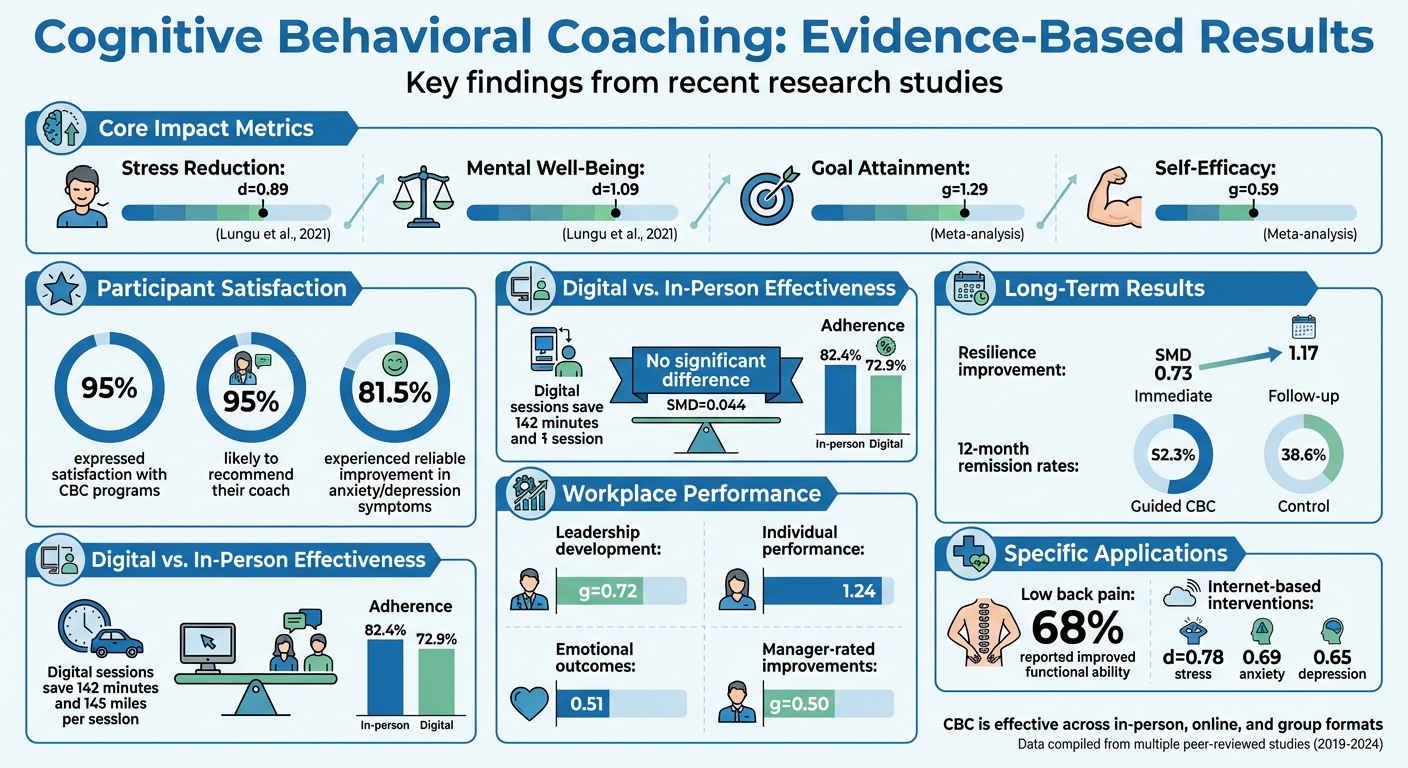
The results were striking: a large effect size of d=0.89 for stress reduction (PSS) and d=1.09 for mental well-being (WEMWBS). These numbers reflect substantial, clinically meaningful changes. Additionally, 95% of participants expressed satisfaction with the program, and the same percentage said they were likely to recommend their coach.
Insights from Other Studies
Building on Lungu et al.'s findings, other studies further validate CBC's effectiveness. For example, BetterUp, Inc. conducted a longitudinal study between July 2019 and June 2020 involving 391 professionals using its virtual coaching platform. Led by Alexis M. Jeannotte, PhD, the research revealed statistically significant improvements (P < .001) across nine dimensions of well-being over six months.
A meta-analysis of 20 studies highlighted CBC's impact on goal attainment, with a large effect size of g=1.29, and a moderate effect size of g=0.59 for self-efficacy. In workplace settings, CBC demonstrated a stronger influence on objective work performance - such as evaluations from 360-degree feedback - compared to participants' self-reported performance.
In healthcare, CBC has shown promise as well. A remotely delivered program for 423 health plan members with low back pain found that 68% reported improved functional ability, with greater improvements linked to completing more sessions. Similarly, Lyra Health's Blended Care-CBT program, conducted between September 2019 and July 2021, helped 6,738 U.S.-based employees. Over an average of 7.6 weeks, 81.5% of participants experienced reliable improvement in anxiety or depression symptoms.
A 2022 meta-analysis of internet-delivered cognitive behavioral interventions reported pooled effect sizes of d=0.78 for stress reduction, d=0.69 for anxiety, and d=0.65 for depression. Crucially, research comparing video-based and in-person sessions found no significant difference in effectiveness (SMD=0.044), confirming that digital delivery is just as effective.
Core Benefits of Cognitive Behavioral Coaching
Stress Reduction and Emotional Well-Being
Cognitive Behavioral Coaching (CBC) is a powerful tool for managing stress by helping individuals identify and replace unhelpful beliefs about stressful situations. By fostering healthier thought patterns and teaching effective coping strategies, CBC empowers individuals to respond to challenges more constructively. For instance, research on internet-based interventions reports a pooled effect size of d = 0.78, highlighting its effectiveness.
CBC doesn't just alleviate immediate symptoms - it builds long-term psychological resilience. This resilience helps individuals maintain their functionality and adapt to adversity. Studies show that the impact of CBC strengthens over time, with a standardized mean difference (SMD) of 0.73 immediately after intervention, increasing to 1.17 during follow-ups.
"CBT-based interventions aim to change such maladaptive cognitions and alter individuals' maladaptive behavioral patterns through cognitive restructuring, Socratic questioning, reassessment, and reassignment of interpretations made by individuals." – Journal of Behavioral and Cognitive Therapy
The versatility of CBC makes it effective for various groups, including nurses, managers, teachers, and students - populations often dealing with high-pressure environments. Even brief group sessions, such as one-day workshops, have shown measurable improvements in mental health. For example, participants experienced reductions in depression (g = 0.31) and anxiety (g = 0.28), along with boosts in self-esteem (g = 0.15) at three-month follow-ups. These improvements highlight how CBC's stress-relief benefits can ripple out to broader organizational contexts.
Scalability and Accessibility
CBC's flexible delivery methods make it accessible and practical for a wide range of users. Whether provided in person, through video calls, or via digital platforms, CBC consistently delivers positive outcomes. Research indicates that digital sessions are just as effective as face-to-face ones, offering added convenience.
Remote options, in particular, remove common access barriers. For example, video sessions save participants an average of 142 minutes and 145 miles per session, making CBC more accessible for individuals in rural areas or those with limited mobility. While face-to-face interventions have slightly higher adherence rates (82.4% vs. 72.9% for digital), guided digital programs - those that include human support - achieve comparable results when accounting for participant characteristics.
CBC's scalability also extends to group formats, making it a cost-effective solution for organizations. Even ultra-short workshops, lasting as little as two hours, have been shown to improve workplace communication and performance. A notable example is the 2024 DISCOVER intervention in the UK, where one-day CBT workshops combined with telephone follow-ups supported 900 adolescents. This program demonstrated both clinical success and cost-efficiency, showcasing CBC's potential for large-scale initiatives.
"Brief group CBT therapies have significant and relatively stable efficacy... providing a promising time-saving and low-cost approach to address immediate and large worldwide psychological needs." – Psychiatry Research
sbb-itb-3c06305
Applications in Professional and Organizational Development
CBC in Executive Coaching
Cognitive Behavioral Coaching (CBC) plays a pivotal role in shaping leadership skills within professional environments. By leveraging the ABCDE model, CBC helps executives identify and overcome mental obstacles that may hinder their performance. Unlike traditional coaching methods that focus on listening and facilitation, CBC is action-driven, emphasizing goal setting, actionable plans, and accountability.
The benefits of CBC in leadership development are backed by measurable outcomes. Studies reveal that workplace coaching interventions yield an effect size of 0.51 for emotional outcomes like self-confidence and well-being, and an even higher 1.24 for individual performance improvements. For executives working on essential skills like negotiation, delegation, or strategic communication, CBC demonstrates a notable positive impact, with an effect size of g = 0.72.
One illustrative example comes from a study conducted in October 2016, involving 23 mid-level managers at a multinational manufacturing company. The program focused on building assertive communication, managerial coaching abilities, and motivational skills. Even amid challenging circumstances - such as the factory's announced closure - participants showed marked improvements in leadership behaviors, as measured by the Multifactor Leadership Questionnaire, and reported enhanced performance effectiveness.
"Coaching, as a professional development method, has great potential to contribute to the managerial behaviors that facilitate development at subordinate level." – Lucia Ratiu, Oana A. David, and Adriana Baban
Organizations considering CBC for leadership development should take note: internal coaches often achieve better results than external consultants. This is likely due to their deeper understanding of the company's culture and objectives. With global workplace coaching investments surpassing $2 billion USD annually, selecting the right coaching approach is critical for achieving meaningful results and maximizing return on investment. Importantly, the benefits of CBC extend beyond individual leaders, positively influencing team dynamics and overall organizational growth.
CBC for Teams and Organizations
Beyond individual leadership, CBC significantly enhances team collaboration and organizational performance. It strengthens interpersonal relationships, improves communication, and aids in conflict resolution. Managers trained in CBC techniques develop "manager-as-coach" skills, enabling them to support their team members' professional development more effectively.
The evidence for CBC's impact on teams is compelling. Manager-rated improvements show an effect size of g = 0.50, while self-reported outcomes come in at g = 0.41. These gains translate into better team coordination, fewer workplace conflicts, and stronger collective performance. Additionally, CBC's adaptability allows organizations to scale its implementation across multiple teams, even in virtual settings - a key advantage for companies with distributed workforces.
CBC's structured, outcome-focused approach makes it highly effective for tackling specific team challenges. Whether the aim is to improve communication, resolve conflicts, or boost motivation, CBC provides a clear framework for identifying cognitive barriers and applying evidence-based solutions. Its flexible delivery methods, ranging from in-person sessions to video conferencing, make it an accessible solution for teams across different locations.
Future Developments and Quality Assurance in CBC
Importance of Standardization
As cognitive behavioral coaching (CBC) continues to grow across various professional settings, ensuring consistent quality has become a top priority. Organizations like the Canadian Association of Cognitive and Behavioural Therapies (CACBT) have stepped in with guidelines that outline key knowledge areas, necessary competencies, and evaluation methods to help practitioners provide effective care. Their mission is straightforward:
"to improve CBT training; thus, improving the Canadian public's access to high quality, effective psychological treatments".
The impact of structured training is hard to ignore. Research shows that 95% of graduate-level coaches who received comprehensive training - including live sessions, detailed manuals, and weekly supervision - reported positive experiences. Additionally, 94.6% of these coaches felt well-prepared for their roles and more confident in delivering interventions. To maintain quality, best practice rubrics are now widely used to categorize expected behaviors, which independent adherence teams evaluate against standardized criteria. Tools like the Cognitive Therapy Rating Scale (CTRS) and the Assessment of Core CBT Skills (ACCS) allow observers to objectively measure a practitioner’s competence. Supporting this, studies highlight the importance of ongoing feedback:
"formative feedback (e.g., through continuous supervision) is important to improve and maintain therapeutic competence".
There’s also growing momentum for accrediting bodies like the APA and NASW to recognize digital coaching hours as part of clinical training requirements. These efforts are laying the groundwork for integrating standardization into digital platforms, ensuring quality remains a cornerstone of CBC.
Opportunities for Digital Integration
With these quality assurance measures in place, digital tools present an exciting opportunity to scale CBC. Between November 2022 and August 2023, a nationwide trial in the U.S. tested SleepioRx, an automated digital CBT-I program for insomnia. The trial, which included 336 adults, revealed that participants had 5.8 times greater odds of remission at 10 weeks compared to a control group, with a Cohen's d effect size of 0.60. This success led to FDA authorization for insomnia treatment. Speaking on the study, Aric A. Prather, PhD, from the University of California, San Francisco, remarked:
"These findings underscore the potential of a new class of FDA-authorized, fully automated digital treatments to provide first-line, guideline-recommended CBT at scale".
Digital tools address challenges like geographic barriers, mobility issues, and clinician shortages. A meta-analysis of 106 studies involving 11,854 patients showed that digital CBT is just as effective as face-to-face interventions when factors like treatment duration and baseline severity are considered. Blended approaches - combining digital modules with human supervision - stand out for delivering even better outcomes than unguided digital tools.
Platforms like Coachtrusted are already leveraging these advancements by connecting users with certified coaches who adhere to standardized training protocols. These platforms incorporate features like adherence tracking, competence assessments, and supervision logs, ensuring that digital coaching maintains the rigor of traditional CBC. Organizations can further enhance quality by providing detailed onboarding manuals, often exceeding 100 pages, that cover everything from technical platform navigation to crisis response and motivational interviewing techniques.
The future of CBC lies in merging evidence-based practices with digital innovation. By scaling access without sacrificing quality, digital integration ensures that more people can benefit from effective coaching tailored to their needs.
Conclusion
Research highlights that Cognitive Behavioral Coaching (CBC) plays a key role in improving stress management, emotional resilience, and professional performance. Studies show CBC leads to significant gains in workplace performance and moderate improvements in abilities, mood, and cognitive function. Its effectiveness remains consistent across face-to-face sessions, group settings, and digital platforms, providing a flexible approach to personal and professional growth.
What sets CBC apart is its reliance on evidence-based cognitive-behavioral frameworks, which help individuals identify and reframe limiting beliefs. Unlike general coaching methods that lean heavily on subjective experience, CBC is rooted in science. As Lungu et al. noted in Telemedicine and e-Health:
"Coaching, when delivered by accredited professionals, can be efficacious in decreasing perceived stress and increasing well-being."
The benefits of CBC extend well beyond short-term outcomes. Long-term studies reveal that guided interventions result in remission and response rates of 52.3%, compared to 38.6% in control groups at 12-month follow-ups. Additionally, the resilience improvements achieved through CBC have been shown to last long after the initial intervention period.
However, the quality of coaching can vary widely due to limited external regulation in the field. This makes choosing the right platform essential. Verified platforms like Coachtrusted address this issue by connecting users with accredited coaches trained specifically in cognitive-behavioral principles. These platforms maintain rigorous vetting processes - accepting as few as 3% of applicants - to ensure practitioners deliver structured, evidence-based coaching rather than surface-level motivational advice.
FAQs
What makes Cognitive Behavioral Coaching different from traditional therapy?
Cognitive Behavioral Coaching (CBC) is all about guiding individuals to recognize and shift unhelpful thoughts and behaviors, paving the way for personal and professional development. While traditional therapy often focuses on addressing mental health challenges, CBC zeroes in on boosting performance, building resilience, and equipping people with practical coping strategies.
This approach is highly action-driven and goal-oriented, making it a great fit for addressing everyday challenges. Plus, CBC sessions are often held over video or phone, offering a flexible and convenient way for individuals to work toward their specific growth objectives.
What are the proven benefits of Cognitive Behavioral Coaching (CBC) in the workplace?
Cognitive Behavioral Coaching (CBC) has proven to be a game-changer in workplace settings, offering tools that promote both personal and professional development. Research underscores its ability to strengthen psychological resilience, boost job performance, and encourage behavioral shifts that improve workplace dynamics.
The impact of CBC extends to areas like skill enhancement, emotional health, and functional capabilities. For instance, individuals applying CBC techniques have reported lower stress levels and increased productivity, especially when dealing with challenges such as chronic pain or workplace pressures. These positive outcomes tend to grow with regular participation in coaching sessions.
By relying on evidence-based practices, CBC provides actionable strategies to tackle obstacles, build healthier habits, and pursue goals more effectively in professional settings.
Can Cognitive Behavioral Coaching be effective through digital platforms?
Digital platforms are proving to be an effective way to deliver Cognitive Behavioral Coaching (CBC). Studies indicate that structured CBC programs conducted through video calls or phone sessions can significantly lower stress levels and improve mental health. Participants often express high satisfaction with these programs and are inclined to recommend their coaches to others.
What’s more, digital tools make CBC more accessible to a broader audience, offering tailored support for both personal and professional development. Research also shows that digital CBC, when facilitated by a coach or mentor, can deliver results on par with traditional in-person sessions, all while boosting engagement and adherence to the program.