Career Development
10 Questions to Ask Before Hiring a Coach
December 16, 2025
17 min read

10 Questions to Ask Before Hiring a Coach
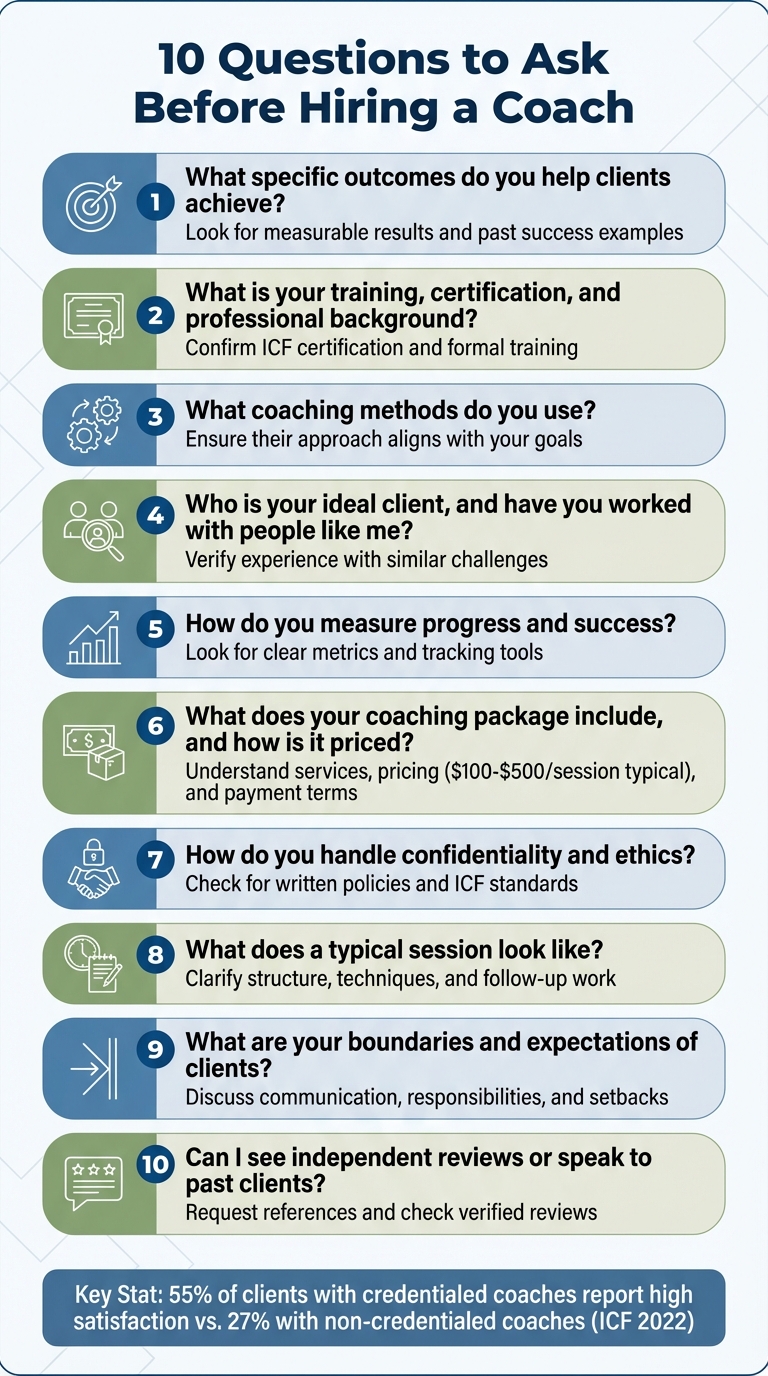
Hiring a coach can help you achieve personal or professional goals, but not all coaches are equally qualified. Since coaching is an unregulated industry, thorough vetting is essential to ensure you find someone skilled and trustworthy. Here are the 10 key questions you should ask to evaluate a coach’s qualifications, methods, and fit for your needs:
-
What specific outcomes do you help clients achieve?
Look for measurable results and examples of past success. -
What is your training, certification, and professional background?
Confirm formal training, certifications (like ICF), and relevant experience. -
What coaching methods do you use?
Ask about their approach and whether it aligns with your goals. -
Who is your ideal client, and have you worked with people like me?
Ensure they have experience addressing challenges similar to yours. -
How do you measure progress and success?
Look for clear metrics and tools to track your growth. -
What does your coaching package include, and how is it priced?
Understand the services offered, pricing, and payment terms. -
How do you handle confidentiality and ethics?
Check for written policies and adherence to ethical standards. -
What does a typical session look like?
Clarify session structure, techniques, and follow-up work. -
What are your boundaries and expectations of clients?
Discuss communication, responsibilities, and handling setbacks. -
Can I see independent reviews or speak to past clients?
Request references and check reviews for additional insights.
Asking these questions ensures you select a coach who meets your needs and delivers results. Take your time to compare options and prioritize coaches with proven credentials, clear methodologies, and strong client feedback.
10 Essential Questions to Ask Before Hiring a Coach
What to Look For When Hiring a Coach
How to Use These Questions
Before jumping into discovery calls, take a moment to reflect on your goals, personality, and any areas where you feel you need support. This bit of self-reflection can help you ask better questions and determine if a coach is the right match for you. Having this clarity will also make it easier to evaluate coach profiles effectively.
Start by exploring coach profiles to narrow down your choices. Pay attention to details like their certifications, how long their core coaching education lasted (look for at least nine months), their dedication to ongoing learning, and whether they specialize in a specific area or take a more holistic approach. Platforms like Coachtrusted let you view verified profiles and read feedback from past clients, which can be incredibly helpful.
Once you’ve shortlisted two or three potential coaches, schedule free discovery calls to ask the key questions. Use these calls to dig into their coaching methods, how they measure progress, their pricing structure, and the expectations they set. But don’t just focus on their answers - pay attention to how you feel during the conversation. Bernadette Cabrera, Senior Coach at AIIR Consulting, emphasizes:
A good coach-coachee fit is necessary to build the environment of trust necessary for a successful coaching engagement.
Notice if the coach seems genuinely curious about your situation or if they’re giving generic advice. Ask yourself if you’d feel comfortable challenging them or asking tough questions. Trust your instincts - do they seem like someone who can create a safe and supportive space for you?
After evaluating their approach and expertise, make sure to cover practical details like scheduling, session format (online or in-person), and payment options. With virtual coaching now widely available, you can easily connect with coaches across the U.S. and even internationally. The questions ahead will help you make a well-informed decision.
1. What Specific Outcomes Do You Help Clients Achieve?
Alignment with client-specific goals and needs
A skilled coach should be able to share real, relatable examples of how they’ve helped clients succeed. For instance, have they guided someone through a smooth transition into an executive role? Helped a professional bounce back after a layoff? Supported a leader in resolving team conflicts by developing emotional intelligence? Or maybe they’ve worked with someone to balance the demands of motherhood while advancing their career? These are the kinds of tangible results you should look for.
Executive coaches focus on helping clients change behaviors to achieve clear professional goals - whether that’s stepping into leadership roles, navigating career transitions, or improving overall effectiveness. Financial coaches, on the other hand, don’t just help clients create plans; they ensure those plans are put into action and followed through. The best coaches go beyond surface-level advice, helping clients embrace a new reality and tackle their unique challenges head-on while moving toward their goals.
A great coach gives credit where it’s due - to the client. They also show genuine interest by asking open-ended questions like, “Can you tell me more about that?”. As Sir John Whitmore, a recipient of the International Association of Coaching’s lifetime achievement award, puts it:
Coaching is 'unlocking people's potential to maximize their own performance. It is helping them to learn rather than teaching them. Coaching focuses on future possibilities, not past mistakes'.
When evaluating a coach, don’t hesitate to ask about their track record. How do they measure success? Ask for specific examples of measurable transformations they’ve achieved with clients who faced challenges similar to yours. Make sure the testimonials they provide come from leaders, not just peers. These concrete outcomes can serve as a valuable benchmark when comparing coaches and deciding which one aligns best with your goals.
2. What Is Your Training, Certification, and Professional Background?
Coach's Qualifications and Certifications
The coaching industry doesn’t have strict regulations, which means anyone can claim the title of "coach". With more than 53,000 certified coaches worldwide - and countless others without formal training - it’s crucial to take a closer look at a coach’s credentials before deciding to work with them.
Start by asking about their training, certifications, and how long their program lasted. For example, a weekend workshop on cognitive behavioral techniques is far different from a 2–4 year graduate program that includes supervised practice. Ideally, look for coaches trained through programs accredited by the International Coaching Federation (ICF). A 2022 ICF Global Consumer Awareness Study found that 55% of respondents who worked with credentialed coaches were very satisfied with their experience, compared to just 27% who worked with non-credentialed coaches. These numbers highlight how formal training directly impacts the quality of coaching.
Dr. Robin Buckley, a cognitive-behavioral coach with a Ph.D. in clinical psychology, stresses the importance of proper training:
For the best results, find a coach who has training in cognitive behavioral strategies. You want to work with a coach who understands the connection between thoughts, emotions and behaviors.
Alignment with Client-Specific Goals and Needs
Credentials are important, but they’re only part of the equation. A coach’s professional background should also align with your specific goals. For example, career coaches with experience as people leaders, recruiters, or HR professionals often bring valuable insights into employee development and skills assessment. If you’re navigating an executive transition, a coach with leadership experience in your industry might be better equipped to guide you.
Be wary of coaches who are unclear or defensive about their training, lack a defined approach, or don’t follow recognized standards like those set by the ICF. Also, don’t assume that someone’s success in business automatically makes them a qualified coach. A successful executive may be better suited as a mentor than a trained coach. It’s also worth asking if they’ve ever had a coach themselves and what they’ve learned from that experience. A skilled coach will have formal training (or be actively pursuing it) and should be able to clearly explain their coaching philosophy.
3. What Coaching Methods Do You Use?
Clarity and Structure of Coaching Methodology
A coach's methodology should lay out a clear, structured plan for helping you achieve your goals. Nick Tubach, MBA, PCC, from Bridgeline Coaching, highlights the importance of understanding a coach's approach:
What is your coaching methodology? Different coaches use different methods. Asking this question will help you understand if their approach aligns with your learning style and preferences.
Many effective coaches rely on established frameworks, such as the Socratic method, which uses thought-provoking questions, or cognitive behavioral strategies that focus on how thoughts, emotions, and behaviors are interconnected. Some coaches combine these with other techniques, like mindfulness practices or leadership assessment tools, to track progress and set benchmarks . A good coach should be able to explain how their methods help you uncover blind spots, tackle limiting beliefs, and create actionable plans to move forward.
Alignment with Client-Specific Goals and Needs
While a structured methodology is essential, a coach's ability to adapt their approach to your unique needs is equally important. Great coaches customize their methods to suit your personal circumstances, learning style, and objectives. Many balance "coaching the person" (focusing on holistic growth and self-awareness) with "coaching the problem" (addressing specific challenges with targeted solutions).
A strong indicator of a coach's effectiveness is whether they ask thoughtful questions about how you prefer to learn and receive feedback. As Josh Dolin explains:
A good coach brings about positive change by asking powerful coaching questions that prompt introspection, challenge existing perspectives, and encourage growth. These questions are not random but are tailored to align with the client's current situation, career goals, and life goals.
Be cautious of coaches who cannot clearly articulate their methodology or how it aligns with your goals .
4. Who Is Your Ideal Client, and Have You Worked With People Like Me?
Matching Your Goals with the Right Coach
Coaches often focus on specific areas like leadership levels, career stages, or particular challenges. Whether it's an executive, career, business, or life coach, their expertise is often tailored to distinct professional needs - like navigating leadership transitions, restarting a career, creating strategic business plans, or achieving personal growth. A coach with experience addressing challenges similar to yours can provide more focused guidance. This makes it crucial to confirm that their background aligns with what you're looking for.
Shannon Hilmar, Owner of AUDACITY Career Consulting, highlights this point:
Look for a career coach with professional experience in your target industry or your specific role, or with expertise in assessing and hiring talent.
Ask direct questions: Have they worked with clients in your industry? Do they understand the challenges you’re facing or the stage of your career? Request examples of past successes or references from clients in similar situations. These insights can help you gauge whether the coach truly understands your circumstances and can adapt their approach to meet your needs. This step can also clarify how they track and measure progress, ensuring their methods align with your expectations.
5. How Do You Measure Progress and Success?
Clarity and Structure of Coaching Methodology
To truly gauge progress, having clear and measurable metrics is essential. Without them, it's impossible to tell if you're moving in the right direction. When considering a coach, ask about the specific benchmarks they use to track your growth. Effective coaches establish concrete milestones, refine your goals along the way, and monitor actionable steps that lead to noticeable improvements. Many coaches rely on structured tools like Everything DiSC®, CliftonStrengths®, or EQ-i 2.0®. These tools provide a baseline at the beginning of the coaching process and are often re-administered later to measure growth in areas like emotional intelligence or leadership skills.
Alignment with Client-Specific Goals and Needs
Progress tracking should never follow a cookie-cutter approach. As Lindsay White puts it:
Every coaching engagement is uniquely tailored.
Your coach should adapt their methods to fit your personal goals and working style. This could mean setting milestones specific to your needs or focusing on measurable outcomes like improved strategic planning or career growth. From the outset, a good coach will define objectives, expected outcomes, and timelines. This transparency ensures you both share a clear understanding of what success looks like and how to recognize it when it happens. By tailoring progress tracking to your goals, the coach's methodology becomes a powerful tool for achieving meaningful results.
sbb-itb-3c06305
6. What Does Your Coaching Package Include and How Is It Priced?
Understanding the Coaching Methodology and Services
Before signing up for a coaching package, make sure you understand exactly what you're paying for. Coaching packages can vary a lot. Some might offer a handful of targeted sessions, while others include long-term support over 3, 6, or even 12 months. These packages often cover a range of services like strategic planning, networking advice, resume writing, personal branding, interview preparation, and salary negotiation. If you're in the middle of a career change, specialized coaches can help you identify transferable skills, give insights into the job market, and guide you through programs to gain new skills. Ask your coach to clearly outline what’s included in their package so you know what to expect. Pricing is another key piece of the puzzle you’ll want to clarify upfront.
Pricing Transparency and Ethical Practices
Always request a detailed breakdown of costs. This should include the total amount you’ll need to invest, how payments are structured, and whether there are any extra fees to watch out for. This way, you can ensure the package aligns with your budget and avoid unexpected surprises. A trustworthy coach will be open about their pricing and explain why their services are priced the way they are. While coaches often consider market rates when setting prices, the focus shouldn’t just be on being the cheapest option. Instead, think about the value you’ll gain from the coaching experience. If the price feels steep, don’t hesitate to ask about flexible payment plans or options that can be tailored to your needs.
7. How Do You Handle Confidentiality and Ethics?
Protecting Privacy and Maintaining Ethical Standards
Confidentiality forms the backbone of any coaching relationship. It’s what allows you to share personal or sensitive details without hesitation. A reliable coach should have a written policy that explains how your private information is safeguarded during and after your sessions. This policy isn’t just about compliance - it’s about creating a safe space where open, honest conversations can thrive.
Since coaching isn’t a regulated field, understanding a coach’s ethical principles is crucial. Don’t hesitate to ask whether they’re affiliated with professional organizations like the International Coaching Federation (ICF). Even if they’re not certified, they should be able to clearly explain their ethical approach.
"Confidentiality is critical in a coaching relationship. Ensure that the coach has a clear policy in place to protect your privacy and sensitive information." - Bridgeline Coaching
It's also important to discuss how they handle conflicts of interest and maintain professional boundaries. A seasoned coach will have clear strategies for addressing these situations and should feel comfortable discussing their approach with you. If a coach seems evasive or defensive when asked about their ethical guidelines, consider it a warning sign.
"If someone isn't certified, they should at least know what the ICF is and have a clear stance on their coaching ethics and principles." - Kim Witten, PhD
8. What Does a Typical Session Look Like?
Clarity and Structure of Coaching Methodology
When choosing a coach, it's important to understand how their sessions are structured and whether their approach aligns with your learning style. A clear structure can make a big difference in how effectively the sessions help you reach your goals.
Most coaching sessions are about 60 minutes long. During that time, the focus is on making meaningful progress toward your objectives. Typically, a session begins with an intake process to understand your background and goals. From there, the coach uses targeted, open-ended questions to encourage self-reflection and challenge your current perspectives.
"A good coach brings about positive change by asking powerful coaching questions that prompt introspection, challenge existing perspectives, and encourage growth." - Josh Dolin
Ask about the specific tools and techniques the coach uses. These might include the Socratic method, mindfulness exercises, or cognitive-behavioral strategies to support your growth. Also, clarify whether there will be any follow-up work, such as assessments or actionable tasks, between sessions. This additional work is often key to achieving lasting progress and personal development.
9. What Are Your Boundaries and Expectations of Clients?
For a coaching relationship to thrive, both you and your coach need to be on the same page from the very beginning. Before committing, take the time to ask your potential coach about their boundaries and what they expect from you as a client.
One key area to discuss is communication. Coaches should clearly outline how and when you can contact them outside of sessions. This might include specific hours or preferred methods of communication, ensuring professionalism is maintained without crossing into personal territory. It's crucial to have these boundaries in place to avoid misunderstandings.
On your end, coaching isn't a passive experience - it requires your active involvement. Be prepared to dedicate time, energy, and financial resources to the process. This means fully engaging in assignments, reflecting on your progress, and following through on action plans. While your coach will support and hold you accountable, the responsibility for your growth ultimately lies with you.
What happens if things don't go as planned? It's important to ask how your coach handles setbacks, such as unmet expectations or stalled progress. A good coach will have a thoughtful approach to navigating tough conversations or addressing conflicts that might arise during your work together. They should also be open to discussing how to adjust or even end the coaching relationship if it isn’t meeting either party’s needs.
Establishing clear expectations on both sides is key to a productive coaching partnership. Use this understanding to compare how different coaches define their boundaries and expectations, helping you find someone whose approach aligns with your goals.
10. Can I See Independent Reviews or Speak to Past Clients?
To make sure you're choosing the right coach, ask for references from previous clients. Since coaching credentials vary widely, talking directly to past clients can give you a clearer picture of the coach’s approach and whether they deliver the outcomes you're looking for.
When you reach out to references, focus on specific questions. Ask about the coach’s methods, their working style, and the results they helped achieve. If a former client faced challenges or pursued goals similar to yours, their experience could provide particularly relevant insights. These conversations help you gauge whether the coach is a good match for your needs.
During your discovery calls, don’t hesitate to ask for examples from past clients. For instance:
"If you can't get a referral from another career restarter, definitely be sure to ask any coaches you interview if they've worked with returners and if you can speak to one or two former restart clients to gain critical insight into the process and client outcomes from someone who was in a similar situation."
In addition to personal references, check public reviews on platforms like Google. Reviews can reveal how other clients felt about their experience. Bridgeline Coaching suggests asking yourself:
"Do those reviews look like one you'd like to be able to write by the end of the coaching engagement?"
Pay attention to recurring themes in feedback. Do clients frequently mention specific results or transformations? Are there consistent comments about the coach’s communication style or accountability practices? Reviews that highlight measurable, positive outcomes are a strong indicator of the coach’s effectiveness. On the other hand, if a coach can’t provide testimonials or references, it’s worth considering that as a warning sign.
You can also turn to your personal network for referrals. Former colleagues, friends, or family members might recommend someone they’ve worked with. These trusted recommendations can offer valuable insights and complement your other research, giving you a well-rounded view of whether a particular coach aligns with your goals.
Comparing Coaches Based on Their Answers
Once you've gathered responses, organizing the information into a comparison table can make your decision easier. Include columns for details like credentials (e.g., ICF or NCDA certifications), specialty areas (such as executive leadership or career transitions), coaching methods (behavioral, cognitive-behavioral, etc.), pricing (typically ranging from $100 to $500 per session), and client reviews.
This side-by-side format helps highlight key differences. For example, one coach might bring years of healthcare industry expertise, while another focuses on tech leadership. Pay attention to what’s included in their packages - some coaches might offer extras like assessments or email support between sessions, while others stick to scheduled calls only. This comparison can help you narrow down your options before diving into more detailed research.
Platforms like Coachtrusted make this process even smoother. With verified profiles, coaches showcase their credentials, areas of expertise, coaching methods, and pricing right upfront. Plus, user reviews and ratings provide a snapshot of other clients' experiences, saving you time and effort.
When reviewing coaches, focus on their track records and measurable outcomes. Look for reviews that mention tangible results, like landing a new job, negotiating a higher salary, or navigating a successful career transition. While most coaching fees fall between $100 and $500 per session, keep in mind that highly specialized coaches may charge more for their expertise.
Conclusion
Finding the right coach isn’t about chance - it’s about asking the right questions and following a thoughtful evaluation process. This approach ensures you won’t waste time or money on a partnership that doesn’t deliver.
By focusing on key questions, you can identify a coach whose methodology, experience, and style align with your goals. As Jennifer Eggers wisely states:
Coaching MUST be meaningful to be effective.
Once you’ve narrowed down your options, applying these insights during discovery calls or interviews with 2-3 candidates will help you compare their approaches and find the best fit. Whether your focus is on career transitions, leadership growth, or personal development, a well-matched coach becomes a true partner in your journey. The right coach doesn’t just guide you - they help you achieve specific, measurable outcomes like greater confidence, clearer goals, and tangible progress.
Taking the time to choose carefully enhances the value of your investment. A great coach helps you navigate challenges, accelerate your growth, and create lasting change that continues long after your sessions end.
FAQs
How can I tell if a coach’s approach fits my learning style?
When meeting a coach, start by discussing their coaching style and how they usually work with clients. Share how you like to learn or receive feedback, and ask if they’re open to tailoring their methods to suit your preferences. It’s also helpful to ask for examples of how they’ve adapted their approach for others in the past. Compatibility is crucial, so trust your gut during the conversation to determine if their style aligns with what you’re looking for.
What warning signs should you look out for when evaluating a coach's qualifications?
When considering a coach, it's important to be on the lookout for warning signs that might suggest a lack of professionalism or credibility. Here are some common ones to be mindful of:
- No relevant certifications or training: A coach without proper credentials or expertise in their field may not have the knowledge needed to guide you effectively.
- Over-the-top promises: Be cautious if they guarantee specific results or success - no coach can ensure outcomes with certainty.
- High-pressure sales tactics: If they push you to commit on the spot without giving you time to reflect, it’s a red flag.
- Poor communication skills: Forgetting past discussions or being unclear in their methods can indicate disorganization or lack of focus.
- Unproven claims: Flashy marketing, like flaunting a luxurious lifestyle, shouldn’t replace evidence of real expertise and results.
Take your time to evaluate whether the coach’s approach, values, and experience truly align with your goals. Trust your gut - it’s often a reliable guide.
Why is it important to check a coach's experience and success with past clients?
When choosing a coach, looking into their experience and the success stories of their past clients is key. This insight gives you a better understanding of their ability to help you achieve results. Feedback from previous clients can shed light on the coach's strengths, dependability, and the kinds of outcomes they've helped others accomplish.
It also allows you to see if their methods align with your objectives. A history of successful results can provide reassurance that you're making a solid investment in your personal or professional development.