Career Development
Online vs In-Person Coaching: Which Works Better?
December 23, 2025
9 min read

Online vs In-Person Coaching: Which Works Better?
Deciding between online and in-person coaching depends on your goals, schedule, and preferences. Here's a quick breakdown:
- Online coaching offers flexibility, lower costs, and access to global expertise. It’s ideal for people with busy schedules, remote locations, or those who prefer the convenience of virtual sessions.
- In-person coaching provides stronger personal connections and immediate feedback, especially for skills like leadership or public speaking. However, it requires more time and money due to travel and scheduling constraints.
Quick Comparison
| Factor | Online Coaching | In-Person Coaching |
|---|---|---|
| Cost | Lower (no travel or venue fees) | Higher (travel, venue expenses) |
| Flexibility | High (schedule anytime, anywhere) | Low (fixed times, travel required) |
| Accessibility | Global access to coaches | Limited to local options |
| Personal Connection | Weaker due to fewer non-verbal cues | Stronger with face-to-face interaction |
| Best For | Time management, remote lifestyles | Leadership, communication, public speaking |
Both formats have pros and cons. Some even choose hybrid coaching to combine the strengths of both. Platforms like Coachtrusted can help match you with the right coach based on your needs.
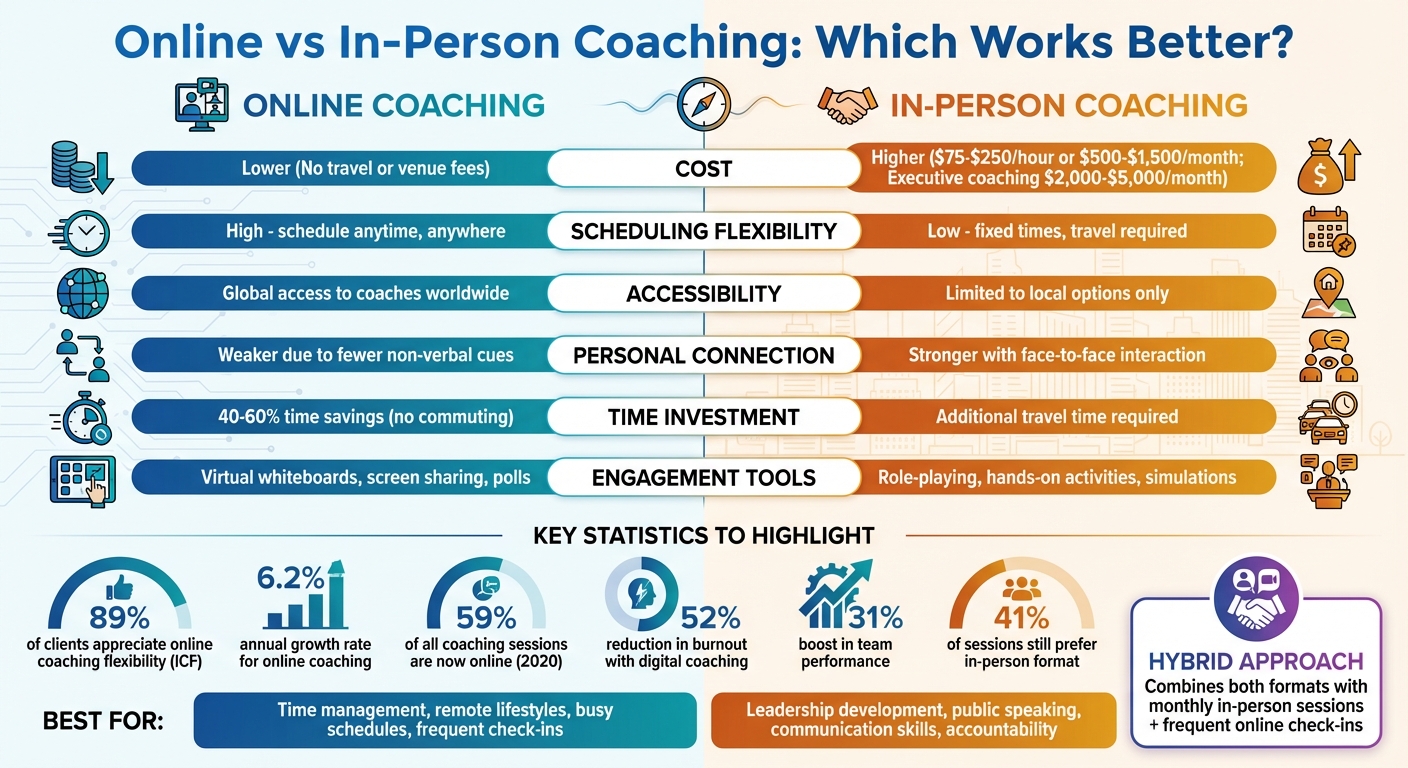
Online vs In-Person Coaching: Complete Comparison Guide
Online Coaching: Benefits, Limitations, and Best Fit
Benefits of Online Coaching
Online coaching has transformed the way people access professional guidance, offering convenience and flexibility that traditional formats can’t always match. One of its standout advantages is the elimination of commuting and venue costs. You can connect with a coach from virtually anywhere as long as you have a stable internet connection. This opens up opportunities to work with experts worldwide, giving you access to specialized knowledge that might not be available locally. In fact, the International Coaching Federation found that 89% of coaching clients appreciate the flexibility that virtual coaching provides.
Another major perk is the ability to schedule sessions outside of typical business hours. Whether you're juggling time zones, dealing with a packed calendar, or needing an urgent check-in, online coaching adapts to your needs. Plus, attending sessions from the comfort of your own home or another familiar space can create a more relaxed environment, making it easier to open up and engage fully.
Limitations of Online Coaching
However, online coaching isn’t without its challenges. One of the biggest hurdles is the difficulty in picking up on subtle nonverbal cues, like body language or facial expressions. These nuances often play a key role in effective communication and may be harder to interpret over a screen, potentially leading to misunderstandings.
Distractions can also be an issue. Home interruptions, screen fatigue, or even technical problems like a weak internet connection or software glitches can disrupt the flow of a session. These interruptions might make it harder to maintain focus and continuity during discussions.
Who Benefits Most from Online Coaching
Given its strengths and drawbacks, online coaching is particularly well-suited for people whose lifestyles align with a digital-first approach. It works especially well for:
- Individuals with unpredictable schedules who need flexible session times.
- Remote employees or those living in areas with limited local coaching options.
- People who benefit from frequent, short check-ins.
- Anyone who feels more comfortable engaging from a familiar environment, like their home.
The impact of online coaching is clear. Research shows that employees who received personalized digital coaching reported a 52% reduction in burnout. Meanwhile, companies implementing such programs saw a 31% boost in team performance. These results demonstrate how online coaching can effectively build skills like time management, leadership, communication, and work–life balance, making it a valuable tool for personal and professional growth.
In-Person Coaching: Benefits, Limitations, and Best Fit
Benefits of In-Person Coaching
In-person coaching offers the unique advantage of real-time observation. Coaches can pick up on nonverbal cues like posture, facial expressions, and body language, allowing them to provide immediate and precise feedback.
Face-to-face sessions also help build trust and accountability more effectively. According to a 2020 study by the German Coaching Association, 41% of coaching sessions took place in person, highlighting the preference for this format.
Another key benefit is the focused environment. A dedicated, distraction-free coaching space encourages growth in areas like leadership, resilience, and self-awareness.
While these strengths make in-person coaching highly effective, it does come with some challenges.
Limitations of In-Person Coaching
The convenience of in-person coaching often comes at a cost - both in time and money.
Hourly coaching fees typically range from $75 to $250, or $500 to $1,500 per month. For long-term executive coaching, costs can climb to $2,000–$5,000 per month. On top of that, you’ll need to factor in travel expenses, parking, and commuting time.
Scheduling can also be a hurdle. Aligning your availability with your coach’s can be tricky, especially if your schedule is packed or unpredictable. Rescheduling a face-to-face session is often more complicated than rearranging a virtual one.
Geography can further limit your options. If you live in a rural area or a smaller city, finding a coach with the right expertise nearby might be challenging. Your choices are often confined to professionals within a reasonable distance.
Who Benefits Most from In-Person Coaching
In-person coaching is ideal for people whose goals require direct, hands-on interaction and immediate feedback.
This format works particularly well for developing skills like public speaking, presentation techniques, or leadership presence. A coach observing you in real time can fine-tune your body language and delivery on the spot, making sessions highly impactful.
Additionally, those who thrive on accountability may find in-person coaching especially motivating. The act of showing up at a dedicated location often fosters a stronger sense of commitment compared to logging into a virtual session.
Side-by-Side Comparison: Online vs In-Person Coaching
Comparison Table: Key Factors
Here’s how online and in-person coaching stack up across several important factors:
| Factor | Online Coaching | In-Person Coaching |
|---|---|---|
| Cost | Typically more affordable since it eliminates travel and venue expenses. | Generally more expensive due to added costs like travel and venue fees. |
| Scheduling Flexibility | Highly flexible - sessions can be arranged at almost any time. | Requires fixed locations and scheduled times, offering less flexibility. |
| Accessibility | Provides access to coaches worldwide, regardless of location. | Limited to local coaches, which can be a challenge in remote areas. |
| Personal Connection | Building rapport may require more effort due to fewer non-verbal cues. | Face-to-face interaction often leads to stronger personal connections. |
| Engagement Tools | Relies on digital tools like virtual whiteboards, screen sharing, and polls. | Focuses on hands-on activities, role-playing, and simulations. |
| Time Investment | Saves commuting time, potentially reducing time spent on sessions by 40–60%. | Involves travel, which adds time and may lead to external disruptions. |
In 2020, online coaching sessions made up 59% of all coaching interactions, with the sector expected to grow at an annual rate of 6.2%.
Hybrid Approaches: Combining Online and In-Person Coaching
A hybrid model blends the strengths of both online and in-person coaching, offering a balanced approach. For instance, some hybrid setups include monthly in-person sessions to focus on skill-building, paired with frequent online check-ins to maintain accountability.
"The future lies in a hybrid approach, where online coaching complements traditional methods. Combining the strengths of both can create a more comprehensive and effective coaching strategy." – LeggUP
This approach allows for both the convenience of online sessions and the personalized feedback of face-to-face interactions. To decide on the best fit, consider your specific goals and preferences.
sbb-itb-3c06305
How to Choose the Best Coaching Format for Your Needs
Evaluating Your Goals and Preferences
Start by identifying what you want to achieve. If your goals lean toward developing cognitive or skill-based abilities - like mastering time management or boosting self-motivation - online coaching could be a great fit. Research suggests that non-face-to-face coaching delivers the strongest results for cognitive goals, with an impressive effect size of 1.494, followed by psychological goals at 0.943. Digital coaching is particularly effective for targeted skills and behavior changes.
On the other hand, if you're looking to enhance soft skills such as communication or leadership, in-person coaching might be a better match. Think about what aligns best with your goals, and then factor in your personal preferences.
Practical Considerations: Budget, Schedule, and Technology
Practical details like budget, schedule, and tech know-how are just as important as your goals. Online coaching tends to be more cost-effective since it eliminates travel expenses and venue fees, often resulting in lower session costs. Plus, if your calendar is packed or you live far from major coaching hubs, online sessions offer unmatched flexibility, with many coaches providing options outside the typical 9-to-5 window.
However, a reliable internet connection and comfort with video conferencing tools are essential for online coaching to work smoothly. In contrast, in-person coaching avoids these tech requirements but demands geographic proximity and a more rigid schedule.
How Coachtrusted Simplifies Your Decision
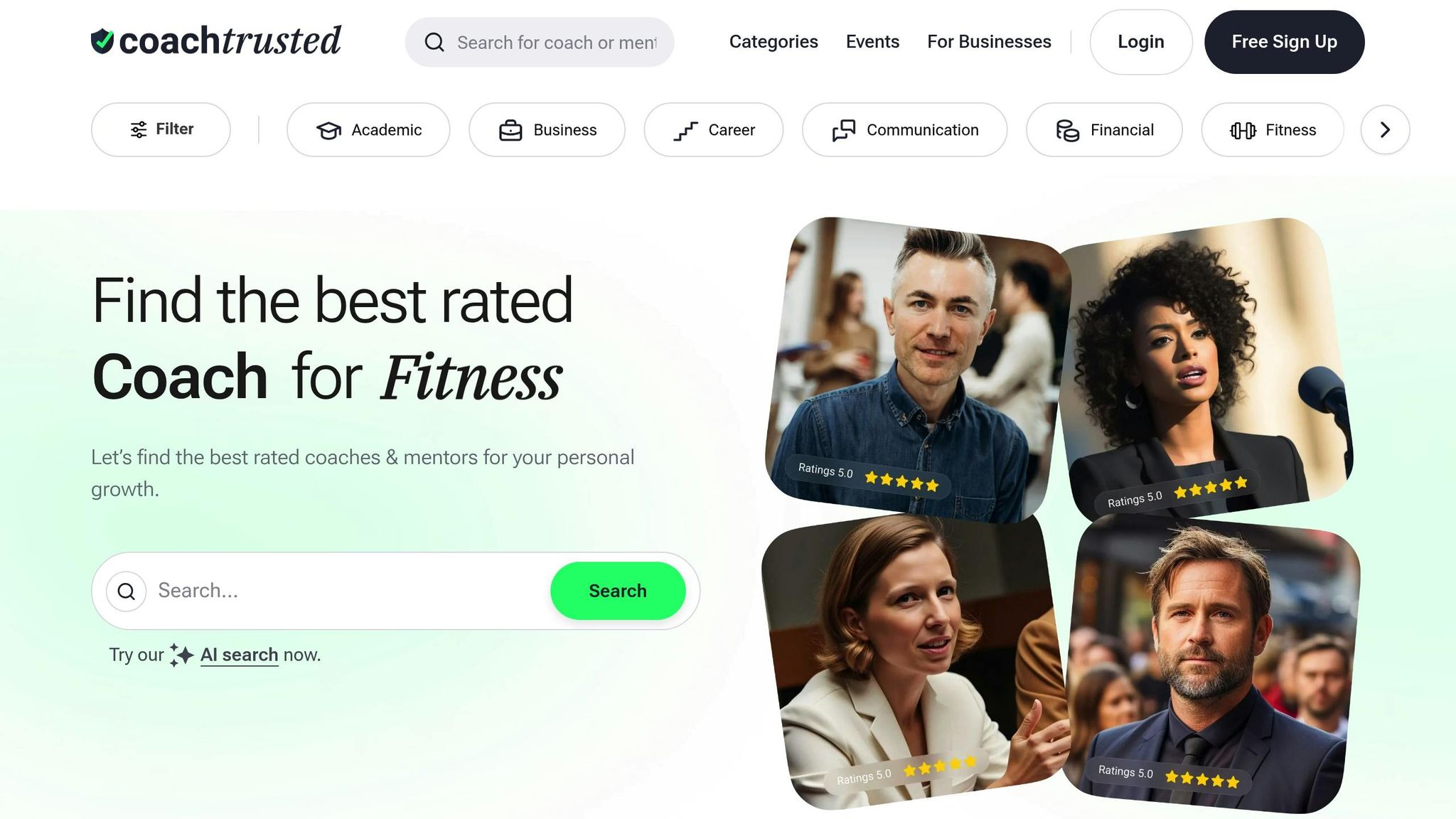
Once you've considered your goals and practical needs, Coachtrusted makes the decision process easier. The platform offers smart search tools and quiz-based recommendations to help you narrow down coaches by format, specialty, and style. Each verified profile clearly states whether the coach offers online, in-person, or hybrid sessions.
What sets Coachtrusted apart is its verified review system, which includes feedback specific to each coaching format. This transparency helps you move beyond marketing language to see what real clients have experienced. Whether you value the convenience of virtual sessions or the personal touch of face-to-face meetings, Coachtrusted's tools can guide you to the right choice for your unique situation.
Ep. 136- Online vs. In-Person Coaching: Pros and Cons
Conclusion
There’s no universal solution when it comes to coaching formats - it all boils down to your goals, schedule, budget, and personal preferences. Studies confirm that both online and in-person coaching can lead to measurable progress.
The coaching world has shifted significantly, with virtual sessions now dominating most interactions. This trend highlights not just growing acceptance but also the effectiveness of online coaching.
Ultimately, the best format for you is the one that aligns with your personal development goals. If you’re aiming to sharpen specific skills like time management, online coaching might be a convenient and effective option. On the other hand, if you’re focusing on soft skills like leadership or communication, in-person sessions may offer the deeper, face-to-face connection you need.
For those seeking flexibility, many coaches now offer hybrid models that combine virtual check-ins with occasional in-person sessions. This approach can give you the best of both worlds, tailoring the experience to your needs.
Platforms like Coachtrusted make the selection process easier by providing verified profiles and real client reviews. Whether you value flexibility or prefer a more personal connection, their smart search tools can help you find a coach who delivers results in the format that suits you best.
FAQs
What are the main advantages of online coaching compared to in-person coaching?
Online coaching gives you more flexibility by letting you schedule sessions at times that work for your busy life - even outside the usual 9-to-5 hours. Plus, it saves you the hassle of commuting, making it a practical choice if you're juggling a packed calendar.
Another big plus? Access to a wider range of coaches. You're no longer limited to local professionals - you can connect with top-notch experts from anywhere in the world. On top of that, online coaching is often easier on your wallet, offering an affordable way to reach your personal or professional goals without compromising quality.
How do I know if hybrid coaching is the best fit for me?
To figure out if hybrid coaching suits you, take a close look at your priorities and daily routine. Do you appreciate in-person interactions for building trust and getting real-time feedback, but also need the convenience of online sessions? If so, hybrid coaching might be the perfect blend.
Think about your learning preferences, personal goals, and availability. For example, hybrid coaching is ideal if you like meeting face-to-face occasionally but want the flexibility of virtual sessions when you're busy or on the go. It’s a tailored approach that adapts to your unique needs and lifestyle.
How do I choose the right coach on Coachtrusted?
When choosing a coach, consider your learning preferences, objectives, and availability. If flexibility and convenience are high on your list - or if you're looking for a more cost-effective option - online coaching might be the way to go. On the flip side, if you thrive on in-person interactions, enjoy building stronger personal connections, and value immediate feedback, face-to-face coaching could be a better fit.
Think about which approach aligns best with your lifestyle and what keeps you motivated. Whether your focus is on accessibility or building a deeper connection, the right format is the one that helps you achieve your goals most effectively.