Career Development
Empathy vs. Professionalism: Finding the Right Balance
March 14, 2026
13 min read

Empathy vs. Professionalism: Finding the Right Balance
In coaching, balancing empathy and professionalism is essential. Empathy helps build trust and emotional safety, allowing clients to open up and feel understood. Professionalism, on the other hand, ensures clear boundaries, ethical standards, and accountability, creating a structured environment for progress.
Too much empathy can lead to over-involvement or dependency, while excessive professionalism risks making the relationship feel cold or impersonal. The key is integrating both - listening deeply and validating emotions while maintaining structure and objectivity. This balance supports client growth and protects the coach from burnout.
Key Takeaways:
- Empathy builds trust and connection but requires boundaries to avoid emotional overreach.
- Professionalism provides structure and ethics but must include warmth to avoid disconnection.
- Tools like active listening, clear agreements, and regular self-reflection help maintain this balance.
Empathy and professionalism together create a coaching dynamic that is supportive, ethical, and effective.
How can leaders balance empathy with maintaining professional boundaries? | Daniel Murray
sbb-itb-3c06305
What Is Empathy in Coaching
Empathy in coaching isn’t just about understanding feelings - it’s about connecting with a client’s emotions without passing judgment. It’s often described as "presence without rescue," meaning the coach can witness a client’s discomfort without stepping in to fix it.
Empathy in this context operates on three levels: cognitive (understanding a client’s unique perspective), emotional (relating through shared human experience), and compassionate (offering care while respecting the client’s independence). This balance is key to maintaining the client’s autonomy while offering meaningful support.
"Empathy is presence, not performance. It's not in the words you say or the solutions you offer. It's in your willingness to witness pain without being consumed by it."
- Yamini Kandpal, Content Specialist, Coacharya
This approach is vital because empathy allows coaches to uncover deeper issues that might not be immediately apparent. It also helps them resist the urge to jump in with quick fixes - often called the "righting reflex." This restraint not only builds trust but also lays the groundwork for stronger client relationships, which will be discussed in the next section.
How Empathy Builds Client Relationships
Empathy is the cornerstone of trust and connection in coaching. When clients feel truly understood, they’re more likely to open up and share their experiences. This openness creates a safe space where they can explore their goals without fear of being judged.
By acknowledging struggles and validating emotions, empathy encourages clients to take ownership of their goals. Challenges become opportunities for growth rather than insurmountable barriers. A key part of empathetic coaching is paying attention to non-verbal cues - changes in tone, energy, or facial expressions - and expanding emotional vocabulary. Moving beyond broad terms like "happy" or "sad" to more specific descriptors like "overwhelmed", "hopeful", or "disconnected" helps clients articulate their feelings more clearly, all while maintaining professional boundaries.
Empathy vs. Sympathy: Understanding the Difference
Empathy and sympathy often get mixed up, but they’re fundamentally different. Sympathy involves feeling pity for someone from a distance, while empathy is about stepping into their perspective and "feeling with" them.
"If someone's down in a pothole and crying, and you jump in with them and cry too - that's sympathy. But if you stay at the top, hold space, and help them find a way out - that's empathy."
- Richa Chadha, Faculty Member, Coacharya
This distinction matters because sympathy can lead to over-identification with a client’s struggles, which may result in emotional burnout for the coach. It can also unintentionally frame the client as a victim, undermining their sense of agency. Empathy, on the other hand, validates the client’s experience while keeping the coach grounded and objective, enabling them to guide the client toward growth.
A review of 30 coaching practices revealed that 50% expressed positive views on empathy (without addressing sympathy), while 23% were explicitly critical of sympathy but valued empathy. This highlights the importance of maintaining an observational stance - offering support without stepping into a rescue role. This balance ensures that coaches remain professional and effective, helping clients navigate challenges while staying focused on their goals. The next section will delve into how professionalism shapes these interactions.
What Is Professionalism in Coaching
After diving into empathy, let’s now explore how professionalism serves as the backbone of the coaching process, offering structure and safety.
Professionalism in coaching is more than just credentials - it’s about aligning ethical values with visible actions. It’s the glue that ensures accountability and upholds the integrity of the coaching relationship. While empathy fosters connection, professionalism provides the framework that keeps that connection effective and secure.
"Ethics are not merely rules; they are promises coaches make about how they will act, communicate, and support clients." - Laurie Dupar, iACTcenter
This shift from treating ethics as a checklist to embracing ongoing ethical reflection has become a cornerstone of modern coaching, especially with updates to the ICF framework expected in late 2025.
Professional coaching thrives on structure, clear boundaries, and accountability. Coaches operate within proven methodologies, use written contracts, avoid dual relationships, and adhere to guidelines from organizations like the ICF. On the other hand, informal coaching often lacks these safeguards, relying on personal opinions, verbal agreements, and blurred boundaries between friendship and professional guidance. Ethical standards are a priority for most coaches, and clients consistently rank trustworthiness and ethical conduct among the top factors when choosing a coach - often above experience or qualifications.
Core Elements of Professionalism
Professionalism in coaching is built on key pillars that protect both the coach and the client, ensuring the relationship remains ethical and effective.
Confidentiality is the foundation of trust. By safeguarding client information - except in cases where disclosure is legally required - coaches create a safe space where clients feel secure enough to engage in meaningful self-exploration.
Boundaries define the structure of the coaching relationship.
"Boundaries aren't walls - they're pathways to authentic connection." - Dr. D. Ivan Young
These boundaries typically cover five areas: time (session lengths and rescheduling policies), money (clear pricing and refund terms), communication (defined channels and response times), scope (differentiating coaching from therapy), and energy (managing personal capacity). Setting these limits helps clients develop independence rather than relying too heavily on their coach.
Competence and scope require coaches to stay within their areas of expertise. When a client’s needs go beyond coaching - such as addressing mental health trauma - professional coaches rely on referral networks to connect clients with the right support. Many professional credentials demand between 100 and 500 hours of verified coaching experience.
Accountability is shown through clear agreements, session preparation, and tracking progress. These practices help eliminate misunderstandings about fees, schedules, or outcomes. Coaches who participate in regular supervision and ongoing education report 43% fewer ethical dilemmas in their work. Yet, with fewer than 24% of coaches earning a full-time income from coaching, a strong professional foundation is essential for sustainable practice.
Maintaining Ethical and Objective Coaching Practices
Balancing empathy with objectivity allows coaches to support their clients without letting personal biases cloud the relationship. This involves managing power dynamics and avoiding dual relationships that could compromise impartiality. Dr. Elena Stavrianos from the European Centre for Coaching Excellence notes that the quality of a coaching relationship hinges on the clarity of its boundaries.
Ethical practice also requires continuous reflection and self-awareness. As the coaching industry evolves, there’s a growing focus on equity and inclusivity. Coaches are encouraged to challenge their assumptions, seek diverse perspectives, and stay updated on ethical guidelines. Coaches with documented ethical frameworks not only build trust but also see tangible benefits, like 28% more repeat clients and 35% more referrals.
Many professional coaches also carry liability insurance to protect both themselves and their clients - a clear marker of a well-established practice. They often engage in peer supervision or mentoring to identify blind spots and refine their ethical decision-making.
"Clear agreements prevent ethical grey areas. They provide a reference point when challenges arise and protect both parties." - Maria Konstantinidou, Coaching Supervisor
Empathy vs. Professionalism: Direct Comparison
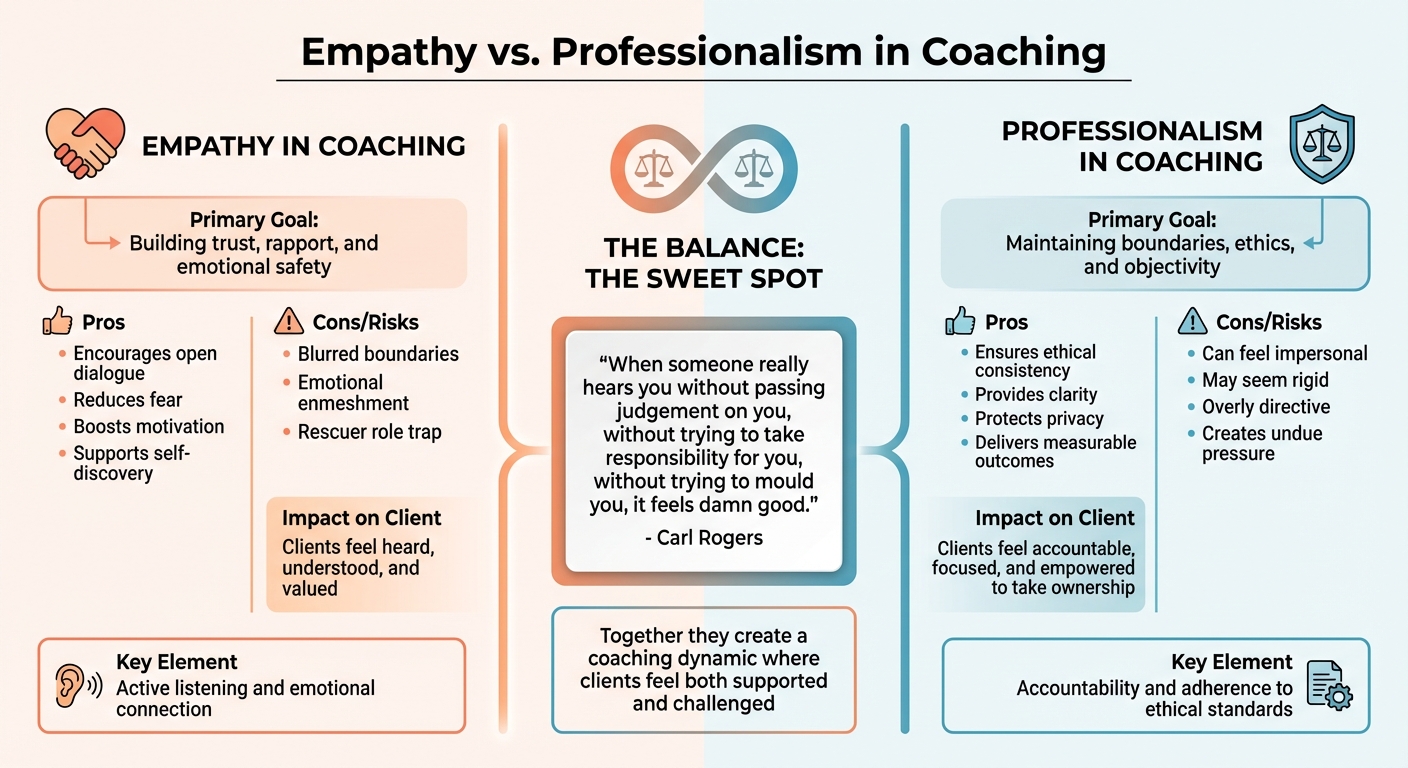
Empathy vs Professionalism in Coaching: Key Differences and Balance
After examining empathy and professionalism individually, it's time to see how these two approaches compare. Each brings unique strengths to coaching, but they also come with potential pitfalls if not balanced thoughtfully.
Empathy creates the emotional foundation clients need to feel safe and open up. When a coach listens without judgment, clients often feel truly heard and understood. This reduces fear of failure and fosters honest, meaningful conversations. However, too much empathy without boundaries can blur the coach-client relationship, leading to emotional over-involvement or a "rescuer" mentality that can undermine the client's ability to grow independently.
Professionalism, on the other hand, provides the structure and ethical grounding necessary for effective coaching. It ensures objectivity, confidentiality, and client accountability. But if professionalism is applied without empathy, the relationship may feel distant or overly formal, leaving clients feeling disconnected or pressured.
"When someone really hears you without passing judgement on you, without trying to take responsibility for you, without trying to mould you, it feels damn good." - Carl Rogers, Psychologist
This quote perfectly captures the delicate balance needed in coaching. Empathy fosters trust and connection, while professionalism ensures structure and focus. Together, they create a coaching dynamic where clients feel both supported and challenged, striking the ideal balance for growth.
Comparison Table
| Feature | Empathy in Coaching | Professionalism in Coaching |
|---|---|---|
| Primary Goal | Building trust, rapport, and emotional safety. | Maintaining boundaries, ethics, and objectivity. |
| Pros | Encourages open dialogue, reduces fear, boosts motivation, and supports self-discovery. | Ensures ethical consistency, clarity, privacy, and measurable outcomes. |
| Cons/Risks | Risk of blurred boundaries, emotional enmeshment, or overstepping into a rescuer role. | Can feel impersonal, rigid, or overly directive, potentially creating undue pressure. |
| Impact on Client | Clients feel heard, understood, and valued. | Clients feel accountable, focused, and empowered to take ownership. |
| Key Element | Active listening and emotional connection. | Accountability and adherence to ethical standards. |
Risks of Imbalance: Too Much Empathy vs. Too Much Professionalism
Striking the right balance in coaching is essential, but it’s easy to lean too far in one direction. When a coach leans heavily into empathy, the relationship can shift from supportive to overwhelming. Instead of reflecting and guiding, the coach might become a "sponge", absorbing the client’s stress. This can lead to dependency, where the client leans on the coach as an emotional crutch rather than building their own problem-solving abilities. Julia Stewart, founder of the School of Coaching Mastery, explains it perfectly:
"If the coach creates dependency in the client, that's good for the coach's ego but not for the client. Because no one reaches their full potential if they need someone else as a crutch."
Another trap is the "fixer" mentality. Coaches who feel too deeply for their clients may rush to provide solutions. While well-intentioned, this approach stunts the client’s ability to develop their own problem-solving skills. Additionally, over-attachment to outcomes can create noticeable pressure, which might trigger resistance from the client. This dynamic not only hinders the client’s growth but can also lead to burnout for the coach.
On the other hand, leaning too far into professionalism introduces its own risks. Excessive professionalism can turn coaching into a cold, transactional process. Without a genuine connection, clients may feel unheard or undervalued, making them less likely to open up or engage in the deeper work needed for meaningful change.
"Without empathy in the world, all our relationships would be transactional."
An overly detached approach may also create a sense of control rather than collaboration. Relying solely on cognitive empathy - understanding a client’s feelings without emotional connection - can come across as manipulative or overly directive. When rigid structures replace authentic connection, clients may feel judged or pressured, fostering perfectionism and a fear of failure. This, in turn, stifles their growth.
A good rule of thumb is to assess your emotional investment. If you rate it above 7 out of 10, you might be leaning too far into empathy. On the flip side, if sessions feel overly metrics-driven or detached, you may be veering toward excessive professionalism. Both extremes can undermine the transformative power of coaching. The key lies in maintaining a balanced approach that supports and empowers clients without tipping too far in either direction.
How to Balance Empathy and Professionalism
Striking the right balance between empathy and professionalism is less about choosing one over the other and more about weaving them together into a consistent coaching approach. The best coaches develop habits and frameworks that allow them to connect deeply with their clients while maintaining the structure and objectivity needed to drive meaningful progress.
Active Listening with Clear Boundaries
Active listening is a powerful way to combine empathy and professionalism. It involves not only hearing the words a client says but also tuning into their tone, body language, and underlying emotions - all while staying focused on their goals.
One helpful technique is the "Empathy Sandwich": start by acknowledging the client’s feelings, follow up with a gentle challenge or suggestion, and close by affirming their strengths. For example, instead of diving straight into solutions, you could say, "I can sense how frustrated you’re feeling right now. What do you think is within your control to change in this situation? I know you have the strength to work through this."
Strategic silence is another key tool. When emotions run high, resist the urge to immediately offer solutions. A thoughtful pause gives clients space to process their thoughts and emotions, ensuring they feel heard without turning you into a problem-solver. Early in the coaching relationship, consider setting clear expectations with what professional coach Ella Mitkin calls a "clarity agreement":
"You own the insight. I own the structure. Let's make space for both."
This approach lays a foundation for fostering both connection and accountability, empowering clients while maintaining professional boundaries.
Client Empowerment and Accountability
Empathy without accountability can lead to dependency, while professionalism without connection risks creating emotional distance. The ideal balance empowers clients to take ownership of their growth while providing the structure they need to succeed. Reflective inquiry is a great way to achieve this balance, encouraging clients to explore their own solutions while holding them accountable.
Encouraging clients to expand their emotional vocabulary can also make a big difference. Instead of settling for broad terms like "happy" or "sad", guide them to articulate more specific feelings, such as "relieved", "disappointed", or "content". This level of precision fosters clarity and ensures conversations are grounded in reality rather than assumptions.
Having a consistent session structure can also help. It creates a safe space for open dialogue while naturally setting boundaries that support both connection and progress.
Self-Reflection and Continued Learning
Sustaining the balance between empathy and professionalism requires regular self-reflection. Much of the important work happens between sessions. Taking time to reflect on your emotional state after intense sessions helps you separate your feelings from those of your client, preventing burnout.
It’s also worth periodically evaluating your emotional attachment to your clients' outcomes. If you find your emotional investment exceeding a "7" on a scale of 1 to 10, it may be time to reassess your boundaries. As Mitkin cautions:
"When your value becomes tied to other people's breakthroughs, you stop seeing yourself clearly."
Engaging in peer supervision or mentorship can offer valuable perspective. More than 90% of coaches agree that maintaining ethical standards is critical for success, highlighting the importance of ongoing professional development. Whether through ethics training, formal supervision, or debriefing with trusted colleagues, these practices help you stay grounded as a reflective guide rather than an emotional sponge.
Finally, don’t underestimate the value of physical grounding. After particularly draining sessions, brief activities like stepping outside or taking a short walk can help you reset. These rituals serve as a reminder that your role is to guide - not to absorb - your client’s challenges.
Conclusion
The best coaching strikes a balance between empathy and professionalism. Empathy fosters trust, encouraging clients to open up and engage deeply, while professionalism provides the structure and accountability needed to turn those conversations into meaningful action. Together, these elements create an environment where clients feel both supported and constructively challenged.
On this foundation, ethical commitment goes beyond simply following rules. It’s about maintaining a practice that serves clients effectively while safeguarding your own well-being. This balance benefits everyone: clients gain the independence to take ownership of their growth, and coaches avoid the emotional exhaustion that can come from taking on responsibilities that aren’t theirs to carry.
Carl Rogers captures this dynamic beautifully:
"When someone really hears you without passing judgement on you, without trying to take responsibility for you, without trying to mould you, it feels damn good".
This quote highlights the power of being fully present without overstepping boundaries.
Sustaining this approach requires ongoing self-awareness, clear boundaries, and a commitment to growth. Whether it’s using clarity agreements, evaluating your emotional involvement, or embracing reflective silence, these tools ensure your coaching remains impactful. They also help you avoid the pitfalls of imbalance - steering clear of dependency caused by excessive empathy or the disconnection that can come from overly rigid professionalism.
FAQs
How can I tell if my coach is too empathetic?
Coaches can sometimes lean too heavily on empathy, which might affect their ability to maintain boundaries or even lead to emotional exhaustion. This overextension can cloud their objectivity, slow progress toward a client’s goals, or even result in burnout. By identifying these red flags, coaches can strike a balance between being empathetic and staying professional, ensuring they provide effective support while protecting their own well-being.
What boundaries should a professional coach set?
Establishing clear boundaries is essential for any professional coach. These boundaries not only safeguard the client’s progress but also protect the coach’s mental and emotional well-being. Key aspects include defining specific working hours, managing emotional involvement, and staying within the agreed scope of practice.
Practical steps like setting limits on availability and clearly outlining session goals help create a structured, supportive environment. This approach ensures the coaching relationship remains productive and focused while helping to prevent burnout for the coach.
When should coaching shift to therapy or referral?
Coaching has its boundaries, and it's essential to recognize when a client’s needs surpass its scope. If a client begins to show signs of emotional distress, mental health challenges like depression or anxiety, or unresolved trauma, it’s time to consider therapy or a referral. These issues often demand the expertise of a licensed therapist who is trained to provide specialized care. Referring clients in such situations not only upholds ethical standards but also ensures they receive the support necessary to address their specific needs effectively.