Career Development
Red Flags When Choosing a Life Coach
December 29, 2025
20 min read

Red Flags When Choosing a Life Coach
Choosing a life coach can be risky if you're not careful. The industry is unregulated, meaning anyone can call themselves a coach, regardless of training or qualifications. Here’s a quick guide to avoid common pitfalls:
- Bold Promises: Coaches claiming quick fixes or guaranteed results are a red flag. Real progress takes effort and time.
- No Credentials: Verify certifications like those from the International Coaching Federation (ICF) to ensure proper training.
- High-Pressure Sales: Beware of urgency tactics like "limited-time offers" or pressure to pay upfront.
- No Written Agreement: Always insist on a contract outlining fees, services, and confidentiality.
- Boundary Issues: Coaches should maintain professionalism and avoid crossing personal or financial boundaries.
- Medical Claims: Coaches are not licensed to treat mental health or medical conditions. Seek a therapist for these needs.
To protect yourself, research credentials, ask questions, and avoid rushed decisions. A trustworthy coach will focus on your growth and provide clear, ethical guidance.
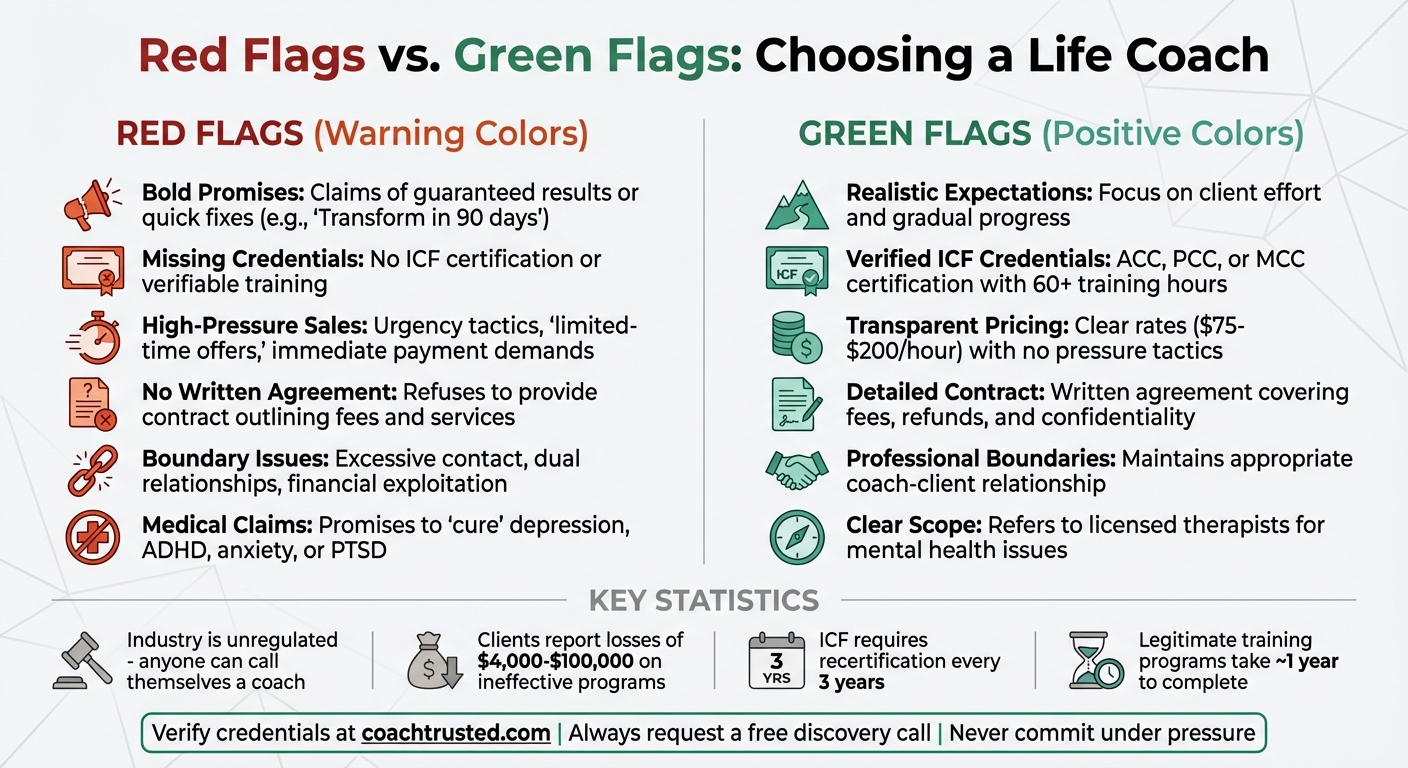
Red Flags vs Green Flags When Choosing a Life Coach
Coaching Myths Busted! Red Flags To Look Out For & If You REALLY Need A Coach!
sbb-itb-3c06305
Guarantees of Quick Results
In an industry with little regulation, exaggerated promises have become a glaring red flag. Be wary of coaches who claim they can deliver life-changing results in just 90 days or promise instant wealth. These bold claims often signal trouble. Leadership coach Denise G. Lee explains it best:
I've seen the hype merchants who promise 'transform in 90 days' if you max your credit card and chant enough affirmations.
Professional coaching standards, like those set by the International Coach Federation, emphasize that coaches cannot guarantee specific results. Achieving goals depends largely on the client’s own efforts and dedication.
What These Promises Look Like
These exaggerated promises can take many forms. Some coaches insist they can save your marriage overnight or guarantee business success after just a few sessions. Others flaunt luxury cars, designer outfits, or exotic vacations as "proof" that their methods work, promising you the same lifestyle if you invest in their $20,000 program.
Another tactic to watch for is the use of "scarcity and urgency" - pressuring you to make a decision immediately by claiming their offer expires tonight. These artificial deadlines are designed to push vulnerable individuals into making impulsive, and often costly, decisions.
Be especially cautious of coaches who promise "effortless success" or happiness without effort. Certified life coach Bijan Kholghi warns:
If a life coach is promising to tell you what to do with your life, or a life of happiness without you having to put in the work, they may well be a scam artist.
These deceptive strategies often lead to deeper issues, as discussed below.
How False Promises Harm Clients
Unrealistic claims don’t just mislead - they can have serious financial and emotional consequences.
The fallout from these false promises goes beyond losing money. When the promised results fail to materialize, clients often feel embarrassed, duped, or even ashamed. These feelings can damage self-esteem and discourage people from seeking legitimate help in the future.
Take the experience of Angela Lauria, for example. She found herself caught in a cycle of escalating expenses with little to show for it. These situations can create a harmful dependency, where clients keep paying for the next program, the next level, or the next "breakthrough", all while their personal and professional lives remain stagnant. Even more troubling, some coaches claim they can "cure" medical conditions like depression, ADHD, or PTSD, potentially delaying clients from seeking the clinical treatment they truly need.
Dr. Sean O'Connor, Director of the Coaching Psychology Unit at the University of Sydney, highlights the issue with these guarantees:
Credible life coaches aren't people who promise to completely transform your life with six sessions before they even know what your circumstances are.
Missing Credentials or Training
The life coaching industry operates without any formal regulation - there's no medical board or government agency to address complaints about poor service or unethical practices. This lack of oversight means anyone can claim the title of "life coach" without any training or expertise. As relationship coach Nancy Koenig explains:
"Because coaching has become so mainstream, it doesn't occur to people that you don't need training or experience to start a business."
This reality highlights the importance of verifying a coach's credentials. Credentials act as a vital measure of a coach's ability to deliver results. Without proper qualifications, many coaches rely on personal anecdotes instead of proven, science-backed methods, leaving them ill-equipped to guide clients toward meaningful, lasting change. Some even obtain certificates from questionable programs that offer credentials based on life experience or short, overpriced courses that lack depth.
Considering the high fees life coaches often charge - ranging from $75 to $200 per hour, with executive coaching packages sometimes exceeding $14,000 annually - you deserve to work with someone who has professional training.
What Qualifications to Check
The International Coaching Federation (ICF) is the gold standard for accrediting coaching professionals. Coaches with ICF credentials, such as Associate Certified Coach (ACC), Professional Certified Coach (PCC), or Master Certified Coach (MCC), have undergone extensive training, including at least 60 hours of supervised coaching practice and rigorous exams.
When evaluating potential coaches, look for those trained in science-based disciplines like neuroscience, behavioral psychology, or emotional intelligence - not just motivational catchphrases. Oregon State University PACE offers this advice: "If it's not ICF-accredited, think twice".
You can confirm a coach's credentials through several reliable sources. For university-affiliated programs, check the U.S. Department of Education Database of Accredited Postsecondary Institutions or the Council for Higher Education Accreditation (CHEA). Many reputable coaches display digital ICF certificates on their websites. You can also verify their business standing through organizations like the Better Business Bureau (BBB), your local Chamber of Commerce, or your state's Attorney General's office.
Be cautious of certifications that can be earned in just a weekend. Mary Allen, a life coach, warns:
"Unfortunately, some certifications can be earned in a weekend."
Legitimate training programs typically take about a year to complete. Without these verifiable credentials, coaches are more likely to fall into the pitfalls outlined below.
Problems with Untrained Coaches
Untrained coaches often rely on prescriptive advice drawn from their personal experiences rather than helping clients discover their own solutions. Executive coach Jennifer Rickmers points out the flaw in this approach:
"If a coach provides prescriptive advice, this ignores any nuance of context and fails to acknowledge your expertise in your own life."
Coaches without formal training may lack essential skills such as active listening, goal-setting, and ethical decision-making. Instead of facilitating meaningful conversations, they tend to dominate discussions, leaning heavily on their own success stories. This approach contradicts the coaching standard where clients should be speaking 70% of the time. Effective coaching is about asking thoughtful questions to help clients uncover insights, not dictating a one-size-fits-all solution.
The risks extend beyond wasted money and time. Untrained coaches often struggle to strike the right balance between comfort and challenge, leaving clients either stagnant in their comfort zones or overwhelmed. They may also fail to adhere to professional ethical standards, leading to issues like boundary violations, excessive after-hours contact, or inappropriate personal relationships.
Hanneke Antonelli, an entrepreneur and author, captures the essence of proper coaching:
"There is an art form to coaching... that you only understand once you've gone through a coaching certification."
Up next, we’ll explore how formal agreements can add another layer of protection to your coaching experience.
Missing Written Agreement
A written contract is the foundation of any professional coaching relationship. It sets clear expectations, defines boundaries, and outlines deliverables for both parties involved. Without one, you're left relying solely on trust in an industry that operates with little regulation.
The absence of a written agreement only adds to the risks already posed by unverified credentials and empty promises. It reflects a lack of professionalism and weakens accountability. As Dawn C. Reid, Ph.D., explains in Psychology Today:
"Coaching is not a federal or even state regulated field... As such, anyone can decide to call themselves a coach without proof of professional development or credentials... read the written agreement."
If a coach refuses to provide a written contract or pressures you to pay upfront, you're being asked to commit your money without any legal protection. This should raise a red flag, especially considering the high fees many coaches charge.
What Should Be in the Contract
A solid coaching contract serves as a safety net for both the coach and the client. It should clearly define the scope of services, goals, and boundaries of the engagement. This level of detail helps avoid "scope creep", where additional services are demanded or offered outside the original agreement.
Key elements of a coaching contract include:
- Fees, payment terms, and any potential extra charges
- Cancellation policies and termination rights
- Dispute resolution procedures
- Confidentiality provisions
A confidentiality clause is particularly important since coaches are not bound by HIPAA regulations. Without this, your personal experiences could end up being shared publicly, such as on social media. Additionally, the contract should have legal disclaimers clarifying that coaching does not replace medical, legal, or financial advice.
Sam Vander Wielen, an attorney and business coach, emphasizes the importance of having everything in writing:
"A well-structured coaching contract can be your guiding light when these issues arise."
Understanding these details helps protect you from financial and professional risks.
Problems Without a Contract
Operating without a written agreement leaves you exposed to numerous problems that can undermine your coaching experience and even put your finances at risk. In an unregulated industry, hidden fees and vague terms can easily arise without proper documentation. If a coach fails to deliver what they promised or changes their approach midway, you may have no legal recourse.
Chauncey Zalkin, writing for Inc.com, doesn't mince words:
"Coaches do not have degrees in psychology and are not licensed therapists yet they cost significantly more than those professionals... you should hold your coach to the same standard as any other business service."
Without a written contract, boundary violations also become harder to address. For instance, a coach might contact you at unreasonable hours, demand unlimited email access, or blur professional lines - leaving you with little evidence to resolve disputes. The lack of a termination clause could trap you in an ineffective or even toxic coaching relationship, forcing you to continue paying for services that don't meet your needs.
A 2016 class-action lawsuit in Texas, where clients sought $30 million in damages, highlights the potential legal risks of working without a formal agreement.
Brand identity coach Annamaria Nagy underscores the importance of documentation:
"If anything goes south in your coaching relationship, this will be your primary point of reference to settle disagreements and legal disputes."
Never hand over money based on a verbal agreement or a high-pressure sales pitch. If a coach insists on immediate payment or claims an offer will expire in 48 hours, they're likely trying to bypass your ability to review the terms carefully. A professional coach will always allow you time to go through a written contract before making a financial commitment.
Inappropriate Personal Boundaries
Crossing personal boundaries in the coaching world can seriously harm the integrity of the process. Maintaining a professional distance doesn’t mean being cold or detached - it means ensuring the focus stays on your growth, not the coach’s personal life or ego. When boundaries are crossed, the relationship can shift from being helpful to harmful. This kind of erosion often happens slowly, making it harder to notice until you're deeply involved. Below are examples of how such boundary issues can show up in real-life coaching relationships.
The lack of regulation in the life coaching industry can make these problems even more likely.
What Boundary Problems Look Like
Boundary violations can take many forms, but they all share a troubling pattern: the coach’s needs start to take precedence over yours. For instance, some coaches might shower you with excessive praise early on, only to turn to harsh criticism later. This tactic can destabilize your ability to trust your own judgment. Another red flag is when a coach blurs professional lines by inviting you into their social circle, offering you a job, or suggesting business partnerships. These dual relationships create conflicts of interest and can lead to exploitation. Dr. Lissa Rankin, founder of the Whole Health Medicine Institute, explains:
"Good therapists know that it's dicey boundary territory and can be harmful to the client if the therapist engages in relationships beyond the professional therapeutic container."
Excessive communication outside of sessions is another warning sign, especially if it feels intrusive. Some coaches may even use confusing jargon to sidestep your concerns.
The most extreme boundary violations involve controlling behavior. For example, in 2022, former therapist Jodi Hildebrandt, working as a life coach through ConneXions Classroom in Utah, instructed her client Ethan Prete to sever ties with friends and family completely. Prete paid over $1,000 per month for sessions where Hildebrandt dictated his personal life, even ordering him to live in a tent as a form of "humbling". Hildebrandt was later convicted of child abuse and sentenced to prison.
Financial exploitation often accompanies these boundary issues. Some coaches might pressure you to invest in their business, cover operational costs, or provide unpaid labor under the guise of supporting their "mission". If a coach becomes defensive or dismissive when you try to set boundaries or question their advice, it’s a serious red flag.
How This Affects the Coaching Process
When boundaries blur, the core purpose of coaching is compromised. The goal of coaching is to help you develop your own decision-making skills and inner wisdom. But when a coach fosters dependency, you risk losing your independence and becoming overly reliant on them.
Chauncey Zalkin of Inc.com offers this advice:
"If a coach makes you feel bad or doesn't respond to your concerns about your coaching experience with the accountability they are asking of you, walk away."
These blurred boundaries don’t just stunt personal growth - they can also lead to significant financial losses. Angela Lauria, for example, initially signed up for a $2,000 retreat while struggling with postnatal depression. Over time, due to manipulative tactics and boundary violations, she ended up spending nearly $100,000 on additional courses and mentorships.
A professional coach’s role is to act as an objective "truth mirror", helping you uncover your own insights without becoming your friend, boss, or decision-maker. When boundaries break down, the coach’s interests start to overshadow your growth. Recognizing these warning signs early on can help you protect yourself and avoid long-term harm.
Aggressive Sales Methods
High-pressure sales tactics are a red flag when considering a life coach. These pushy approaches often prioritize making a sale over addressing your actual needs, potentially leading to poor financial decisions. Let’s break down some common examples of these aggressive sales methods.
What Pressure Tactics Look Like
One common strategy is the use of fast-action discounts that expire almost immediately - sometimes during the very first call. For instance, in December 2021, life coach Karen Strang Allen offered an undercover CBC producer an $11,000 "empowerment" program, promising a $3,000 discount if they signed up before the call ended. To secure the deal, she also demanded a $500 deposit plus tax on the spot, creating a sense of urgency designed to push the client into a rushed decision.
Emotional manipulation is another tool in the arsenal. During a 2021 undercover investigation, Toronto-based coach Giovanni Maccarrone pressured a client to pay a $1,000 deposit for a package costing between $5,000 and $10,000. When the client hesitated, Maccarrone questioned their "readiness" for success and implied they might not be a "good fit" if they didn’t commit immediately.
Some tactics go even further. In April 2022, marketing strategist Chauncey Zalkin recounted an experience where a coach withdrew a $15,000 offer because her bank couldn’t process the full payment within a three-day window over a weekend. When the deadline passed, the coach disappeared entirely. In another instance, a coach refused to provide a price upfront, instead asking Zalkin to assign a value based on her "self-worth." The coach eventually suggested $20,000 as a "fair" price, despite offering no concrete deliverables.
Be wary of countdown clocks, claims like "spots are filling fast", or encouragement to max out credit cards. These are clear signs of pressure tactics. As journalist Jane Marie points out:
I think any time a business is specifically targeting a customer base that is desperate, a scam can be perpetrated.
These examples emphasize the importance of clear and transparent pricing.
Why Clear Pricing Matters
Transparent pricing is a cornerstone of professionalism. Most reputable life coaches charge between $75 and $200 per hour. For premium services, multi-month packages might range from $4,000 to $20,000. However, some high-ticket programs can cost anywhere from $20,000 to $100,000, offering as little as bi-weekly 30- to 45-minute sessions.
A trustworthy coach should provide straightforward pricing or offer a detailed quote without requiring you to "prove your worth." As Chauncey Zalkin puts it:
It's of my opinion that you should hold your coach to the same standard as any other business service and get a written road map of how they work and what they are delivering.
Vague or evasive pricing often signals a focus on profit over real value. Attorney SaraEllen Hutchison explains:
A high fee is in service of an affluent client, but is predatory if an indigent client is talked into incurring debt to pay for it.
Clear communication about costs fosters trust and helps you make informed decisions. If a coach dodges pricing questions, inflates perceived value with "bonus stacking", or pressures you for an immediate decision, it’s a sign to walk away. Angela Lauria offers this advice:
Don't buy from anyone who needs an answer now – scarcity and urgency is made up.
Chauncey Zalkin echoes this sentiment:
If you feel like you are being shamed into spending more than you have, you probably are being manipulated. You don't have to prove your value to anyone, least of all someone you are hiring.
Coaches Claiming to Treat Medical Conditions
Be cautious of coaches who claim they can diagnose or treat medical or mental health conditions. Life coaching is part of an unregulated industry, meaning anyone can label themselves a coach, regardless of their medical or psychological training. This lack of regulation becomes dangerous when coaches step into areas that should be handled by licensed medical professionals.
When Coaches Overstep Their Role
Avoid coaches who promise to "cure" clinical conditions like depression, ADHD, anxiety, or PTSD. These are serious issues that require diagnosis and treatment from licensed professionals. Many coaching clients may already be dealing with mental health challenges that demand qualified care.
Some coaches use clinical-sounding language to appear knowledgeable, but they often lack the supervised experience needed to address these issues safely. Emily Hemendinger, Assistant Professor of Psychiatry at the University of Colorado, emphasizes this point:
A credible life coach is not going to promise to completely change your life or cure you.
There have even been undercover investigations exposing coaches who advise clients to reduce psychiatric medications or claim that depression is merely a "mindset". Lorraine Bennington, a Registered Psychologist and Life Coach, highlights the dangers of such practices:
There is potential risk involved whenever someone treats mental illness without having the appropriate background.
This misuse of clinical language and unqualified advice reinforces the importance of seeking professional therapy for mental health concerns.
Why Coaching Isn't Therapy
Coaching and therapy are fundamentally different, and understanding these distinctions is critical. Therapists are highly trained, holding advanced degrees and completing extensive supervised experience. They are licensed to diagnose and treat mental health conditions - something coaches are neither trained nor legally allowed to do.
The focus of their work also differs. Therapy often explores past experiences to address present challenges, while coaching is more future-oriented, focusing on goals and accountability. Christine Purdon, Professor and Psychologist at the University of Waterloo, explains:
If it was just a matter of changing your mindset, no one would need help… you would have solved it by now.
Another key distinction is confidentiality. Therapy clients are protected by legal safeguards like HIPAA in the United States, but coaching clients typically do not enjoy the same privacy protections. A responsible coach should clearly define their boundaries and know when to refer clients to licensed therapists. Trauma specialist Britt Frank warns:
Anyone who says, "You don't need a licensed psychotherapist - I can heal your trauma", is not safe.
When meeting with a coach for the first time, ask them directly: "How do you determine when a client's issue is outside your expertise, and what is your process for referring them to a licensed therapist?". If they can't provide a clear answer, consider it a red flag. Understanding these boundaries is vital for evaluating a coach's credibility and protecting your mental health.
How to Find a Qualified Coach
Now that you're familiar with the warning signs, it's time to focus on how to find coaches who meet professional standards. Verified platforms make this process much easier.
Using Verification Platforms
Platforms like coachtrusted.com take the guesswork out of finding a qualified coach. They pre-screen professionals, verifying credentials from organizations such as the International Coach Federation (ICF). The ICF requires coaches to complete at least 60 hours of supervised training and mandates recertification every three years. This saves you the hassle of manually researching credentials through resources like the U.S. Department of Education or the Council for Higher Education Accreditation. These platforms help steer you toward trustworthy professionals by building on your knowledge of red flags.
Another advantage is that these platforms authenticate user reviews, so you can trust the feedback you see. Look for coaches who display verified ICF credentials on their profiles rather than just claiming to be "certified." Bijan Kholghi, a Certified Life Coach, highlights the importance of ICF accreditation:
Obtaining an ICF accreditation takes a long time and it isn't easy. But that's why you can be sure an ICF-accredited coach isn't a scammer.
In addition to credentials, many of these platforms require coaches to provide written agreements that outline fees, refund policies, and confidentiality protections. This transparency ensures you know exactly what to expect before committing.
Positive Signs to Look For
A good coach will typically offer a free discovery call to assess whether you're a good fit for each other before any payment is made. During this call, they should clearly explain their approach and take the time to understand your specific goals, rather than pressuring you into a quick decision.
Look for coaches with proven expertise in your area. They should be able to demonstrate results relevant to your industry and provide tangible deliverables. Chauncey Zalkin, a columnist with extensive experience writing about coaching, underscores the importance of this:
It's of my opinion that you should hold your coach to the same standard as any other business service and get a written road map of how they work and what they are delivering.
Transparency is another hallmark of a qualified coach. Professionals will openly discuss their rates and provide a clear breakdown of what's included in their packages.
To help you evaluate potential coaches, here's a quick comparison of warning signs versus positive indicators:
Comparison Table: Warning Signs vs. Positive Signs
| Warning Signs (Red Flags) | Positive Signs (Green Flags) |
|---|---|
| Missing or "self-issued" credentials | Verified ICF or third-party accreditation |
| Aggressive, high-pressure sales tactics | Transparent pricing and discovery calls |
| Claims to treat medical or mental health conditions | Clear boundaries between coaching and therapy |
| No formal written contract or agreement | Detailed contract covering fees and refunds |
| Unrealistic expectations | Realistic goals and focus on client progress |
| Focuses only on personal "story" or "lifestyle" | Evidence-based methods and client empowerment |
Lastly, don’t overlook the importance of continuing education. Reputable coaches stay current by updating their training regularly, rather than relying on a one-time certification. When speaking with potential coaches, ask when they last completed training and how they keep up with the latest coaching practices.
Conclusion
Choosing the right life coach can lead to meaningful progress, but the wrong choice can drain your wallet and waste your time. The stakes in the life coaching industry are undeniably high.
John M. Formella, Attorney General, has emphasized this concern:
Many coaches offer real value, but others exploit people's hopes and vulnerabilities.
The warning signs we've outlined - promises of quick results, lack of credentials, high-pressure sales tactics, unclear contracts, boundary violations, and claims of treating medical conditions - are critical to watch for. If you encounter any of these red flags, it's best to walk away. The financial consequences can be severe, with some clients reporting losses ranging from $4,000 to $100,000 on ineffective or exploitative programs. Protecting your investment starts with careful evaluation and ensuring transparency in agreements.
To minimize risks, take proactive steps. Verify a coach's credentials, such as ICF accreditation, through trusted platforms like coachtrusted.com. Schedule a free discovery call to gauge their approach, and always insist on a written contract that clearly outlines deliverables, pricing, and refund policies.
Angela Lauria, who spent $100,000 on coaching services, offers this advice:
Don't buy from anyone who needs an answer now – scarcity and urgency is made up.
FAQs
What’s the best way to check if a life coach is qualified?
To determine if a life coach is qualified, start by checking if they’ve completed a certification program accredited by the International Coaching Federation (ICF). You can confirm this by browsing the ICF coach directory. It’s also a good idea to ask the coach for proof of their credentials. Don’t shy away from requesting references or speaking with former clients to learn about their experiences.
You should also look into the training school they attended. Make sure it’s listed in the U.S. Department of Education’s database of accredited institutions. These steps can help you make an informed decision and steer clear of scams or unqualified coaches.
What key terms should I include in a coaching contract to protect myself?
When putting together a coaching contract, it’s crucial to lay out clear terms that protect both you and your coach. Here are some key elements to include:
- Scope of services: Clearly define what the coaching sessions will cover and outline any boundaries or limitations.
- Fee structure: Detail the payment terms, including the cost, due dates, and any refund policies.
- Confidentiality: Explain how your personal information will be handled and safeguarded.
- Termination terms: Specify the conditions under which either party can end the agreement.
- Disclaimer of guarantees: Make it clear that results aren't promised, as success often depends on individual effort and commitment.
- Dispute resolution: Include a plan for handling disagreements, such as mediation or arbitration.
Having a well-written contract not only promotes transparency but also sets clear expectations for both parties. This helps establish trust while protecting everyone’s interests. If you’re unsure about the details, consulting a legal expert can ensure your agreement is thorough and enforceable.
What’s the difference between life coaching and therapy?
Life coaching and therapy serve different purposes, even though both involve personal, one-on-one conversations. Therapy is conducted by licensed mental health professionals trained to diagnose and treat psychological conditions. It focuses on areas like healing past trauma, managing mental health challenges, and examining deep emotional patterns. This practice is regulated by state boards and is often covered by insurance.
Life coaching, in contrast, operates in an unregulated space and does not require licensing. Coaches work with clients to set goals, create accountability, and develop strategies for personal or professional growth. Unlike therapists, they do not diagnose or treat mental health conditions. If someone claims they can "cure" issues like depression or anxiety, they are likely offering therapy, not coaching.
Recognizing these differences helps ensure you get the right type of support, avoiding confusion or unmet expectations.