Career Development
Skill Assessment Tools for Coaches
March 16, 2026
16 min read

Skill Assessment Tools for Coaches
Coaching is more effective when guided by clear, measurable progress. Skill assessment tools provide coaches with structured ways to track client development, improve communication, and focus on strengths. With the coaching industry expected to grow by 14% in the next decade, the demand for reliable, data-driven tools is increasing. Here's a breakdown of six popular tools and their key features:
- Coachtrusted: A platform that builds trust through verified profiles and client reviews. It’s ideal for showcasing expertise but doesn't focus on traditional assessments.
- CliftonStrengths: Identifies 34 talent themes to highlight individual strengths. Great for performance-focused coaching but doesn't address weaknesses.
- DiSC: Focuses on behavioral styles (Dominance, Influence, Steadiness, Conscientiousness) to improve communication and team dynamics.
- Genos EQ: Measures emotional intelligence through workplace behaviors, helping clients improve self-awareness and empathy.
- Process Evaluation Scale (PES): Tracks goal achievement and coaching quality over time using a structured questionnaire.
- TalentLMS: Combines course creation with diverse assessments like quizzes, assignments, and AI-powered skill evaluations.
Each tool has unique strengths and limitations. Choosing the right one depends on your coaching focus - whether it's leadership, emotional intelligence, team dynamics, or tracking progress over time.
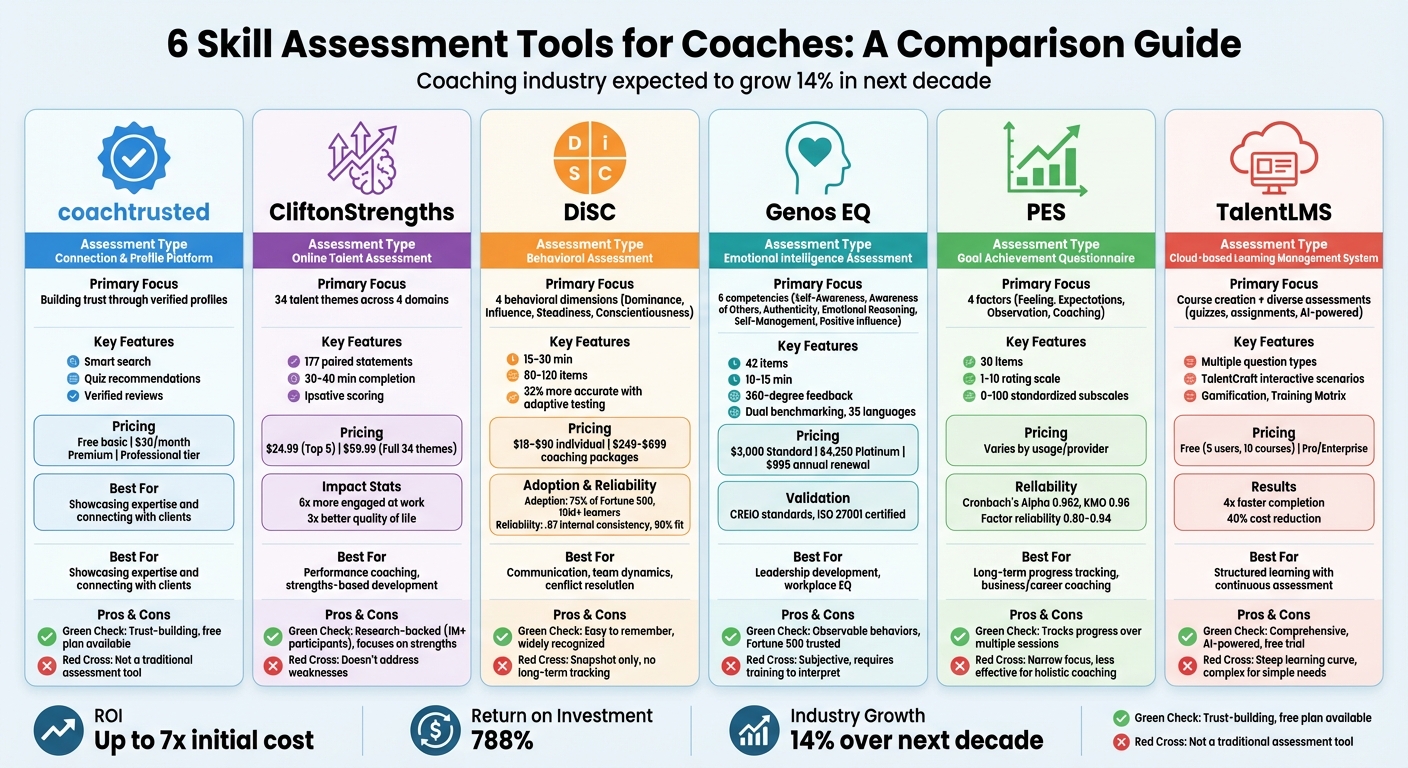
Comparison of 6 Skill Assessment Tools for Coaches: Features, Pros and Cons
1. coachtrusted
Assessment Type
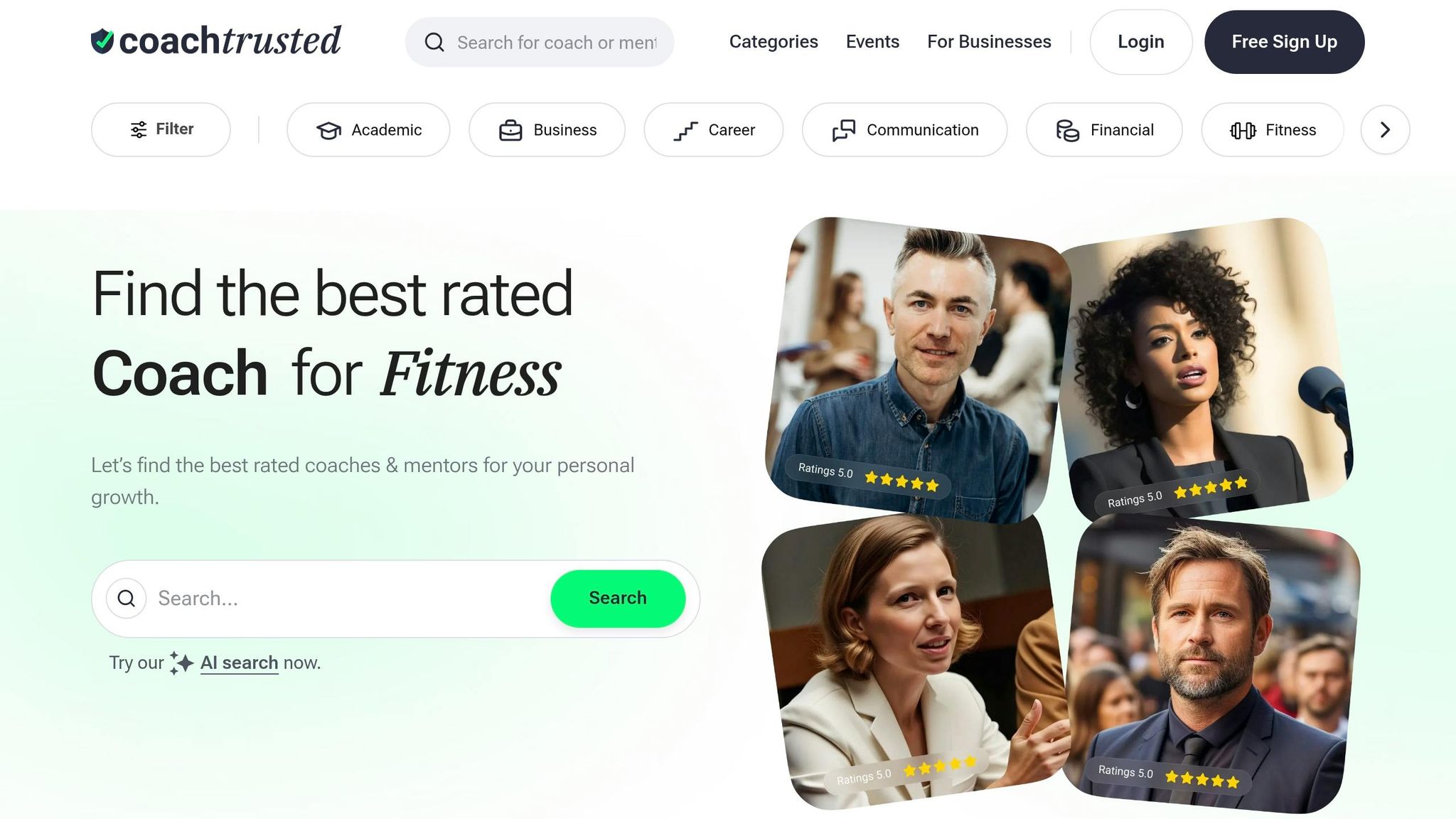
Coachtrusted operates as a connection and profile platform, focusing on building trust rather than offering traditional assessments like psychometric tests or skill evaluations. Its core value lies in helping coaches establish their credibility through verified profiles and genuine client reviews.
Primary Use Case
Coachtrusted addresses a key need by fostering trust and transparency - essential elements for tracking client progress. It allows coaches to display their expertise in areas such as health, fitness, trading, and design. By combining a verification process with a review system, the platform ensures potential clients can make well-informed decisions when choosing a coach who aligns with their goals.
Features for Coaches
Coachtrusted provides three membership options tailored to different needs:
- A free basic profile that includes contact buttons and social media links.
- A Premium plan priced at $30/month, offering custom buttons and increased visibility through the platform's advertising system.
- A Professional tier, which includes live chat, expert verification badges, and personalized marketing support, such as individual blog posts.
The platform also includes tools like smart search and a quiz-based recommendation system to connect coaches with clients based on specific objectives. Coaches can monitor their reputation through verified reviews, ensuring feedback is genuine. Additionally, messaging tools and customizable dashboards simplify client communication and profile management.
This combination of trust-building features and user-friendly tools positions Coachtrusted as a valuable resource for both coaches and clients.
sbb-itb-3c06305
2. CliftonStrengths
Assessment Type
CliftonStrengths is an online talent assessment designed to identify natural patterns in thinking, emotions, and behavior across 34 themes. The assessment consists of 177 paired statements and typically takes 30–40 minutes to complete. Unlike traditional personality tests with fixed options, CliftonStrengths uses ipsative scoring - ranking themes relative to one another - to uncover a person's distinct talent profile. This ranking system aligns well with data-driven coaching, offering measurable insights into individual strengths.
The 34 themes are grouped into four key domains: Executing (turning ideas into action), Influencing (leading and persuading), Relationship Building (fostering connections), and Strategic Thinking (processing and analyzing information). This structure helps coaches create tailored strategies that play to a client’s natural strengths. The assessment differentiates "talent" (inherent ability) from "strength", defining strength as Talent x Investment (where investment refers to time and effort spent developing the talent).
Primary Use Case
CliftonStrengths is widely used by coaches to shift the focus from correcting weaknesses to enhancing inherent talents. By identifying what clients naturally excel at, the assessment helps transform those talents into enduring strengths. Research underscores its effectiveness: individuals who actively apply their CliftonStrengths are 6 times more likely to feel engaged at work and 3 times more likely to report a high quality of life.
Don Clifton, the creator of this approach, summarized its philosophy with the statement:
"Strengths science answers questions about what's right with people rather than what's wrong with them." - Don Clifton, Founder
Validation/Evidence Base
The CliftonStrengths assessment is supported by extensive research involving over 1 million individuals and nearly 50,000 business units. Gallup highlights its strong test-retest reliability, with studies involving more than 57,000 participants showing stable results over several years - even up to a decade. In recognition of his contributions, Don Clifton was awarded a Presidential Commendation by the American Psychological Association in 2003 as the father of strengths-based psychology.
Organizations implementing strengths-focused strategies report measurable improvements, including 7% to 23% higher employee engagement, 10% to 19% increased sales, and 8% to 18% better performance. These findings demonstrate the practical benefits of the assessment for both individuals and businesses, offering coaches a research-backed tool for delivering personalized insights.
Features for Coaches
Through the Gallup Access platform, coaches gain access to tailored reports for specific roles, such as managers, leaders, sales professionals, and students. The platform also includes a personalized dashboard with tools and resources to support development. Pricing for reports starts at US$24.99 for the Top 5 themes and US$59.99 for the full 34-theme profile.
Coaches frequently use the "Name It, Claim It, Aim It" framework to help clients identify their strengths, recognize their unique value, and apply them intentionally toward achieving their goals. Additionally, role-specific reports, such as the "Brings & Needs Analysis", help clients articulate their contributions and identify the conditions they need to thrive. These features make CliftonStrengths a versatile tool for coaching professionals looking to provide targeted guidance.
3. DiSC
Assessment Type
DiSC is a behavioral assessment designed to explore how individuals naturally respond to situations, focusing on behavior rather than intelligence, aptitude, or mental health. It categorizes behavior into four key dimensions: Dominance (D) for those who are direct and results-driven, Influence (i) for outgoing and persuasive communicators, Steadiness (S) for patient and supportive team players, and Conscientiousness (C) for analytical and detail-oriented thinkers. Modern iterations, like Everything DiSC, utilize a circular model and adaptive computerized testing, which improves accuracy by 32%. Completing the questionnaire typically takes 15–30 minutes and includes 80–120 items.
Primary Use Case
DiSC is widely used by coaches to improve communication, resolve workplace conflicts, and strengthen team dynamics. It's particularly effective for guiding individual contributors as they step into management roles, helping them adjust their communication styles to better connect with others. This aligns with the "Platinum Rule", which emphasizes treating others the way they prefer to be treated.
The assessment is trusted by nearly 75% of Fortune 500 companies for team building and communication training and has reached over 10 million learners across 150,000 organizations in 72 countries. Adam Stamm, Managing Partner at Online DISC Profile, highlights its simplicity:
"We find that many coaches use DISC because the model is easy to remember and, therefore, easier to use".
This widespread adoption underlines its value in coaching and organizational development.
Validation and Evidence Base
DiSC's effectiveness is supported by strong validation metrics, making it a reliable tool for tracking coaching outcomes. It boasts a median Cronbach's alpha of .87 for internal consistency and a test-retest reliability coefficient of .86. Around 90% of participants rate their DiSC profile fit as "good" or "excellent". Additionally, the tool meets validation standards set by organizations like the American Psychological Association and the Equal Employment Opportunity Commission.
Research also shows its relevance in leadership development, with DiSC styles ranking among the top two highest means in 88% of leadership practices. Organizations report a 97% satisfaction rate globally with the Everything DiSC learning experience. To ensure quality, new versions undergo extensive beta testing. For instance, the Everything DiSC Productive Conflict tool involved nearly 14,000 participants in three testing rounds before its release.
Features for Coaches
The Catalyst™ platform enhances coaching by offering personalized learning tools and real-time communication tips. Clients can connect with colleagues for instant comparisons and tailored guidance. Coaches also gain access to specialized reports, including 360-degree feedback, team culture visualizations, and pair comparisons, enabling them to create customized strategies.
Looking ahead, the DISC AI Coach, set to launch in 2026, will analyze profiles to provide instant, context-specific strategies. Dr. Liz Masen, CEO of Athlete Assessments, explains:
"The AI Coach simply helps you work faster, deeper, and smarter".
For added flexibility, coaches can white-label assessments with their branding. Individual profiles range from $18 to $90, while coaching packages start at $249 for a single 45-minute session or $699 for a three-session package.
Using Self-Assessment Tools in Your Coaching Practice Ep. 71
4. Genos EQ
Genos EQ stands out by offering a practical way to measure emotional intelligence in everyday workplace settings. Like other tools we've covered, it provides coaches with behavior-focused data to help clients achieve meaningful progress.
Assessment Type
Genos EQ evaluates emotional intelligence through observable workplace behaviors. The assessment includes 42 items, takes about 10–15 minutes to complete, and focuses on six key areas: Self-Awareness, Awareness of Others, Authenticity, Emotional Reasoning, Self-Management, and Positive Influence. Coaches can choose from several formats, including self-assessments, 180-degree feedback (self plus one rater), or comprehensive 360-degree feedback.
What makes Genos EQ unique is its dual benchmarking system. Results are compared against global research standards and importance ratings provided by colleagues or the organization. The tool is designed for individuals aged 17 to 75 and is available in up to 35 languages, making it highly accessible.
Primary Use Case
Genos EQ is designed to help clients transition from less productive emotional states to ones marked by greater awareness, empathy, and resilience. Its assessments are tailored for various scenarios, including:
- Leadership: For everyone from first-time managers to executives.
- Workplace: Suitable for employees and teams at all levels.
- Sales: Incorporates customer feedback to refine client interactions.
- Selection: A recruitment tool with built-in interview guidance.
- Life: Focuses on personal or academic coaching.
Debbie Muno, Managing Director at Genos North America, highlights the tool's practical focus:
"The Genos model focuses on observable behaviors – in other words, what leaders actually do with their emotional intelligence".
This emphasis on behavior has made the tool popular among Fortune 500 companies. The 360-degree feedback format, in particular, helps uncover gaps between how leaders view themselves and how their colleagues perceive them, paving the way for targeted coaching strategies.
Validation and Evidence Base
Genos EQ is backed by substantial research, originating from Swinburne University in 2002. It meets the rigorous standards of the Consortium for Research on Emotional Intelligence in Organizations (CREIO), which requires at least five peer-reviewed publications to validate an assessment. Additionally, it complies with ISO 27001 standards, ensuring top-notch data security.
For recruitment purposes, the Selection version incorporates advanced tools to detect inflated responses, social desirability bias, and inconsistencies in answers. As Genos North America explains:
"The goal of emotional intelligence development is not perfection. Rather, the model provides a framework for awareness, conscious choice-making, and improvement".
Features for Coaches
Genos EQ goes beyond assessments by offering tools that transform feedback into actionable development plans. The Genos Digital platform uses videos and streamlined processes to help coaches implement feedback effectively. Coaches also have access to a Resource Portal filled with marketing materials, research papers, and sample reports. The system can even integrate with existing learning management systems via an API.
For those looking to become certified, training is available in face-to-face, virtual, or self-paced formats. Pricing includes:
- Standard Package: $3,000, which includes a digital credential, access to multiple assessment models, and one 360-degree credit.
- Platinum Package: $4,250, which adds access to the GROW platform and extra credits.
- Annual Platinum Renewal: $995.
This combination of research-backed tools and flexible resources makes Genos EQ a valuable asset for coaches aiming to help clients develop their emotional intelligence.
5. Process Evaluation Scale (PES)
The Process Evaluation Scale (PES) provides coaches with a structured framework to measure client progress and evaluate the quality of their coaching methods. Initially created for professional skills training in nursing and medical fields, PES has since found broader applications in coaching, offering measurable insights that turn subjective progress into objective, trackable data.
Assessment Type
The PES consists of a 30-item questionnaire using a 1–10 rating scale to assess both goal achievement and the quality of coaching. This tool, refined from an initial 52 items through expert reviews and pilot testing, focuses on four key factors: Feeling (emotional response to the process), Expectations (alignment with the client’s goals), Observation (evaluation of coaching skills), and Coaching (practical effectiveness). Subscale scores can also be standardized on a 0–100 scale, allowing coaches to monitor client satisfaction over time.
Primary Use Case
What sets the PES apart is its ability to differentiate between surface-level skill application and the deeper integration of abilities into real-world scenarios. It’s particularly valuable in environments where psychomotor and critical thinking skills are essential. Regular administration of the PES - not just a one-time evaluation - helps coaches track progress over multiple sessions, providing a clearer picture of goal achievement.
Validation and Evidence Base
Researchers at Ege University validated the PES between October and December 2015, demonstrating its reliability. The tool achieved a Cronbach's Alpha of 0.962, a Kaiser-Meyer-Olkin coefficient of 0.96, and factor reliabilities ranging from 0.80 to 0.94.
Features for Coaches
By analyzing scores across the four subscales, coaches can pinpoint areas needing improvement, such as unmet expectations, weak rapport, or ineffective techniques. Honest client feedback is essential for the 1–10 scale to provide meaningful results - where a score of 10 indicates complete goal achievement. This structured approach goes beyond basic training, encouraging the development of critical thinking and problem-solving skills.
6. TalentLMS
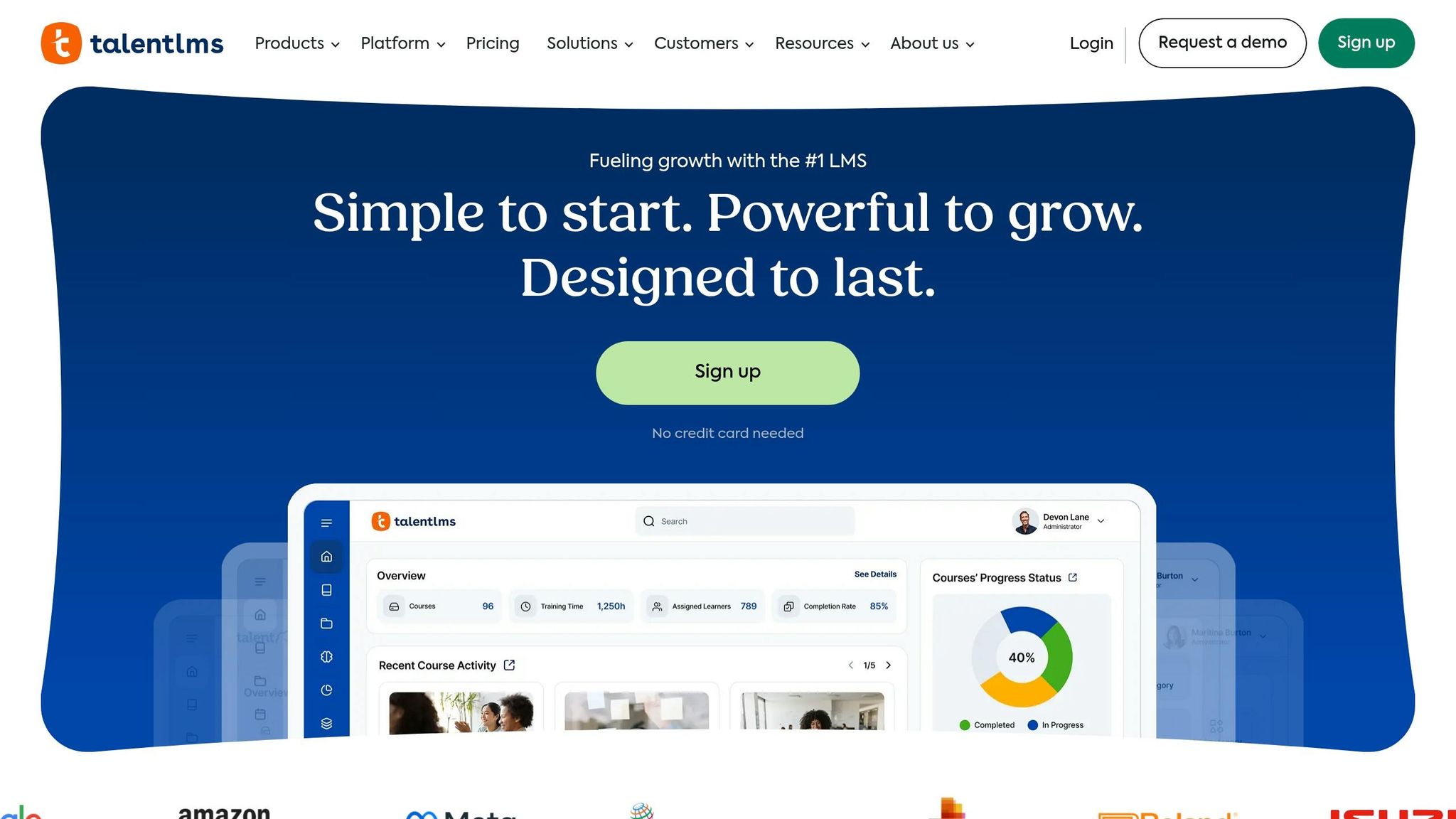
TalentLMS is a cloud-based platform designed to help coaches create, deliver, and track training programs. Unlike tools that focus solely on assessments, TalentLMS combines course creation with diverse evaluation methods, making it ideal for blending structured learning with regular assessments.
Assessment Type
TalentLMS offers a range of assessment formats, allowing coaches to customize evaluations to suit their needs. Tests and quizzes can include multiple-choice, fill-in-the-blank, ordering, drag-and-drop, and free-text questions. These are automatically generated from existing content using AI. Clients can also submit text-based assignments, upload files (like PDFs or Word documents), or record video and audio demonstrations to showcase soft skills and practical abilities.
For more complex scenarios, the TalentCraft feature enables coaches to design interactive assessments where a client’s response determines the next challenge. Additionally, AI-powered skills assessments help verify proficiency levels and pinpoint capability gaps. Coaches can also use surveys with Likert scales for non-graded feedback collection.
This combination of course creation and varied assessment tools empowers coaches to deliver tailored and effective training programs.
Primary Use Case
TalentLMS is particularly effective for coaches who want to combine structured learning with continuous assessment. For instance, Corin Birchall, Head of Retail at Roland Corporation, shared that the platform enabled the company to automate course rollouts and department reports, achieving a fourfold increase in course completion speed. Similarly, Nicolas Mejia from Smart Aviation Services reported a 40% reduction in training costs by using TalentLMS to deliver service training. The platform’s ISO and WCAG certifications ensure both data security and accessibility.
By integrating traditional assessments with real-time performance tracking, TalentLMS provides a comprehensive solution for data-driven coaching.
Features for Coaches
TalentLMS equips coaches with user-friendly tools to track and motivate client progress. The Training Matrix offers a clear visual of which clients have started, advanced in, or completed specific courses, while the Timeline logs every client action, enabling detailed audits and identifying areas for improvement. Coaches can prioritize critical concepts by assigning weights to specific questions and use question banks to store, reuse, and randomize questions across assessments.
The platform also includes gamification elements like points, badges, levels, and leaderboards to keep clients engaged. Christopher Pappas, Founder of eLearning Industry, praised the platform, saying:
"For its price and feature set, TalentLMS is a goldmine."
TalentLMS offers an unlimited free trial for up to five users and 10 courses, with no time limit or credit card required. Paid plans unlock advanced features, including TalentLMS Skills (available on Pro and Enterprise tiers), which uses AI to map organizational capabilities and identify training needs. Coaches also gain access to TalentLibrary, a collection of over 1,000 expertly curated courses on topics like leadership and soft skills.
Pros and Cons
Choosing the right tool for your coaching practice can be challenging, especially with so many options available. To simplify the decision, the table below highlights the strengths and weaknesses of several popular tools, helping you find the best match for your specific needs.
| Tool | Pros | Cons |
|---|---|---|
| coachtrusted | Builds trust with verified coach profiles; smart search and quiz-based recommendations connect clients with suitable coaches; includes a free plan with basic features; premium plans offer marketing support and custom dashboards | Functions as a connection platform rather than an assessment tool; advanced features require paid plans starting at $30/month |
| CliftonStrengths | Identifies 34 talent themes for performance coaching; focuses on abilities rather than weaknesses, boosting client confidence; provides measurable metrics to track natural patterns | Exclusively emphasizes strengths, leaving skill gaps unaddressed; access codes must be purchased; less effective for tracking behavioral changes over time |
| DiSC | Enhances communication and reduces workplace conflict; assesses four clear behavioral dimensions (Dominance, Influence, Steadiness, Conscientiousness); widely recognized and easy to understand | Focuses on behavior rather than emotional intelligence or technical skills; offers only snapshot assessments, not long-term tracking; limited for coaching tied to specific goals |
| Genos EQ | Measures emotional intelligence, including self-awareness, empathy, and interpersonal skills; supports better leadership decisions and employee engagement | Emotional intelligence assessments can be subjective; coaches may require extra training to interpret results accurately |
| Process Evaluation Scale (PES) | Designed for tracking goal achievement in business and career coaching; provides data across multiple sessions, useful for long-term tracking; ideal for measuring progress over time | Narrow focus on goal tracking limits use for broader skill assessments; less effective for holistic life coaching; requires consistent use across sessions |
| TalentLMS | Combines course creation with diverse assessments (quizzes, assignments, video demos); AI-powered tools identify skill gaps; includes an unlimited free trial for up to five users and 10 courses | Steep learning curve for those unfamiliar with learning management systems; advanced features like TalentLMS Skills require Pro or Enterprise tiers; may be overly complex for simpler coaching needs |
Investing in the right tools can transform your coaching practice. Research shows that coaching can deliver up to 7 times the initial cost and generate a 788% return on investment, thanks to gains in productivity and savings from improved retention.
When deciding, weigh each tool's features against your coaching priorities. Are you focused on performance improvement, team dynamics, or comprehensive learning management? Tools like coachtrusted can complement these options by connecting you with the right clients while enhancing credibility. Ultimately, your choice should align with your goals, ensuring you can track progress effectively and deliver measurable results.
Conclusion
Choose tools that align with your coaching goals and your clients' specific needs. Career coaches often lean toward strengths-focused platforms, while leadership coaches may prefer tools that emphasize communication and feedback. With the coaching industry expected to grow by 14% over the next decade, selecting tools that fit your niche and deliver clear, actionable results is more important than ever.
"If you're not assessing, you're guessing." - CoachRx
Start by pinpointing the core challenge. For instance, use DiSC to address communication issues, or opt for 360-degree feedback to uncover leadership blind spots. Establishing a baseline early and framing results as "preferences" or "tendencies" can help create a more open and collaborative environment for discussion.
Don’t forget to evaluate the full cost of each tool. This includes certification, subscriptions, and the time needed for training. For example, MBTI certification costs between $2,000 and $4,000, while more affordable options like DiSC (starting at $18) or CliftonStrengths (around $25–$60) offer professional insights. Free tools, such as VIA Character Strengths or the Wheel of Life, can also be valuable entry points.
To take your practice further, platforms like coachtrusted can complement these assessments by connecting you with verified clients and enhancing your professional credibility. Combining the right assessment tools with effective client connection strategies will not only help you deliver measurable results but also justify premium rates and foster lasting client relationships.
FAQs
Which tool fits my coaching niche best?
Choosing the right tool depends on the area you specialize in as a coach. If you're focused on business or leadership coaching, tools with features like automated assessments and progress tracking can be highly effective. For health and fitness coaching, platforms that provide program templates and comprehensive tracking options are often the best fit. Coaches emphasizing mentorship might find value in AI-powered evaluation tools, while sports coaches tend to benefit from platforms designed for athlete assessments and video analysis. Ultimately, the best choice aligns with your niche and the specific needs of your clients.
How do I track client progress over time?
To keep tabs on client progress, it's essential to use structured assessments and consistent tracking methods. Begin with a baseline evaluation - this could include physical measurements, identifying personal strengths, or other relevant metrics. From there, monitor progress using tools like questionnaires, progress photos, or performance benchmarks. Regular reviews help highlight achievements, tackle obstacles, and fine-tune strategies as needed. Using platforms that store and display data visually can make it easier to track metrics like weight changes, energy levels, or workout completion in real-time.
Do I need certification to use these tools?
While certification isn’t always mandatory to use coaching assessment tools, some tools - particularly those aimed at professional development - might suggest or even require specific training or certification. This helps ensure the tools are applied correctly and ethically.