Career Development
How Coaches Help Break Learning Plateaus
February 16, 2026
14 min read

How Coaches Help Break Learning Plateaus
When your progress stalls despite consistent effort, it’s not the end - it’s a learning plateau. This happens when repetitive routines, lack of external feedback, or mental fatigue prevent further improvement. Coaches play a key role in breaking these plateaus by identifying blind spots, providing feedback, and tailoring strategies to push you forward.
Here’s how coaches help:
- Spot Weaknesses: They pinpoint unnoticed issues through observation and tools like video analysis.
- Set Clear Goals: Coaches redefine objectives with specific, measurable targets to reignite progress.
- Introduce New Challenges: They adjust routines, add variety, and focus on deliberate practice.
- Track Progress: Using metrics like performance benchmarks and energy levels, they ensure steady improvement.
- Provide Accountability: Regular check-ins and structured plans keep you on track.
Plateaus are normal, but with the right guidance, they can become opportunities for growth. Coaches don’t just guide - they help you uncover new ways to improve and sustain long-term progress.
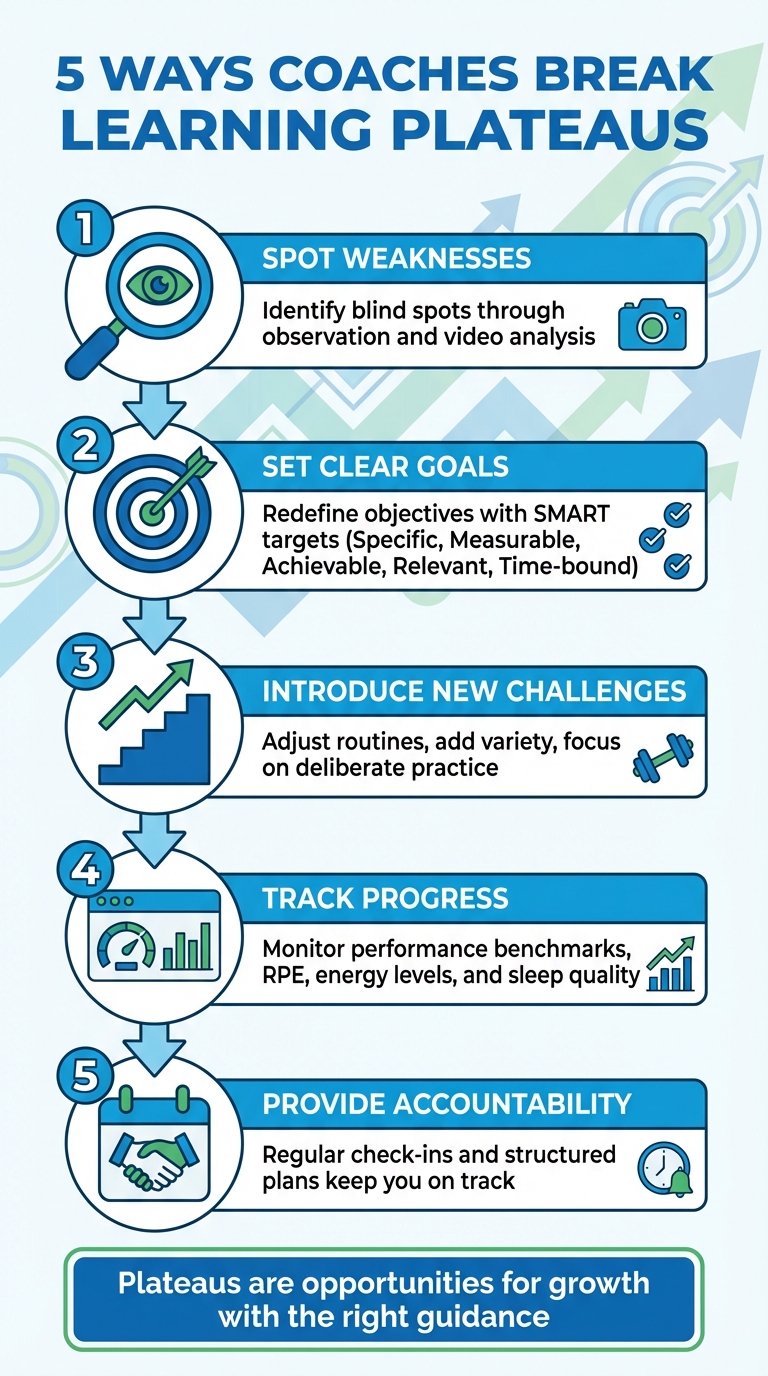
5 Ways Coaches Break Learning Plateaus
How to Overcome Learning Plateaus with Australian Memory Champ & Expert Mnemonics Coach Tansel Ali
What Are Learning Plateaus and Why Do They Happen?
A learning plateau isn’t just a fleeting frustration - it’s a phase where progress seems to stall. Whether it’s academic performance, fitness goals, or mastering a new skill, you might find yourself stuck despite consistent effort. Early improvements often come quickly, but as challenges become familiar, progress can level off.
Common Causes of Learning Plateaus
Several factors contribute to this stagnation. One major reason is repetitive routines. When you keep practicing the same tasks or solving similar problems, your brain stops building new neural pathways. Here’s why: although the brain only makes up 2% of your body weight, it uses 20% of your energy. To conserve energy, it creates shortcuts - what’s known as a "satisficing" approach. While this is efficient, it’s not ideal for tackling more complex challenges. For instance, in fitness, the rapid progress of "newbie gains" fades as your muscles adapt. Similarly, in coding, repeatedly solving the same types of problems without exploring new strategies leads to stagnation.
Another common issue is the "good enough" mindset. Once you’ve reached a basic level of competence - like holding simple conversations in a new language or nailing a few go-to recipes - your brain might settle into a comfort zone, avoiding more challenging tasks that promote growth. This phenomenon is often referred to as the "plateau of contentment".
Lack of external feedback also plays a big role. For example, Dr. Atul Gawande found that after years of practice, his complication rates as a surgeon plateaued. It was only through external feedback that he identified subtle technique adjustments, which reignited his progress. Without an outside perspective, it’s easy to miss areas for improvement, leaving blind spots unaddressed.
The Psychological Impact of Plateaus
Plateaus are frustrating, not just because progress halts but because they can drain your motivation. When your hard work doesn’t yield visible results, it’s easy to feel stuck in a rut. Over time, this frustration can turn once-enjoyable practice into a dull, mechanical routine. Studies show that intense mental effort can lead to cognitive fatigue, with performance declining by about 0.9% for every hour of sustained focus. This fatigue compounds the sense of stagnation.
Anders Ericsson, a leading researcher on learning, explains it well:
"When you first start learning something new, it is normal to see rapid - or at least steady - improvement, and when that improvement stops, it is natural to believe you've hit some sort of implacable limit. So you stop trying to move forward, and you settle down to life on that plateau." – Anders Ericsson, Researcher
This mindset can become a self-fulfilling prophecy. By assuming you’ve hit your limits, you stop pushing yourself, reinforcing the plateau and further eroding your confidence. Recognizing these patterns is the first step in overcoming them, helping coaches and individuals alike to break through these barriers effectively.
How Coaches Identify and Address Learning Plateaus
Assessment Techniques Used by Coaches
Coaches keep an eye out for telltale signs of a plateau. One of the clearest indicators is stagnant performance metrics - like test scores that won’t improve, strength levels that stay the same, or running speeds that plateau despite consistent effort. But numbers alone don’t tell the whole story.
Behavioral changes are just as revealing. A sudden drop in enthusiasm, boredom with routines, or staying in a "comfort zone" without seeking new challenges are all red flags. Coaches, like Kyle Weisbrod from Ultiworld, understand the importance of reading these cues:
"Much of addressing plateaus and generally helping players grow is reading players and understanding where they are comfort-wise."
Technical execution errors are another clue. Recurring mistakes often signal shallow understanding or a lack of focus during practice. Tools like video analysis can uncover subtle issues - such as a golfer’s grip or a runner’s stride - that might otherwise go unnoticed. In fitness coaching, subjective tools like Rate of Perceived Exertion (RPE) are invaluable. If a client feels like they’re working harder but their performance isn’t improving, it’s a clear sign something is off.
Take the case of journalist Joshua Foer, who hit a plateau while training for memory competitions in 2005. Working with memory expert Anders Ericsson, they discovered the issue wasn’t his memory capacity but his encoding speed. By practicing at speeds 10–20% faster than comfortable, they pinpointed specific problem areas, like tricky letter combinations. This targeted practice helped Foer win the 2006 USA Memory Championship.
These assessments give coaches the insights they need to create action plans that address the root of the issue.
How Coaches Create Personalized Action Plans
Once a coach identifies the problem, they develop tailored interventions to break through the plateau. A common first step is goal realignment. Coaches set new SMART goals (Specific, Measurable, Achievable, Relevant, Time-bound) that reflect your current situation. For complex skills, they break them into smaller, manageable parts - like focusing solely on swing mechanics in golf or defensive footwork in martial arts.
From there, they tweak training variables to disrupt the body’s adaptation. This could mean changing the volume, intensity, rest periods, or even the exercises themselves. For experienced learners, coaches often use periodization strategies, which involve structured phases of training. Beginners may benefit from steady, linear increases in intensity, while advanced athletes often thrive with block periodization - focusing on one specific adaptation over 3–4 week cycles.
Sometimes, the solution lies outside the skill itself. Coaches assess factors like sleep, emphasizing the importance of 7–9 hours per night for recovery. They might also refine your nutrition plan or help you manage stress. For example, Dr. Atul Gawande, a surgeon who felt his complication rates had plateaued, hired a former professor to observe his work. The coach identified small but critical issues - like poor lighting alignment, unnoticed anesthesiology concerns, and elbow positioning errors. Addressing these blind spots led to better outcomes.
As Gawande explained:
"The purpose of a coach is to not be the one to set the goals... but instead to say, 'Here are the kinds of goals we can work our way through.'"
Coaches bring an outside perspective, spotting what you might miss - whether it’s a technical flaw, a mental block, or a lifestyle habit holding you back. This external feedback is often the key to breaking through plateaus.
Practical Techniques Coaches Use to Break Plateaus
Building on personalized action plans, coaches use a range of practical techniques to help clients overcome plateaus and make meaningful progress.
Goal Realignment and New Challenges
When a plateau is identified, coaches shake things up by adjusting training variables. They revisit and reset SMART goals - those that are Specific, Measurable, Achievable, Relevant, and Time-bound - to create clear and actionable targets. This could mean tweaking the volume (adding sets or reps), increasing intensity (heavier weights or shorter rest periods), or introducing entirely new exercises.
For those with more experience, coaches often turn to block periodization. This method emphasizes one specific adaptation - like building strength or endurance - over 3–4 week cycles. They also apply the Zone of Proximal Development principle, crafting challenges that are tough but manageable, ensuring you stay in that optimal "flow" state.
Sometimes, progress isn’t about pushing harder but trying a new approach. Anders Ericsson and Robert Pool, authors of Peak, sum it up perfectly:
"The solution is not 'try harder' but rather 'try differently'"
This might mean cross-training in a complementary area or approaching problems from a fresh perspective. For example, using visual tools like drawing to grasp complex ideas can provide clarity and spark progress. These shifts create the foundation for effective feedback and consistent accountability.
Providing Targeted Feedback and Accountability
Coaches excel at offering feedback that highlights blind spots you might not notice on your own. Surgeon Atul Gawande describes this as providing an "external set of data on reality", often using tools like video analysis to pinpoint specific mechanical flaws.
Accountability is another key element. Coaches build structured systems to keep you on track, whether through bi-weekly video reviews, six-week benchmarks, or automated digital reminders. They monitor both objective metrics (like heart rate or rest intervals) and subjective ones (such as your Rate of Perceived Effort) to determine whether your plateau stems from overtraining or a lack of intensity. Instead of overwhelming you with sweeping changes, they break down insights into micro-goals - small, actionable steps that build momentum through consistent, incremental wins.
One simple yet effective accountability tool is the "Never Miss Twice" rule. While skipping a session occasionally is okay, coaches stress the importance of not letting it happen two days in a row. With this level of feedback and structure, they guide you toward deliberate practice that directly addresses your plateau.
Incorporating Deliberate Practice
Unlike mindless repetition, deliberate practice is intentional and methodical, designed specifically to improve performance. Coaches guide clients through a four-step process: breaking down the skill into smaller parts, identifying weaknesses, experimenting with new strategies to address those weaknesses, and then reintegrating the improved components back into the whole. As James Clear explains:
"While regular practice might include mindless repetitions, deliberate practice requires focused attention and is conducted with the specific goal of improving performance."
Coaches push you into the "learning zone", where tasks are challenging but achievable with effort. They focus on sub-skills that can be improved in just one to three sessions, ensuring steady progress. Since this type of practice is mentally taxing, high-intensity sessions are typically capped at 60–90 minutes.
A practical guideline for deliberate practice is the 10% rule: each drill or exercise should be about 10% harder than what feels comfortable. If boredom or disengagement sets in, your coach will either increase the difficulty or switch up the activity to reignite your focus. As psychologist Anders Ericsson aptly stated:
"If you never push yourself beyond your comfort zone, you will never improve"
sbb-itb-3c06305
The Role of Tools and Platforms in Sustaining Progress
Modern tools have transformed coaching into a continuous, measurable process. By offering real-time feedback and tracking, these platforms ensure progress doesn't stall. What was once an exclusive luxury is now an accessible, results-driven system that actively monitors and supports behavioral change.
How Coachtrusted Connects Clients with Verified Coaches

Coachtrusted simplifies the process of finding a coach by using smart search technology. The platform matches clients with verified coaches based on factors like personality, professional goals, industry expertise, and preferred learning styles. Instead of relying on trial-and-error or word-of-mouth, its AI-driven approach connects you with someone equipped to address your specific challenges.
Verification is key because even high performers face limits. For instance, surgeons often see their performance plateau after 10 to 12 years without external coaching. Coachtrusted ensures confidence in your choice by showcasing verified reviews and detailed expert profiles, highlighting coaches with proven success in helping others overcome similar obstacles.
The platform also offers on-demand tools like video, audio, and messaging, allowing immediate access to guidance when you're stuck. This flexibility eliminates the frustration of waiting days or weeks for scheduled sessions, ensuring help is available exactly when you need it.
Using Dashboards and Tracking for Long-Term Growth
Once paired with a coach, the focus shifts to tracking progress. Modern coaching platforms go beyond basic completion rates, emphasizing measurable behavior changes, skill development, and goal achievement over time. For example, Coachtrusted provides dashboards that display data through visual tools like graphs and charts, helping both you and your coach identify trends and celebrate milestones.
These dashboards capture both objective metrics (e.g., strength improvements, technical benchmarks) and subjective factors (e.g., mood, energy levels, sleep quality) that can highlight hidden causes of plateaus. This comprehensive view helps coaches determine whether adjustments are needed, such as reducing overtraining or introducing more variety to your routine.
The transparency of these tools benefits both clients and coaches. Coaches can record sessions and analyze data to provide detailed feedback. For instance, a review of a recorded session might reveal that you're unintentionally dominating the conversation or repeating a technical mistake. These insights create what Education Excellence Magazine describes as an outcome-focused system:
"Digital coaching platforms... are not content delivery systems. They are outcome-based. They affect behavior, attitude, and skill acquisition in a strongly contextual and adaptive way."
Automated reminders and accountability features also keep you consistent between sessions. These tools encourage deliberate practice beyond your comfort zone, helping you avoid the "OK Plateau" - a psychological state where progress halts as tasks become routine. By combining measurable insights with regular adjustments, these platforms create a pathway for sustained growth, ensuring that you're not just tracking numbers but actively improving over time.
Measuring Success and Preventing Future Plateaus
Key Metrics for Measuring Progress
Getting past a plateau is just the start - you need to know if you're actually moving forward. To do this, track performance benchmarks like race times, weights lifted, or power output every 4–8 weeks under consistent conditions. These numbers help cut through daily fluctuations and show if your training is on the right track.
But numbers alone don’t tell the whole story. Pay attention to RPE (Rate of Perceived Exertion) - how hard the effort feels. If your RPE is climbing while performance stays the same, it could be a sign of overtraining or that another plateau is around the corner. Similarly, tracking error rates can uncover areas for improvement. For example, Dr. Atul Gawande worked with a coach to refine his surgical techniques, focusing on details like elbow positioning and light placement. These small tweaks led to better patient outcomes.
Don’t overlook the mental and physical signals. Metrics like energy levels, sleep quality (aim for 7–9 hours), motivation, and resting heart rate can reveal whether you're ready to tackle new challenges. In professional settings, behavioral metrics - like how much time you spend talking versus listening in meetings - can serve as a baseline for personal growth. Together, these indicators provide a clear picture of progress and guide adjustments to keep improvements steady.
Strategies for Long-Term Plateau Prevention
Once you’ve measured your progress, the next step is to prevent future plateaus. Regularly reviewing your metrics helps you spot when it’s time to make changes. One powerful approach is periodization, which involves systematically varying your training routine to prevent your body and mind from becoming too comfortable.
- Linear periodization is great for beginners gearing up for a specific event, as it gradually increases intensity over time.
- Undulating periodization works well for intermediate learners by introducing frequent changes within a single week.
- Block periodization divides training into 3–4 week phases, each focusing on a specific skill like endurance or power.
Another essential tool is the deload week, where you reduce training volume by about 50% to allow physical and mental recovery. Pair these recovery weeks with regular reflection sessions - such as bi-weekly reviews or six-week skill checks - to catch small mistakes before they snowball into bigger issues. Tools like video analysis or recorded sessions can provide external feedback, helping you spot things you might otherwise miss.
Conclusion
Hitting a learning plateau doesn’t mean you’ve reached your limit - it’s just a natural part of improving any skill. Even top performers experience this. Surgeon Atul Gawande, for example, realized after a decade of practice that having an external perspective was key to spotting blind spots he couldn’t see on his own.
The techniques discussed in this guide - like deliberate practice, periodization, and tracking meaningful metrics - become even more effective when combined with expert guidance. A great coach does more than hold you accountable; they help you pinpoint specific obstacles and design exercises to address them directly.
Finding the right coach can make all the difference. Platforms such as Coachtrusted simplify this process by connecting you with verified professionals in areas like fitness, trading, and design. These experts don’t just tailor solutions to your challenges - they also provide tools like progress tracking and regular feedback to turn small wins into lasting improvements.
Overcoming plateaus isn’t just about staying motivated; it’s about having a system. Techniques like "If-Then" planning for setbacks and rotating your focus every few weeks help you stay adaptable and avoid future stagnation. The goal isn’t just to push past today’s barriers - it’s to develop the skills you need to keep progressing on your own.
FAQs
How do I know I’m in a learning plateau?
If you find yourself putting in consistent effort but not seeing improvement, you might be stuck on a learning plateau. Signs include making the same mistakes repeatedly or having trouble using your skills in fresh scenarios. You might also notice a drop in motivation, enthusiasm, or confidence. Spotting these patterns early can help you address the issue and get back on track.
Do I need a coach or just a new practice plan?
Deciding whether to work with a coach or try a new practice plan depends on what you’re looking for. A coach can do more than just offer a plan - they can figure out what’s holding you back, develop strategies specifically for you, and keep you motivated along the way. This level of support often surpasses what a practice plan alone can provide. If you’re unsure, a coach’s personalized approach might be exactly what you need to push past plateaus and achieve your goals.
What should I track to prove I’m improving?
To break through learning plateaus and see progress, it's essential to track specific metrics. Focus on areas like the quality of your practice, how consistent you are, and how close you're getting to your goals. For example, you might monitor successful drills completed, noticeable technique refinements, or milestones tied to SMART goals (Specific, Measurable, Achievable, Relevant, Time-bound).
Incorporating data-driven tools can also help. Methods like comparing performance block by block or estimating your one-rep max (1RM) offer clear, objective ways to measure improvement. On top of that, regular feedback - whether self-assessed or guided by a coach - ensures your efforts are aligned with measurable progress.