Career Development
Ultimate Guide to Keywords for Coaching Profiles
January 24, 2026
16 min read

Ultimate Guide to Keywords for Coaching Profiles
Keywords are the key to making your coaching profile visible to potential clients online. By strategically placing the right terms in your headline, bio, and service descriptions, you can connect with people actively searching for solutions you offer. Here’s what you need to know:
- Why Keywords Matter: Search engines drive 53% of trackable traffic, with leads converting at 14.6% - far higher than paid ads or cold calls. For instance, terms like "Life Coach" get 18,000 monthly searches, while "Divorce Coach" gets 2,000.
- Types of Keywords: Use a mix of short-tail (e.g., "Life Coach"), long-tail (e.g., "life coaching for career transitions"), and niche-specific keywords (e.g., "Financial Coaching") to target the right audience.
- Finding Keywords: Tools like Google Keyword Planner, Moz, and Semrush help identify high-impact keywords. Adding modifiers like location or intent ("best executive coach in NYC") makes them more targeted.
- Keyword Placement: Incorporate keywords naturally into your headline, bio, and service descriptions. Avoid overuse or irrelevant terms, which can hurt both rankings and credibility.
- Tracking Performance: Monitor impressions, click-through rates, and conversions using tools like the Coachtrusted dashboard. Adjust based on results to stay competitive.
Keywords are a powerful way to attract clients ready to hire. Start by researching, placing, and tracking them effectively to grow your coaching business.
Why Is THAT Life Coach Website Ranking #1 in Google? 👉 It's These 6 SEO Strategies
What Keywords Are and How They Work
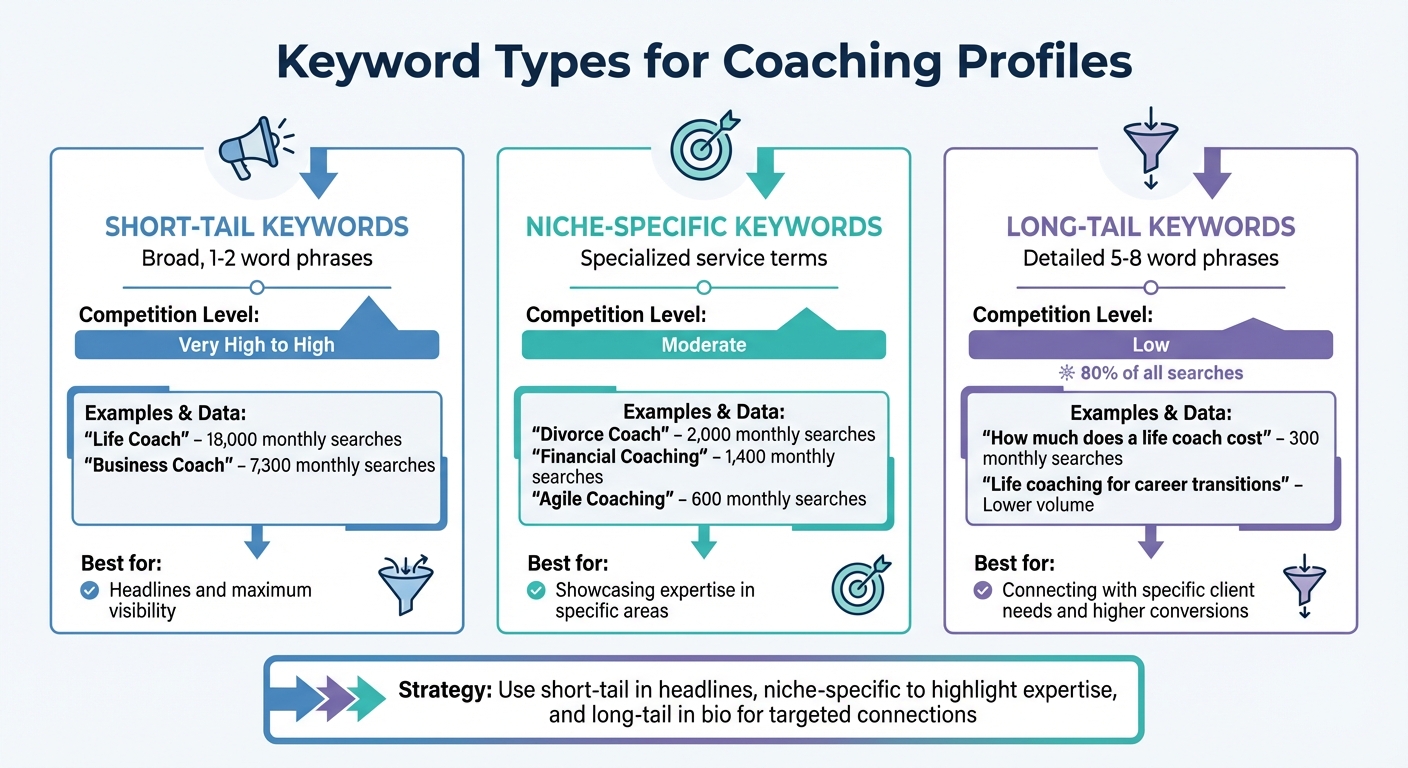
Keyword Types for Coaching Profiles: Search Volume and Competition Comparison
Definition of Keywords
Keywords are the terms and phrases people type into search engines to find what they need. They act as a bridge between how you describe your services and how potential clients search for them. For example, if someone enters "executive coach in New York" or "how much does a life coach cost", those exact phrases are considered keywords.
Search engines like Google use keywords to determine how relevant your content is to a search query. As Google Search Central puts it:
The most basic signal that information is relevant is when content contains the same keywords as your search query.
Including the right keywords in your Coachtrusted profile makes it easier for potential clients to find you. With 90% of consumers starting their search for local services online, using the right keywords is crucial for visibility.
For instance, the phrase "Life Coach Near Me" is searched approximately 7,500 times a month, while "how much does a life coach cost" gets around 300 searches. This shows that factors like location and pricing are often top-of-mind for potential clients.
Next, let’s explore the different types of keywords and how they can work together to enhance your profile.
Types of Keywords: Short-Tail, Long-Tail, and Niche-Specific
Keywords aren’t one-size-fits-all. Knowing the three main types can help you decide which ones to prioritize on your profile.
Short-tail keywords are broad, 1-2 word phrases with high search volume but stiff competition. For instance, "Life Coach" sees about 18,000 monthly searches in the U.S., and "Business Coach" garners around 7,300 searches. These keywords are great for grabbing attention in your headline but may not distinguish you from others in the field.
Long-tail keywords are more detailed phrases, usually 5-8 words, that reflect specific search intent. While "Life Coach" has high volume, something like "life coaching for career transitions" targets a narrower audience with clear needs. Long-tail keywords make up roughly 80% of all searches and often lead to better conversions because they address particular problems. As Greg Gifford, VP of Search at Search Lab, explains:
We're not simply matching keyword to keyword any more. We have to understand how potential customers are searching - and specifically, the intent of their search query.
Niche-specific keywords focus on specialized services or industries. Terms like "Financial Coaching" (1,400 monthly searches), "Divorce Coach" (2,000 searches), and "Agile Coaching" (600 searches) are perfect for showcasing expertise in specific areas. These keywords attract clients who are already informed and looking for a specialist.
| Keyword Type | Example | Monthly Searches (US) | Competition Level |
|---|---|---|---|
| Short-Tail | Life Coach | 18,000 | Very High |
| Short-Tail | Business Coach | 7,300 | High |
| Niche-Specific | Financial Coaching | 1,400 | Moderate |
| Niche-Specific | Divorce Coach | 2,000 | Moderate |
| Long-Tail | How much does a life coach cost | 300 | Low |
| Long-Tail | Life coaching for career transitions | Lower volume | Low |
To make the most of these keywords, mix them strategically. Use short-tail keywords in your headline to maximize visibility, add niche-specific keywords to highlight your expertise, and weave long-tail phrases into your bio to connect with clients who have specific needs.
How to Find the Right Keywords for Your Profile
Optimizing your Coachtrusted profile starts with choosing the right keywords that align your services with what potential clients are searching for. Begin with seed keywords - basic terms that define your coaching expertise. These could include phrases like "executive coaching", "wellness coach", or "career transition support." These foundational terms serve as a starting point to uncover related keywords you can weave into your profile.
One common mistake? Skipping keyword research altogether. As Greg Gifford, VP of Search at Search Lab, puts it:
The biggest mistake I see people making with keyword research is simply not doing it... We have to understand how potential customers are searching - and specifically, the intent of their search query.
Once you’ve identified your seed keywords, dive into search intent - the reason behind a search. Are users looking for information, comparing services, or ready to hire? Understanding this helps you choose keywords that align with what your audience is actually looking for. For example, explore question keywords by checking Google’s "People Also Ask" section. These specific queries are great for your bio or FAQ sections.
Add modifiers to your keywords to make them more targeted. Use location ("Boston"), quality terms ("best", "top"), or format ("online", "virtual"). For instance, "executive coach" can evolve into "top executive coach in Chicago" or "online leadership coaching". If you’re just starting out, focus on keywords with "medium" or "low" competition to boost visibility without competing with well-established coaches.
Free Keyword Research Tools
Once you’ve outlined your keywords, use free tools to refine and expand your list.
- Google Keyword Planner: A must-have for finding high-volume keywords. It’s free with a Google Ads account. Use the "Discover new keywords" option and input phrases or your Coachtrusted URL to get tailored suggestions. The URL method filters out irrelevant terms and focuses on what Google already associates with your services. You can also use the location filter to see which terms are trending in your area, especially if you offer in-person coaching.
- Moz Keyword Explorer: Offers three free searches daily, providing insights like search volume and keyword difficulty. The Questions filter is particularly helpful for identifying FAQs to include in your profile bio.
- Semrush Keyword Magic Tool: The free version lets you explore keyword ideas, search volumes, and intent categories. Focus on lower-difficulty keywords to improve your chances of ranking higher.
- Google Suggest: Simply type your niche into Google and note the autocomplete suggestions. These are real-time, popular search terms. Pair this with Google Trends to ensure your keywords are stable or gaining traction over the past year.
| Tool | Best For | Key Free Feature | Cost |
|---|---|---|---|
| Google Keyword Planner | Volume & competitor research | "Start with a website" URL analysis | Free |
| Moz Keyword Explorer | Intent & FAQ discovery | Questions filter for profile bios | Free (3 searches/day) |
| Semrush | Topic clustering | Keyword intent categorization | Free (limited) |
| Google Trends | Tracking keyword popularity | Rising or falling trend data | Free |
| MozBar | Competition assessment | Domain authority in search results | Free |
Learning From Other Coaching Profiles
After building your keyword list, study successful coaching profiles to validate your choices and gather additional ideas. Search for broader terms like "business coach for women" or "financial wellness coach" on Google. The profiles that consistently rank on the first page are worth analyzing.
Tools like Ubersuggest can help you uncover high-performing keywords by showing which terms drive the most traffic to competitors’ profiles. For a deeper dive, premium tools like Ahrefs or Semrush offer "Content Gap" analysis, which identifies keywords your competitors rank for but you’re missing.
Pay attention to how these top-ranking profiles strategically place keywords in their meta titles, headlines, and body text. If you serve specific areas, note how successful coaches incorporate location-based keywords like "performance coach in Austin" into their profiles and Google My Business listings.
For even more insights, join Facebook Groups or coaching forums relevant to your niche. These communities are goldmines for understanding the language, questions, and concerns of your potential clients. As Brittni Schroeder, Business and Life Coach, explains:
Think of keywords as the bridge between what your ideal client is searching for and the content you create.
Where to Place Keywords in Your Coachtrusted Profile
Once you’ve identified your target keywords, the next step is placing them thoughtfully throughout your Coachtrusted profile. Where and how you position these keywords can make a big difference. Search engines analyze specific sections of your profile to assess its relevance, which is crucial since 90% of all internet experiences start with a search engine. By combining the right keywords with strategic placement, you can increase your visibility and make your profile more appealing to potential clients.
Key areas like your headline, bio, skills, and services sections are essential for signaling your expertise to both search engines and prospective clients. The goal is to integrate keywords naturally while maintaining a polished, professional tone that reflects your expertise. Let’s break down how to include keywords in these sections for maximum impact.
Writing Your Headline and Bio With Keywords
Your headline is one of the most visible parts of your profile. It appears in search results and should immediately convey your specialty. Use your primary keyword here, along with details about your niche or location. For example, instead of a generic headline like "Life Coach", opt for something more specific, such as "Executive Performance Coach for Tech Leaders."
When crafting your bio, start with keyword-rich phrases to capture both search engine attention and client interest. For instance, if you’re a wellness coach focusing on stress management, you could write:
"As a certified wellness coach, I help busy professionals overcome burnout and build sustainable self-care routines."
This approach not only incorporates keywords naturally but also directly addresses a specific client need. Think of keywords as a way to connect what your clients are searching for with the services you provide. As Konstantinos Ntoukakis from Studio for Digital Growth emphasizes:
"The keywords should not merely be sprinkled into existing content as an afterthought; instead, let them inspire and shape the pages and content you create."
Quantify your achievements to make your bio more compelling. For example, instead of saying, "I help clients achieve their goals", you might say, "I’ve guided 50+ entrepreneurs through career transitions using my proven 5R Recovery Framework." Additionally, location-based keywords such as "Life Coach NYC" or "Business Coach Near Me" can help you attract local clients searching for services in their area.
| Profile Section | Keyword Strategy | Example |
|---|---|---|
| Headline | Primary keyword + Niche/Location | "Executive Performance Coach for Tech Leaders" |
| Bio (First Paragraph) | Include primary and secondary keywords early | "As a certified wellness coach, I help…" |
| Bio (Body) | Combine problem-solving language with long-tail phrases | "Overcome imposter syndrome coaching" |
Now, let’s explore how to embed keywords effectively into your skills and services sections.
Adding Keywords to Your Skills and Services
The skills and services sections are where you align your expertise with what clients are actively searching for. Profiles with at least five skills listed are 27 times more likely to appear in search results. Use specific, niche-focused keywords like "executive coaching", "career transition", or "nutrition coaching", rather than broad, generic terms.
Prioritize high-intent phrases that attract clients ready to take action. Keywords like "Hire a coach", "Coaching consultation", or "Book a discovery call" signal that potential clients are serious about engaging your services. If you use specialized methodologies, be sure to mention them explicitly. For example, include phrases like "The 5R Recovery Framework for Burnout" or "Transformational Leadership Coaching."
When selecting keywords, aim for a balance between search volume and competition. For instance, while "Life Coach" might receive 18,000 to 22,000 monthly searches in the U.S., it’s also highly competitive. A more specific term like "Life coach Chicago" may have fewer searches but will likely attract more qualified, local clients.
Outcome-focused keywords are another powerful tool. Use terms that highlight the results clients want, such as "Performance Coaching", "Goal Setting Coach", or "Mindset Transformation." These phrases help demonstrate the value of your services.
Finally, revisit your keyword strategy regularly. Update your skills and services sections to include new, relevant terms as your practice evolves. Don’t forget to include proper names for certifications or methodologies, as these can also serve as trust-building keywords for potential clients.
sbb-itb-3c06305
Common Keyword Mistakes to Avoid
Once you've placed your keywords thoughtfully, it's just as important to steer clear of common missteps. Avoiding these errors ensures your Coachtrusted profile remains not only visible but also engaging and professional.
Keyword Stuffing and Overuse
Keyword stuffing - overloading your content with repeated keywords in an attempt to manipulate rankings - can backfire badly. Google's updates, like Panda and Hummingbird, penalize this practice, and it often makes your profile sound unnatural, driving potential clients away. As digital marketer Terhemba Ucha points out:
Keyword stuffing makes your content awkward and difficult to read, which can drive visitors away.
A good rule of thumb is to keep your keyword density between 0.5% and 3%. For a 1,000-word profile, this means your main keyword should ideally appear 5 to 30 times. Instead of repeating the same term like "Life Coach", try mixing in variations like "personal mentor", "wellness consultant", or "success coaching." This keeps your language more fluid and natural. Digital marketer Prince Kapoor emphasizes:
Keyword placement isn't about cramming in as many keywords as possible. Instead, it's about positioning them where they matter most.
A simple trick? Read your profile out loud. If it sounds repetitive or robotic, it's time to rethink your keyword strategy.
Using Keywords That Don't Match Your Expertise
Another frequent mistake is targeting high-traffic keywords that don't actually align with your services. When visitors land on your profile and realize the content doesn't match their needs, they'll leave quickly. This signals to search engines that your page isn't valuable. SEO specialist Gabriela Jhean explains:
When people land on your page and see keyword-stuffed content, it screams 'spammy' and 'untrustworthy.' It damages your brand's reputation and makes you look unprofessional. Trust is crucial online, and keyword stuffing destroys it.
Misaligned keywords not only hurt your rankings but also erode your credibility. Before committing to a keyword, take a moment to Google it. Check the top-ranking results - if they're mostly blog posts while your goal is to promote coaching sessions, the keyword likely doesn't match your intent. Instead, focus on high-intent phrases that attract clients ready to take action. For example, a keyword like "executive coach for tech leaders" is far more likely to bring in serious prospects than a vague term like "coach."
Tracking Your Keyword Performance
Once you've placed your keywords, the next step is to monitor their performance. Keyword tracking isn't a one-and-done task - it’s an ongoing process that requires you to tweak your strategy as search engine results pages (SERPs) evolve over time.
Even small shifts in your rankings can have a big effect on your coaching business. Climbing higher in the rankings often brings more traffic, which can lead to an increase in client inquiries.
Using Coachtrusted Dashboard Analytics
The Coachtrusted dashboard is your go-to tool for understanding how your profile is performing. Start by reviewing your keyword rankings - these show where your profile appears in search results for your target terms.
Keep a close eye on key metrics such as:
- Impressions: How often your profile shows up in search results.
- Click-through rate (CTR): The percentage of users clicking through to your profile. For example, top results average a 22% CTR, while the tenth position drops to just 2%.
- Conversions: Actions like inquiries, bookings, or signups.
- Engagement time: How long users spend interacting with your content.
If your CTR is below the median organic rate of 1.51%, it might be time to revisit your headline or bio to make them more engaging.
To stay organized, group your keywords into tags like "Life Coaching" or "Executive Coaching." This makes it easier to identify which segments are performing best. You can also set up alerts for significant ranking drops to respond quickly. Aim to review your rankings weekly - this helps you track trends without overreacting to minor changes.
Armed with these insights, you can adjust your keyword strategy to keep improving your profile’s performance.
Updating Keywords Based on Results
Data is only useful if you act on it. If a keyword isn’t delivering results, swap it for a long-tail variation. These longer, more specific phrases might have less competition but often attract clients who are ready to take action. For instance, if "business coach" underperforms, try something more targeted like "executive coach for tech startups".
If your rankings drop, compare your profile to top-ranking competitors. Update your bio or services to better align with what’s working for others. After major algorithm updates, wait one to two weeks before making changes to your strategy to see how the dust settles.
Watch out for keyword cannibalization - this happens when multiple sections of your profile compete for the same term, which can dilute your visibility. If you spot this, consolidate similar content or assign distinct keywords to different sections.
Finally, tie your keyword performance to measurable business outcomes. As Ciaran Connolly, Director at ProfileTree, points out:
The biggest mistake agencies make is presenting keyword data without context. When we tell a client their rankings improved by 15%, they shrug. They renew their contract immediately when we tell them this translates to £50,000 in additional revenue.
Tracking metrics like consultation requests or leads generated by specific keywords will give you a clearer picture of how your efforts are driving real business growth.
Conclusion
Keywords act as essential links between your expertise and the clients actively looking for solutions. By optimizing your Coachtrusted profile with carefully chosen terms, you can establish yourself as a trusted authority in your field while drawing in highly qualified leads who are ready to engage. This kind of data-focused keyword strategy turns your profile into a lasting asset that consistently brings in new clients. Achieving this requires a thoughtful and strategic approach to keyword usage.
To refine your strategy, focus on niche-specific, long-tail keywords that highlight your unique expertise and address the specific challenges your clients face. Use these keywords thoughtfully in key areas of your profile, such as your headline, bio, and services sections. Avoid overloading your profile with keywords, and take advantage of the Coachtrusted dashboard to track and improve your performance.
Your Coachtrusted profile has the potential to be a game-changer for connecting with clients. Start applying these keyword strategies today to increase your visibility and expand your client base. By mastering these techniques, you’ll set the stage for sustained growth and lasting client relationships.
FAQs
What’s the best way to choose keywords for my coaching profile?
To find the right keywords for your coaching profile, start by zeroing in on terms that align with your expertise and what potential clients are likely searching for. Think about specific niche keywords like "career coach for recent graduates" or "fitness coach for beginners" to showcase what sets you apart.
You can also include phrases that address common problems, such as "stress management coaching", or location-specific keywords like "life coach in Los Angeles." These can help you connect with people actively looking for services like yours, especially in your area.
Focus on keywords that strike a balance between relevance, search volume, and competition. Instead of chasing high-traffic terms, aim for ones that are more likely to attract your ideal clients. And don’t forget - regularly updating your keywords keeps your profile in tune with trends, ensuring it remains visible to potential clients.
What are the best tools to find keywords for coaching profiles?
The most effective tools for uncovering keywords for coaching profiles are those designed to pinpoint terms that resonate with your specific niche and audience. Google Keyword Planner is a widely used, free resource that gives you insights into search volume, competition levels, and local search trends. It's particularly handy for finding high-intent keywords that align with potential clients' needs.
Another solid choice is Moz's Keyword Explorer, which provides data on keyword difficulty and estimated traffic. This helps you zero in on terms that match your coaching expertise while offering a realistic chance of ranking well.
For a more focused strategy, you can also explore curated keyword lists tailored for coaches. These lists often highlight phrases and terms that prospective clients are actively searching for.
By combining these tools, you can boost your profile’s visibility and connect with the clients who are already looking for the services you offer.
How can I track and improve the performance of keywords on my coaching profile?
Tracking how your keywords perform is the first step to refining and improving them. Keep an eye on where your profile stands in search rankings for specific keywords and use tools like Google Analytics to evaluate your organic traffic. This will help you pinpoint which keywords are bringing in visitors and which ones could use some work.
To improve keyword performance, weave your target keywords naturally into your profile content - think titles, descriptions, and headings. It’s also crucial to revisit and update your keywords and content regularly, aligning them with current search trends and performance insights. This approach can help increase your visibility and draw in more potential clients.