Career Development
Ultimate Guide to Storytelling for Coaches
March 28, 2026
18 min read

Ultimate Guide to Storytelling for Coaches
Storytelling is one of the most effective tools for coaches to build trust, connect emotionally, and inspire clients to take action. This guide explains how to use storytelling in coaching to simplify complex ideas, motivate change, and create lasting impact.
Key takeaways:
- Why storytelling works: Stories activate the brain, evoke emotions, and create trust through shared experiences.
- How to structure stories: Use frameworks like the Hero's Journey or the But-Therefore structure to organize narratives.
- Techniques to improve storytelling: Personalize stories, show vulnerability, and highlight transformations using before-and-after contrasts.
- Practical applications: Integrate stories naturally into sessions, co-create narratives with clients, and reframe limiting beliefs through storytelling.
- Amplify reach: Share client success stories on platforms like Coachtrusted to attract new clients and build credibility.
BEST Storytelling Techniques for Coaches, Therapists & Leaders | Doug O’Brien
sbb-itb-3c06305
The Science Behind Storytelling in Coaching
Our brains do more than just hear stories - they live them. When you tell a story to a client, their brain activates in a way that mirrors the events of the narrative, a phenomenon called neural mirroring. At the same time, the brain works to predict patterns, making the story feel meaningful. As Mark O'Neill, author and researcher, puts it:
"The brain doesn't question truth but seeks narrative coherence."
This neural activity explains why stories stick with us more than isolated facts. They engage the brain on a deeper level, creating a foundation for trust and connection.
How Stories Build Trust and Connection
In coaching, trust isn’t just about qualifications - it’s also about the bond created through shared experiences. Stories play a powerful role here by triggering the release of oxytocin, a hormone that promotes empathy and social bonding. Research backs this up: in experiments, participants who received synthetic oxytocin before hearing emotionally charged stories donated 57% more to charity and gave 56% more money compared to those given a placebo. Paul J. Zak, Ph.D., a professor at Claremont Graduate University, highlights this effect:
"Oxytocin makes us more sensitive to social cues around us. In many situations, social cues motivate us to engage to help others."
This emotional connection deepens through narrative transportation - when a listener becomes so immersed in a story that they begin to share its emotions and experiences. This alignment between coach and client fosters trust, a critical foundation for the emotional shifts that drive meaningful transformation.
The Role of Emotion in Motivating Change
Understanding how stories tap into these emotional and neural processes is crucial for creating impactful narratives that inspire client change. While logic has its place in decision-making, it’s emotion that truly drives action. Clients respond most strongly to stories of personal struggle and triumph, rather than dry data. Adding tension to a story releases dopamine, keeping clients engaged, while heightened tension triggers cortisol, sharpening their focus.
The classic dramatic arc - starting with an unexpected event, building through conflict, and ending in transformation - mirrors how our brains process significant experiences. It’s no coincidence that over half of Hollywood films and many top TED talks follow the Hero’s Journey structure. By helping clients reshape limiting beliefs within a well-crafted narrative, coaches provide a framework that aids memory retention and emotional integration. As Paul J. Zak explains:
"Stories that are personal and emotionally compelling engage more of the brain, and thus are better remembered, than simply stating a set of facts".
Storytelling Frameworks for Coaches
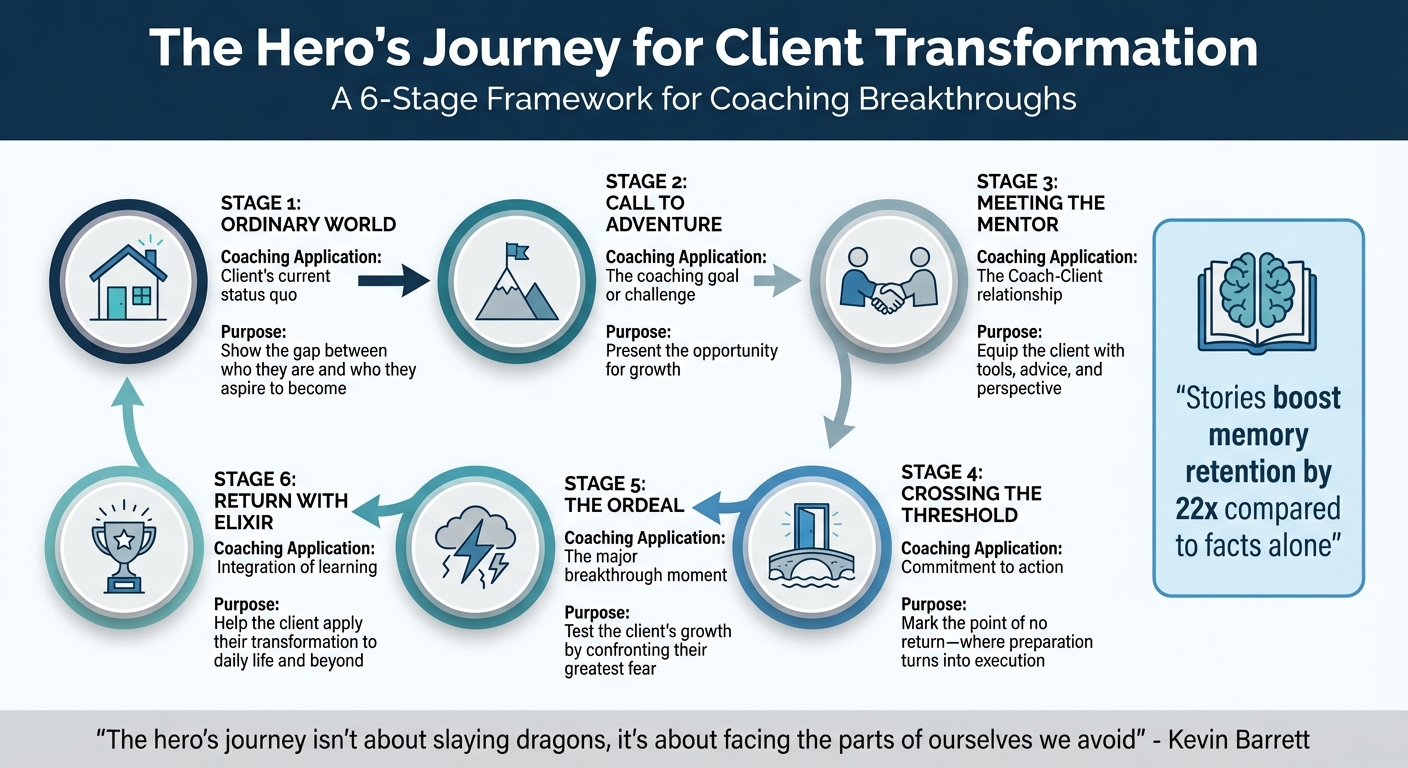
Hero's Journey Framework for Coaching: 6-Stage Client Transformation Process
Once you grasp why stories resonate, the next step is mastering how to structure them. The right framework transforms scattered ideas into compelling narratives that guide clients through meaningful change. These three approaches offer practical tools to craft stories that connect deeply.
The Hero's Journey for Client Transformation
This 12-stage model, adapted by Christopher Vogler from Joseph Campbell’s work, casts your client as the Hero and you as the Mentor offering guidance and tools. It charts a path from the familiar to the unknown and back again - perfect for coaching breakthroughs. As Kevin Barrett, creator of StoryFlint, explains:
"The hero's journey isn't about slaying dragons, it's about facing the parts of ourselves we avoid".
Begin by identifying your client’s Ordinary World - their current reality shaped by limiting beliefs. When they decide to change, they Cross the Threshold into unfamiliar territory. The Ordeal represents their pivotal moment of growth, where they confront their deepest fear. The journey wraps up with the Return with the Elixir, where they integrate their newfound identity into everyday life.
Why does this approach work so well? Stories structured this way stick in our minds - memory retention is boosted by 22x compared to standalone facts. This is because our brains latch onto narratives that are unique or emotionally charged - qualities inherent in the Hero’s Journey.
| Stage | Coaching Application | Purpose |
|---|---|---|
| Ordinary World | Client's current status quo | Show the gap between who they are and who they aspire to become |
| Call to Adventure | The coaching goal or challenge | Present the opportunity for growth |
| Meeting the Mentor | The Coach-Client relationship | Equip the client with tools, advice, and perspective |
| Crossing the Threshold | Commitment to action | Mark the point of no return - where preparation turns into execution |
| The Ordeal | The major breakthrough moment | Test the client’s growth by confronting their greatest fear |
| Return with Elixir | Integration of learning | Help the client apply their transformation to daily life and beyond |
For a more concise way to address challenges, consider the But-Therefore structure.
The But-Therefore Structure for Problem-Solving
While the Hero’s Journey offers a detailed arc, the But-Therefore framework provides a quick, clear way to tackle client challenges. It’s built on three parts: the status quo (beginning), the But (conflict), and the Therefore (resolution). This simple structure keeps conversations focused and avoids tangents.
The But introduces the tension - when staying the same is no longer an option. This conflict drives the narrative forward and keeps engagement high. The Therefore delivers the resolution, outlining the change and its key takeaways. Writing coach Leandre Larouche sums it up well:
"A good story is not a data dump. It's a structured narrative that guides the listener through change - from confusion to clarity, from uncertainty to understanding".
To use this framework effectively, pinpoint the exact moment that sparked the need for change. Then, tie the resolution directly to your client’s situation and next steps.
Show, Not Tell: Making Stories Relatable
The difference between a forgettable story and one that lingers often lies in the details. Showing means painting vivid scenes that bring moments to life. Instead of saying, "it was a tough time", describe it: "the silence in the room felt like it would never end."
Adding sensory details amplifies the emotional impact. Sharing your internal thoughts, struggles, and fears makes you relatable and builds trust. Tap into universal themes - fear of failure, rejection, or the need to belong - that resonate with shared human experiences. As Nimra Khalid, writer and psychologist, notes:
"While AI can take over your content creation, it can't possibly replicate the human experience".
Practice replacing vague phrases like "I felt bad" with specifics: "It felt like my stomach had twisted into knots". Look to moments in your own life where you faced failure, made tough choices, or experienced a shift in perspective. These often become your most powerful coaching stories. Focus each narrative on a single emotion or transformation, and rehearse it aloud to ensure it resonates. By weaving these frameworks into your coaching, every story you tell becomes a catalyst for change.
Techniques for Crafting Stories That Inspire
When it comes to storytelling, the way you craft your narrative can make or break its impact. A well-told story has the power to inspire action, while a poorly executed one can leave your audience disengaged. Below are three techniques to help you turn abstract ideas into stories that resonate and drive results.
Personalize Stories to Fit Client Goals
The key to an effective story lies in tailoring it to your audience. Start by understanding who they are, what they believe, and where you want to guide them. This approach ensures your story connects with their current mindset rather than where you assume they should be. As Michelle Kuei, Business and Visibility Marketing Coach, explains:
"Storytelling in marketing isn't just about selling a product or service; it's about creating a narrative that the audience can identify with, which builds trust and loyalty over time."
A useful tool here is the PAIS Framework. This involves identifying the Problem (your client's pain point), Agitation (why staying in the current situation isn’t sustainable), Inspiration (a relatable success story), and Solution (a clear path forward). Keep your story focused on a single theme - whether it’s courage, perseverance, or growth - to avoid diluting your message. Including personal moments, like setbacks or turning points, adds depth and relatability. Instead of trying to juggle dozens of stories, refine five to six well-practiced ones that you can adapt to different situations.
Next, let’s explore how being genuine can amplify your storytelling.
Use Honesty and Vulnerability
Audiences can spot a fake story from a mile away. Karen Eber, CEO and Chief Storyteller at Eber Leadership Group, cautions:
"They won't trust you if they feel you are making up stories. People want to connect to what is real."
To build trust, share the raw, unpolished parts of your journey - the moments that reveal your humanity. However, timing is everything. Share these experiences only after you’ve had time to reflect and extract meaningful insights, so the story doesn’t feel like an emotional overshare. Avoid overused phrases like "to be honest" or "at the end of the day", and instead focus on specific, vivid details that bring your story to life.
When wrapping up, shift the focus back to your audience. What lessons can they take away? How does your experience relate to their challenges? Adjust your tone based on the setting - a one-on-one session might call for a more personal touch, while a group workshop may require a strategic, big-picture approach.
Finally, let’s look at how to clearly demonstrate transformation in your stories.
Incorporate Before-and-After Contrasts
Transformation is at the heart of any compelling story. To illustrate it effectively, use a 3-Act Structure:
- Beginning: Set the stage by introducing the problem and stakes.
- Middle: Dive into the struggle and the interventions that drove progress.
- End: Highlight the transformation and the lessons learned.
Whenever possible, include measurable results. For example, "increased leads by 150% in six months" is far more impactful than saying "achieved great results." Pinpoint the catalyst - the moment change became unavoidable - so your audience can recognize their own triggers for action.
Research shows that 92% of consumers prefer advertisements that feel like stories. Case studies between 1,000 and 2,500 words strike a balance between depth and readability. Adding client quotes or visual aids like charts and timelines can further enhance credibility and make the transformation more tangible. The goal is to make the change feel achievable, not out of reach.
Integrating Storytelling into Coaching Sessions
Crafting a story is one thing, but weaving it naturally into a coaching session takes finesse. Look for moments in the conversation where a story fits organically, and adjust its length to match the flow of the session. Stories can be especially effective as openers to set the tone, during key moments to deepen understanding, or at the end to connect insights with actionable steps.
Stories have a way of bypassing resistance, triggering both emotional and cognitive responses. Instead of offering direct advice - which can sometimes provoke defensiveness - a well-timed metaphorical story allows clients to explore tough topics in a less confrontational way. As Studyraid puts it:
"Stories are the creative conversion of life itself into a more powerful, clearer, more meaningful experience."
After sharing a story, follow up with open-ended questions like "What resonated with you?" or "How does this relate to your experience?" This encourages clients to connect the narrative to their own lives. To make storytelling a consistent part of your practice, build a "story bank" with five to six core narratives tailored for different client needs. Collect meaningful experiences, pull out the key lessons, and structure them using the three-act format: a beginning to set context, a middle with challenges, and an ending that highlights transformation [1, 3]. Pay attention to how clients respond - when they mention these stories in later sessions or apply the insights, you'll know they're making an impact.
Below, learn how to co-create, reframe, and reinforce storytelling for deeper client engagement.
Co-Create Stories with Clients
Taking storytelling a step further, co-creating narratives with clients makes the process more personal. This approach encourages clients to become active participants in shaping their own journey.
Start by using prompts that help clients tap into pivotal moments. Ask questions like, "Can you share a time you made a decision you later regretted?" or "What conversation changed how you see yourself?" These prompts help uncover specific memories that reveal deeper patterns and beliefs. Guide clients in organizing their experiences using the three-act structure: the Beginning to set the stage, the Middle to explore challenges and decisions, and the End to highlight the transformation. Pay special attention to the catalyst - the moment that sparked a shift in perspective or action.
The goal is for clients to interpret the meaning themselves. As Leandre Larouche, Writing Coach and Consultant at Trivium Writing, explains:
"A compelling story isn't one that happened to someone else; it's one that connects with a listener's own life, challenges, and emotions."
When clients draw their own conclusions, the lessons tend to stick. You can gauge the story's impact by noticing whether they reference it in future sessions or apply its insights to new situations.
Reframe Limiting Beliefs Through Storytelling
After co-creating stories, you can use storytelling to help clients challenge and reframe limiting beliefs. Stories offer a way to explore alternative perspectives, showing that beliefs are choices, not fixed truths. Caroline Adams, Career and Leadership Coach, explains:
"I can think of this differently creates a wedge of daylight to shine on that dark, unchallenged belief. It reminds you that you can CHOOSE how you think about your circumstances."
When a client expresses a limiting belief - like "I can't speak up" or "I shouldn't take risks" - respond with storytelling-based questions such as, "What would happen if you could?" or "What were you telling yourself when you came to that conclusion?".
One effective method is the "Museum of Beliefs" exercise. Encourage clients to temporarily "shelve" beliefs that no longer serve them, much like they moved on from childhood ideas like Santa Claus. As Gemma Perlin, Behavioral Change Coach, notes:
"Beliefs are just ideas that we have committed to. But you can change them if they don't support your purpose."
The key is to ensure the new narrative feels authentic. Overly positive reframes - like jumping from "I'm terrible at this" to "I'm amazing at this" - can backfire, reinforcing the original belief. Instead, use stories that show gradual progress, like someone speaking up in a meeting for the first time, rather than abstract notions of confidence.
Timing matters. Introduce reframing stories during breakthrough moments or at the session's close to connect insights to actionable steps. Encourage clients to notice their inner voice and practice "turning it down" when it isn't helpful.
Reinforce Learning with Story-Based Homework
Storytelling doesn't stop when the session ends. Assigning story-based homework keeps clients engaged and helps them internalize lessons long after a breakthrough.
One approach is to have clients document meaningful daily experiences or moments when they acted differently from their usual patterns. These entries can serve as raw material for future co-created narratives that reflect their growth.
For clients working on reframing beliefs, ask them to practice retelling a transformative story in several ways to find the version that resonates most. Recording and listening back to these stories can reveal shifts in energy and emotional tone.
Another useful exercise is applying the PAIS Framework to a current challenge. This involves identifying the Problem, Agitating the emotional impact, drawing Inspiration from past successes or relatable stories, and outlining a Solution. This structured approach helps clients move from emotional pain to motivated action, reinforcing the session's insights.
Finally, pay attention to how clients reference these homework stories in later sessions. When they bring back documented experiences or revised narratives, it shows that the lessons are sticking and offers an opportunity to build on their progress. Homework like this keeps the momentum alive between sessions, ensuring that transformation continues to unfold.
Using Coachtrusted to Share Your Stories
Your ability to tell compelling stories can be a game-changer for your coaching practice. Coachtrusted offers a platform to showcase the transformations you've guided, turning client success stories into a powerful tool to attract new clients. Considering that 98% of consumers read online reviews when evaluating local businesses, your profile can serve as a vital first impression for those unfamiliar with coaching.
Coachtrusted's tools help you go beyond traditional self-promotion. Instead of simply stating you're a great coach, you can let your clients' experiences speak for you. As Coachvox explains:
"Third-party validation carries significantly more weight than self-promotion. When you claim you're an excellent coach, prospects may be skeptical. When a client says the same thing, people believe it".
This kind of external validation builds trust, reassuring potential clients that choosing you is a smart and safe decision. And where better to showcase these success stories than on your Coachtrusted profile?
Showcase Success Stories on Your Coachtrusted Profile
Your Coachtrusted profile is the perfect place to blend storytelling with credibility. Structure your client success stories to include four key elements: the client's situation before coaching, the challenges they faced, the coaching process you used, and the measurable outcomes achieved. This structured approach helps prospects see themselves in the narrative and grasp the value you bring.
Focus on measurable outcomes to make your stories more impactful. Instead of vague statements like "helped a client gain confidence", highlight specific achievements: "secured a 25% salary increase within three months" or "reduced decision-making time by 40%." These concrete results shift the focus from cost to the value of investing in your coaching. Julia Samoilenko from usetrust.io puts it best:
"A high-quality testimonial is not about you, it's about your clients and their successful transformation. A meaningful testimonial is a success story of how your client got out of misery and into bliss".
To engage different audiences, diversify how you present these stories. Use concise, text-based testimonials (70 words or fewer, with key phrases in bold) for quick reading. Add 60–90 second video testimonials for a deeper emotional connection - video testimonials can boost the likelihood of someone choosing your service by 64%. Place these stories strategically near decision-making points, such as pricing pages or service descriptions, to reassure prospects when they need it most.
For clients in sensitive industries, opt for anonymized descriptions like "a tech executive in healthcare" to maintain privacy while still demonstrating impact. Align testimonials with specific offerings - if you specialize in leadership coaching, feature stories from leadership clients in that section. Refresh your testimonials every 6–12 months to keep them relevant and reflective of your current expertise.
Use Coachtrusted's Messaging Tools to Build Relationships
Coachtrusted's messaging tools let you connect with prospects on a personal level. Tailor your outreach by focusing on the "before state" (their struggles) and the "after state" (the transformation they could achieve). This approach creates an emotional connection by showing empathy and understanding their unique challenges.
Skip the generic intros. Instead, share a relevant story. For instance, if a prospect mentions struggling with work-life balance, briefly describe how you helped a similar client achieve specific results. Keep your tone conversational and genuine - people can tell the difference between a heartfelt message and a canned template.
Encourage prospects to open up by asking targeted questions like, "What does your business look like right now?" or "What hesitations do you have about coaching?" These questions invite meaningful responses, giving you insights to tailor your approach. This back-and-forth storytelling builds trust and strengthens the relationship before your first session.
Beyond direct messages, storytelling can also amplify your online presence.
Grow Your Visibility Through Storytelling
Strategic storytelling on Coachtrusted can boost your visibility and draw in more clients. Regularly update your profile with keyword-rich success stories and testimonials to improve search rankings and engagement. Since 95% of clients consider testimonials before making a decision, keeping your profile fresh signals that you're actively helping clients achieve results.
Use the PAIS Framework (Problem, Agitation, Inspiration, Solution) to create narratives that resonate with prospects. Start by outlining the client's problem, emphasize the emotional toll it took, share inspiration from their journey, and explain the solution you provided. This structure helps prospects visualize themselves in your stories and encourages them to take action.
Michelle Kuei, a Business and Visibility Marketing Coach, explains:
"Storytelling in marketing isn't just about selling a product or service; it's about creating a narrative that the audience can identify with, which builds trust and loyalty over time".
On Coachtrusted, your stories not only showcase your methods but also help reduce any uncertainty about the coaching process. This makes it easier for prospects to take the next step toward working with you.
Conclusion
Storytelling isn't just a creative flourish in coaching; it's a powerful way to build trust and inspire transformation. As Leandre Larouche, Writing Coach and Consultant at Trivium Writing, wisely states:
"People remember stories - not data, not logic".
When used effectively, stories bridge the gap between abstract ideas and tangible understanding, ensuring your coaching messages resonate long after your sessions. They turn complex concepts into relatable, lasting impressions.
This guide has laid out key storytelling frameworks - such as the Hero's Journey and the PAIS structure - that provide actionable strategies for crafting narratives that connect emotionally and motivate action. Whether you're sharing personal experiences or celebrating client wins, every story in your arsenal serves a purpose. By focusing on relevance and incorporating sensory details, you help clients visualize themselves in the narrative. And don’t forget: every story should end with a clear, actionable takeaway.
Start building your collection of stories by documenting impactful moments and organizing them into structured narratives that can adapt to various coaching scenarios. Pay attention to your delivery - timing and authenticity matter. As Beverlee Rasmussen, Founder and Systems Business Coach, emphasizes:
"In an industry where trust and connection matter more than almost anything else, storytelling is your strongest tool to stand out and build meaningful relationships with potential clients".
By incorporating storytelling into your coaching practice, you strengthen your ability to connect with clients and foster trust.
Your stories hold the potential to break through resistance, shift perspectives, and guide clients from uncertainty to clarity. By applying these storytelling techniques consistently - whether in one-on-one sessions, on your vetted coach profile, or in other communications - you'll create lasting change that goes far beyond the coaching relationship.
FAQs
How do I pick the right story for a specific client?
To pick the best story, center your attention on your client's experiences, challenges, and aspirations. Select narratives that incorporate relatable metaphors, real-life successes, or examples that mirror their journey. Be sure to prepare and structure these stories so they feel personal, evoke emotion, and clearly showcase obstacles and solutions that align with the client’s specific situation. This method helps build genuine connections and encourages progress.
What’s the fastest story structure I can use in a session?
The fastest way to structure a coaching session story is by using the Hook, Story, Offer framework. This method grabs attention, shares a compelling narrative, and clearly presents your offer or takeaway, all in a concise manner. Another option is to incorporate key storytelling elements - plot, characters, conflict, and resolution. These help craft relatable and engaging narratives that resonate with clients, making it easier to connect and share valuable insights during your session.
How do I share client success stories without breaking confidentiality?
To highlight client success stories without compromising privacy, anonymize key details such as names, locations, and any personal information. Always obtain explicit consent from clients before sharing their stories. Focus on the transformation they experienced and the results achieved, rather than including identifiable specifics. Discuss with clients what they are comfortable sharing, and incorporate quotes to bring authenticity to the narrative while safeguarding their privacy. Maintain professionalism and respect boundaries to ensure the stories are ethical and respectful.