Career Development
Common Feedback Mistakes Coaches Make
February 21, 2026
11 min read

Common Feedback Mistakes Coaches Make
Feedback is a crucial part of coaching, but it often goes wrong. Poorly delivered feedback can lead to wasted efforts, reduced trust, and even lower performance. Here's a quick summary of the most common mistakes and how to fix them:
- Vague Feedback: Saying things like "good job" or "you need to improve" doesn't help clients understand what they did right or wrong. Be specific and use clear examples.
- Overloading Clients: Giving too many corrections at once overwhelms clients. Stick to 1-2 key points per session.
- Quick Judgments: Harsh or rushed criticism can harm trust. Ask questions and listen before offering feedback.
- One-Size-Fits-All Feedback: Different clients need different approaches. Tailor your feedback to their preferences and experience levels.
- Not Tracking Progress: Feedback is only useful if it leads to measurable improvement. Use metrics and documentation to track results.
Effective feedback builds trust and drives real improvement. Avoid these mistakes, and you'll see better results with your clients.
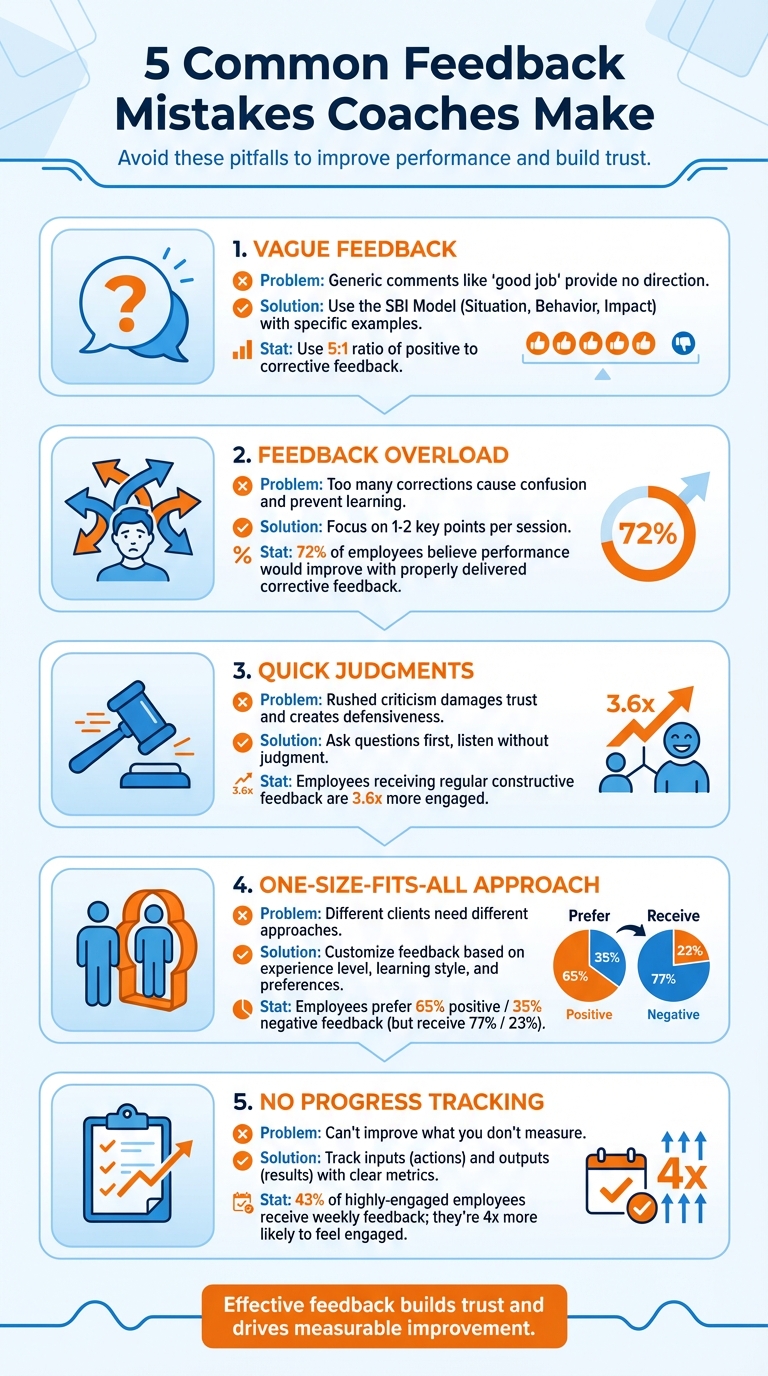
5 Common Feedback Mistakes Coaches Make and How to Fix Them
10 Mistakes to Avoid when Giving Feedback (so you have an effective conversation!)
sbb-itb-3c06305
Mistake 1: Giving Vague or Generic Feedback
Comments like "good job" or "you need to improve" might seem harmless, but they don't provide clients with any real guidance. These kinds of statements fail to highlight what actions were effective or what specifically needs to change. Without clear direction, feedback often misses its mark.
Take vague praise like "great effort" - it doesn't clarify what behavior led to success. For instance, if a client excels during a presentation and all you say is "nice work", they won’t know whether it was their data analysis, delivery style, or visuals that stood out. Similarly, if you tell someone they're "consistently late" but don’t back it up with specifics - like "four of your last five projects were submitted a week past the deadline" - the feedback can feel unhelpfully subjective rather than actionable.
"Vague praise or delayed criticism won't lead to meaningful change for your clients - or the teams they lead." - Team Simply.Coach
When feedback lacks the "why" and the "how", it can come across as patronizing and may even erode trust.
Solution: Base Feedback on Specific Observations
The key to effective feedback is grounding it in clear, detailed observations. Specific feedback can significantly improve coaching outcomes. Instead of vague comments, try using the SBI Model, which breaks feedback into three parts: the Situation (when and where), the Behavior observed, and the Impact it had on the goal or team. For example, instead of saying, "you need to step up more in meetings", you could say:
"During yesterday's strategy call, we missed your input on the client budget. Let’s work on how you can prepare to contribute next time."
For corrective feedback, pair it with actionable steps or tools for improvement. For instance, instead of saying "good job on that shot", you could point out the specific technique:
"Good job snapping your wrist during that shot."
Regular check-ins are also essential to ensure clients are applying your feedback effectively. Additionally, using a 5:1 ratio of positive reinforcement to corrective comments can help build trust and encourage openness to change.
Mistake 2: Giving Too Much Feedback at Once
Trying to fix every issue in one session is a recipe for overwhelm. When you overload your client with corrections, it becomes nearly impossible for them to focus on what really matters. Instead of leaving with a clear plan for improvement, they often walk away feeling unsure about where to start. This approach not only clouds their understanding but also makes meaningful progress harder to achieve.
One of the main reasons feedback fails is because there's simply too much of it. Constant critiques after every attempt can chip away at your client’s confidence. Instead of developing a natural sense of what "right" feels like, they end up second-guessing themselves.
By focusing on fewer corrections, you allow clients to process and implement changes effectively. As Brian McCormick, Performance Director at TrainforHoops.com, explains:
"If I explain every mistake, but he only shoots 15 times in an hour, there is little learning, as he remembers only words (maybe) and not the feel of the correct execution."
When feedback becomes excessive, it prevents clients from building the mental or physical understanding of proper execution. This can lead to a reliance on you to point out mistakes instead of fostering their own ability to self-correct.
Solution: Focus on 1-2 Key Points Per Session
The key to avoiding feedback overload is simple: stick to one or two critical areas per session. Research shows that most people can only process a limited amount of constructive feedback at a time. By narrowing your focus, you give your client a fair chance to absorb and apply what they’ve learned.
Start by identifying the most pressing issues. Often, addressing one major problem can naturally resolve smaller, related issues. For instance, if a client struggles with public speaking, you might focus on either pacing or body language during a session - not both. Once they’ve practiced and internalized one change, you can introduce the next.
Avoid saving up feedback to unload all at once. This tends to create frustration and disengagement rather than improvement. Instead, offer feedback in real time or shortly after the event. Encourage clients to reflect by asking questions like, "What could you adjust to improve?" This approach fosters ownership of their progress.
And here’s a telling stat: 72% of employees believe their performance would improve if managers provided corrective feedback when it’s delivered in the right way. Keep your feedback focused, actionable, and easy to digest, and watch your clients thrive.
Mistake 3: Making Quick Judgments About Client Mistakes
Rushing to judgment is another common trap that can harm the coaching dynamic. Quick, harsh criticisms can damage trust, a cornerstone of any effective coaching relationship. When clients feel judged, they often become defensive or self-critical. This not only wastes energy but also undermines the sense of safety they need to grow, potentially creating an unhealthy dependency on the coach.
John Robinson, the former head football coach at the University of Southern California, wisely said:
"I never criticize a player until they first are convinced of my unconditional confidence in their abilities."
Constructive feedback, on the other hand, fosters engagement and progress. Research highlights that employees who receive regular, constructive feedback are 3.6 times more engaged in their work. This demonstrates how much your approach - tone, timing, and willingness to listen - matters when guiding clients.
Solution: Ask Questions and Listen Without Judgment
Instead of jumping to conclusions, approach the situation with curiosity. Start by asking your client for their perspective before offering your own. This not only helps them identify their own mistakes but also gives you the context needed to provide more focused feedback. Questions like "What do you think happened?" or "What could you do differently next time?" encourage self-reflection and empower clients to take charge of their progress. This aligns perfectly with the idea of offering precise, manageable feedback while fostering a collaborative dialogue.
Scott Jeffrey, founder of CEOsage, puts it well:
"Effective feedback is the timely, compassionate, and actionable exchange of information that enables a person to adjust behavior... while preserving motivation and self-respect."
Timing is equally important. Avoid delivering feedback in the heat of the moment when emotions are running high. Instead, wait until your client is calm and open to discussion. When the time comes, keep the conversation private to avoid embarrassment or defensiveness. A respectful way to ease into feedback is by using the Permission Technique: ask, "May I offer an observation that could help?" This transforms feedback into a shared effort rather than a one-sided critique.
Focus on describing actions rather than making personal judgments. For example, say, "I noticed you stopped after three reps instead of five", rather than, "You're not putting in enough effort." This kind of specific, behavior-focused feedback creates a constructive space for dialogue and growth.
Mistake 4: Using the Same Feedback Approach for Everyone
It's easy to fall into the trap of using a one-size-fits-all feedback method. But here's the thing: what motivates one person might completely backfire with someone else. Some clients are ready to act on feedback immediately, while others need time to process and reflect. Ignoring these individual differences doesn’t just make your feedback less effective - it can even provoke negative reactions like resentment or passive-aggressive behavior. This is why tailoring feedback to each person’s needs is so important.
For example, survey data reveals that employees generally prefer feedback to be 35% negative and 65% positive. However, the actual distribution tends to skew heavily positive, with 23% negative and 77% positive feedback. This mismatch shows how personal preferences for feedback can vary widely. And it’s not just about percentages - factors like cultural background, stress levels, and personal circumstances also shape how feedback is received.
Experience level plays a big role too. A beginner starting from scratch might need frequent, detailed instructions, while someone more experienced may prefer guidance that encourages self-correction. Tony Robbins captured this perfectly when he said:
"To effectively communicate, we must realize that we are all different in the way we perceive the world and use this understanding as a guide to our communication with others."
Solution: Customize Feedback for Each Client
The best way to tailor feedback? Start by asking your clients how they like to receive it. Some people appreciate direct, no-frills critiques, while others prefer a more private, supportive approach. Try questions like: "What kind of feedback helps you the most?" or "Do you prefer to discuss things immediately, or would you rather have time to think first?".
Pay attention to learning styles - whether your client processes information visually, through listening, or by doing. Watch for body language and emotional cues during feedback sessions. These subtle signals can uncover concerns that generic feedback might miss.
Finally, match your approach to where your client is in their journey. A new client who’s feeling nervous may need extra encouragement and step-by-step guidance. On the other hand, a seasoned, confident client might be ready for deeper, more challenging discussions. Use a consistent framework for feedback, but adjust your style to fit each individual’s needs.
Mistake 5: Not Checking if Feedback Actually Works
Giving feedback is just the beginning - it’s what happens after that determines its true value. If you’re not measuring whether your feedback actually leads to improvement, you’re essentially working in the dark. Without clear metrics, it’s easy to fall into the trap of relying on gut feelings rather than hard evidence. This approach can lead to confusion when progress stalls, leaving you unsure whether the issue lies in the feedback itself, how it was implemented, or something entirely different. Over time, this lack of clarity can frustrate your client and even shake their confidence in the process.
As TriageMethod aptly puts it:
"Measurement is the line between a hobbyist who gives 'tips' and a pro who gets predictable, repeatable results." - TriageMethod
The bottom line? If you can’t measure it, you can’t manage or improve it. Studies consistently show that clearly defined, measurable goals outperform vague aspirations.
Solution: Track Progress with Documentation and Metrics
The key to solving this issue is simple: track both the actions your client takes (inputs) and the results those actions yield (outputs). For example, inputs might include completing workouts or meeting daily step goals, while outputs could be strength gains, weight changes, or improved sleep patterns. Tracking both provides a full picture of whether your feedback is driving meaningful progress.
Start by identifying a main “North Star” metric that reflects the client’s primary goal. Then, support it with three to five secondary metrics. For instance, if the main goal is weight loss, secondary metrics might include weekly workout performance, daily step count, and sleep hours. Decide on a tracking schedule - daily for metrics like steps or sleep, weekly for trends like weight or workout completion, and monthly for longer-term indicators such as body composition or progress photos.
If progress is lacking, try an N=1 experiment. This involves forming a hypothesis, making one change (like adding 20g of protein per day), and testing it over two to four weeks. Avoid changing multiple variables at once, as it becomes impossible to pinpoint what’s working. Tools like FEATS (Feedback Engagement and Tracking System) can simplify this process, helping clients log feedback, assess strengths and weaknesses, and create actionable improvement plans.
Always follow up with your client, document key takeaways, and share the agreed-upon action steps. As TriageMethod wisely notes:
"What gets measured gets managed." - TriageMethod
Without tracking, you’re not coaching for progress - you’re just hoping for it. Platforms like coachtrusted make this process easier by offering built-in tools for tracking and documentation, ensuring every session delivers measurable results.
Conclusion
Giving effective feedback isn't just about choosing the right words - it’s about how, when, and what you follow up with. The five common mistakes - vague feedback, overwhelming details, snap judgments, a one-size-fits-all mindset, and skipping progress tracking - can derail even the best intentions. Thankfully, each of these pitfalls has a simple fix you can apply right away.
At the heart of all successful coaching is trust. Without it, even the most well-crafted feedback won’t land. When clients feel genuinely supported, they’re much more open to feedback that sparks real change.
Consider this: 43% of highly-engaged employees receive feedback weekly, and those who get meaningful weekly feedback are 4x more likely to feel engaged at work. Yet, 43% of managers admit that giving corrective feedback feels “stressful and difficult”. This disconnect underscores the importance of having systems that make feedback easier and more effective.
This is where coachtrusted's tools come into play. The platform’s review verification process ensures client feedback is both genuine and actionable, giving you clear insights into what’s working. Its messaging and communication features help you stay on top of follow-ups, track progress, and refine your approach - all in one place. No need to juggle multiple apps - just focus on driving real, measurable results. With these tools and strategies, every coaching session can build toward meaningful, lasting growth.
FAQs
What’s the best way to make feedback specific fast?
To give effective feedback fast, aim to be tactical, actionable, concrete, and specific (TACS). Provide clear and focused observations that directly relate to the task or behavior at hand. This approach makes your feedback relevant and straightforward to implement.
How do I choose the 1–2 feedback points that matter most?
When giving feedback, concentrate on the areas that will make the biggest difference in someone's growth and performance. Focus on providing clear, actionable suggestions that target the most important behavior or skill related to their goals. This approach keeps the feedback relevant and motivating, making it more likely to inspire real progress without feeling overwhelming.
What should I track to prove feedback is working?
Tracking measurable outcomes is key to proving that feedback works. Pay attention to performance improvements, shifts in behavior, engagement levels, and progress toward clear goals. These metrics give you a way to assess how effective your coaching is and make adjustments when necessary.