Health & Fitness
Time Management for Health and Fitness Goals
March 17, 2026
20 min read
Time Management for Health and Fitness Goals
Struggling to find time for fitness? You’re not alone. The key isn’t more hours in the day - it’s better use of the time you already have. Here’s how to prioritize health and fitness without overwhelming your schedule:
- Plan Ahead: Schedule workouts like appointments and prep meals in advance to cut decision fatigue.
- Set SMART Goals: Specific, measurable, and realistic goals keep you focused and track progress effectively.
- Consistency Over Intensity: Short, regular workouts (e.g., 15 minutes, 3x per week) yield better results than sporadic long sessions.
- Use Efficient Workouts: Try HIIT or circuit training to maximize results in less time.
- Track Your Time: Audit your day to find hidden time (e.g., reduce social media use).
- Prioritize Recovery: Sleep and rest are just as important as exercise for long-term progress.
- Leverage Tools: Use apps for meal planning, fitness tracking, and accountability.
Bottom line: Treat fitness as a non-negotiable part of your routine. With just 5 hours a week, you can balance workouts, meal prep, and recovery while staying on track with your goals.
How I find time to exercise with a full-time job (4 easy steps)
Setting SMART Goals for Fitness
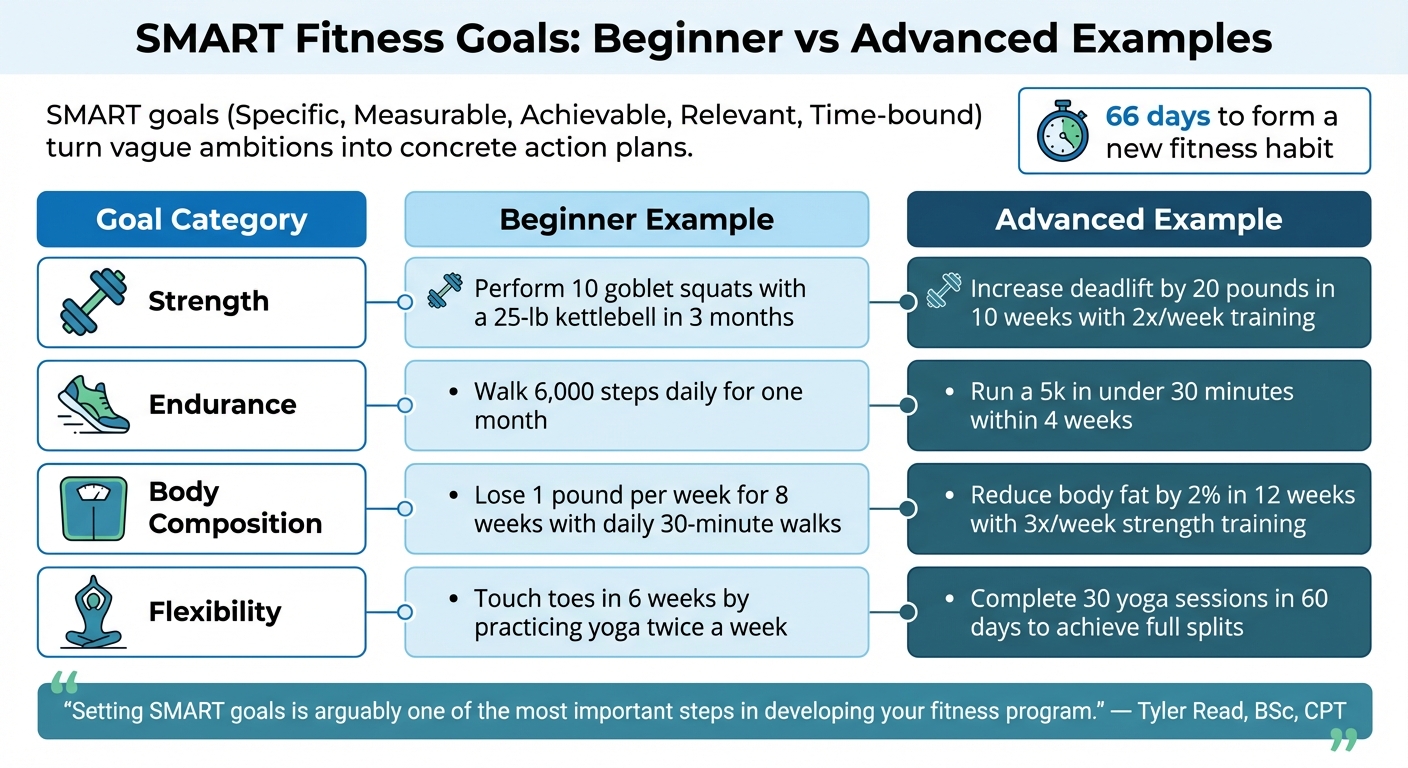
SMART Fitness Goals Framework: Beginner vs Advanced Examples
You've committed to improving your fitness - now it's time to set a clear, actionable plan using the SMART framework. This approach (Specific, Measurable, Achievable, Relevant, Time-bound) helps turn vague ambitions into concrete steps. A 2010 behavioral change study found that SMART goals provide focus and a clear way to measure success.
"Setting SMART goals is arguably one of the most important steps in developing your fitness program." - Tyler Read, BSc, CPT
Think about the difference between saying, "I want to lose weight", and declaring, "I will lose 1 pound per week for 8 weeks by eating 1,500 calories daily and walking 30 minutes a day." The first is just a wish, while the second is a detailed plan. SMART goals rely on clear numbers, measurable outcomes, realistic expectations, personal relevance, and deadlines (often within 1–3 months) to keep you on track .
What SMART Goals Look Like in Fitness
No matter your fitness level, the SMART framework can work for you. For example, someone new to strength training might set a goal like "perform 10 goblet squats with a 25-lb kettlebell within 3 months." Meanwhile, a more experienced lifter could aim to "increase deadlift by 20 pounds in 10 weeks by training twice a week" . For endurance, a beginner might start with "walk 6,000 steps a day for one month", while a seasoned runner might target "run a 5k in under 30 minutes within 4 weeks" .
| Goal Category | Beginner Example | Advanced Example |
|---|---|---|
| Strength | Perform 10 goblet squats with a 25-lb kettlebell in 3 months | Increase deadlift by 20 pounds in 10 weeks with 2x/week training |
| Endurance | Walk 6,000 steps daily for one month | Run a 5k in under 30 minutes within 4 weeks |
| Body Composition | Lose 1 pound per week for 8 weeks with daily 30-minute walks | Reduce body fat by 2% in 12 weeks with 3x/week strength training |
| Flexibility | Touch toes in 6 weeks by practicing yoga twice a week | Complete 30 yoga sessions in 60 days to achieve full splits |
Once you’ve set your goals, track your progress with a fitness log or app. Use tools like smartwatches to automatically monitor metrics such as steps or workout minutes. If your goal feels overwhelming, break it into smaller steps. For instance, if running a marathon feels out of reach, start with a half-mile run and build from there .
Making Goals Fit Your Lifestyle
Unrealistic goals that don’t align with your daily life often lead to frustration.
"SMART fitness goals are a framework for how you're going to achieve certain results. If we don't have something that we're moving toward or a plan to get there, we can get lost and lose motivation." - Christopher Travers, MS, Exercise Physiologist at Cleveland Clinic
To make your goals stick, start by assessing your lifestyle. Review your work hours, family commitments, and energy levels. Are you more productive in the morning or evening? Do you have 30 minutes before work, or is your free time only available after dinner?
Choose activities you enjoy to stay motivated. For example, if running isn’t your thing, aiming for a marathon might feel like a chore and lead to burnout. Instead, focus on activities that excite you. Process goals - like strength training three times a week - can support bigger outcomes, such as losing 20 pounds . Stick to 1–3 main goals at a time to stay focused, and consider your resources, such as budget, equipment, or physical limitations.
Simple habits can also improve your chances of success. For instance, packing your gym bag the night before has been shown to double attendance rates for beginners. Treat your workouts like appointments - block time on your calendar and make them non-negotiable. If you’re short on time, swap a 60-minute gym session for a 20-minute home circuit. Consistency matters more than intensity. Check in with yourself every 4–6 weeks to evaluate progress and tweak your goals if needed. As Travers points out, adjusting to smaller, achievable goals is far better than giving up entirely.
Scheduling Workouts and Daily Routines
Once you've set your SMART goals, the next step is to figure out how to fit your workouts into your schedule. The trick isn’t about magically creating more hours in the day - it’s about using the time you already have more effectively. Start by doing a time audit: track your daily activities in 15-minute intervals for two weeks. You might be surprised to find "hidden" time, like the hours spent scrolling through social media or messaging apps - on average, over two hours a day.
"By identifying where your time goes, you can make small adjustments that add up to big changes." - Kalin Birkel, NBC-HWC
Consistency beats intensity when it comes to fitness. It’s less about when you work out and more about showing up regularly. Treat your workouts like appointments - block them on your calendar and set reminders . To make mornings easier, lay out your workout clothes the night before to avoid decision fatigue.
If carving out an hour feels impossible, start small with the 5-5-5-30 Rule: commit to five minutes of movement, five simple exercises, five days a week, for 30 days. You can also add "movement snacks" (two- to five-minute bursts of activity) throughout the day to increase your weekly total . Everyday tasks like walking during calls or biking to work can help you seamlessly fit more activity into your routine .
Morning vs. Evening Workouts: A Comparison
Deciding whether to work out in the morning or evening depends on your schedule and energy levels. Both have their perks, and research shows that most people exercise during two peak windows: 7:00–9:00 AM or 5:00–7:00 PM.
| Feature | Morning Workouts | Evening Workouts |
|---|---|---|
| Primary Benefits | Builds consistency, boosts mood and productivity, may aid fat loss | Improves strength and endurance, relieves stress, offers social opportunities |
| Physiological Factors | Lower body temperature; muscles need longer warm-ups | Higher body temperature; muscles are more pliable from daily activity |
| Downsides | May require waking earlier or cause fatigue without proper fueling | Intense workouts late in the evening may disrupt sleep; gyms can be crowded |
| Ideal For | Weight management and routine-building | Strength training, high-intensity workouts, and unwinding |
Evening workouts often allow for better performance - studies show you might lift 5% to 10% more weight or complete more reps due to natural circadian rhythms. On the other hand, morning exercisers tend to stay more active throughout the day, often logging more steps than those who work out after 3:00 PM. If you prefer evening sessions, aim to finish high-intensity workouts at least 90 minutes to two hours before bed to give your body time to cool down.
"For most of us who want to exercise for general health effects, the best time is the time that works best for your lifestyle and allows you to perform it regularly." - Erik Van Iterson, PhD, Cardiologist, Cleveland Clinic
Building a Weekly Fitness Schedule
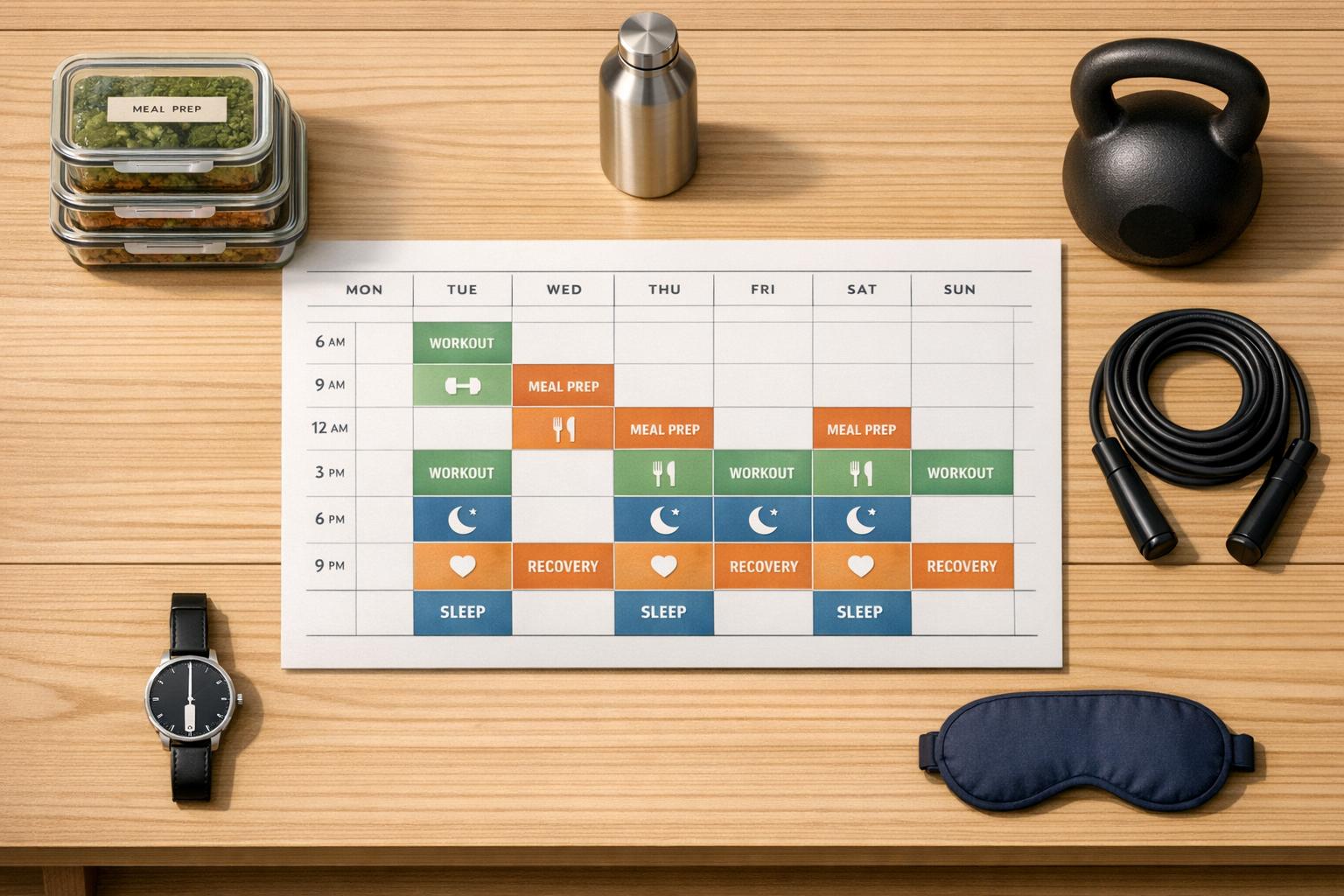
Using these insights, design a weekly plan that balances effort, recovery, and your daily commitments. Choose a workout time that matches your natural rhythm - whether you’re a morning person or a night owl - to make it easier to stick with your plan . Regularly exercising at the same time each day helps turn fitness into a lasting habit.
The American Heart Association and CDC recommend at least 150 minutes of moderate aerobic activity or 75 minutes of vigorous exercise per week . Break this into manageable chunks, like 30-minute workouts on Monday, Wednesday, and Friday mornings, with two 15-minute movement breaks on Tuesday and Thursday.
Minimize barriers by choosing a gym close to home or work, or opt for home workouts to eliminate commute time . Have a backup plan ready - like a quick 15-minute bodyweight routine - for days when life gets in the way. Set aside time each week to review your progress, identify challenges, and tweak your schedule as needed.
"A short workout you actually do is better than a long one you always find excuses not to do." - Calm Editorial Team, Calm
Flexibility is important. If you miss a workout, adjust the timing or intensity instead of skipping the whole week. Even brief sessions of five to 10 minutes contribute to your goals and help maintain your routine. Partnering with a workout buddy or hiring a coach can also keep you motivated and accountable .
Time-Efficient Workout Techniques
For those juggling tight schedules, High-Intensity Interval Training (HIIT) and circuit training deliver impressive results in less time. HIIT alternates short bursts of intense effort (pushing 80–95% of your max heart rate) with brief recovery periods. A quick 20-minute HIIT session can burn as many calories as an hour of steady cardio. Plus, the "afterburn effect" - formally known as Excess Post-Exercise Oxygen Consumption (EPOC) - keeps your metabolism elevated for hours post-workout, continuing to burn calories even after you've stopped.
The effectiveness of HIIT is well-documented. Research shows that just one minute of all-out effort within a 10-minute HIIT session, done three times weekly, can significantly improve blood sugar levels and aerobic capacity. For individuals managing conditions like obesity or diabetes, HIIT has been shown to improve cardiorespiratory fitness almost twice as effectively as moderate-intensity cardio.
"We now have more than 10 years of data showing HIIT yields pretty much the exact same health and fitness benefits as long-term aerobic exercise, and in some groups or populations, it works better than traditional aerobic exercise."
- Todd Astorino, Professor of Kinesiology, California State University, San Marcos
Circuit training, on the other hand, combines strength and cardio by cycling through five to 10 exercises targeting different muscle groups with little to no rest in between (typically 0–30 seconds). These sessions usually last 20 to 45 minutes and keep your heart rate elevated while allowing specific muscle groups to recover as others work. Incorporating compound movements like squats, push-ups, and rows maximizes efficiency by engaging multiple muscles at once and boosting hormonal responses.
HIIT vs. Traditional Cardio: Time Comparison
| Feature | HIIT | Traditional Cardio |
|---|---|---|
| Typical Duration | 15–30 minutes | 30–60+ minutes |
| Intensity Level | High (80–95% max HR) | Moderate (50–70% max HR) |
| Calorie Burn | 20–30% higher per minute, with afterburn | Burns only during activity |
| Muscle-Building Potential | Moderate to high; preserves lean muscle | Low; risk of muscle loss |
| Beginner Suitability | Less suitable without a fitness base | More beginner-friendly |
| Primary Goal | Rapid fat loss and power | Building endurance |
For those short on time, a 15–30 minute HIIT session can provide the same cardiovascular benefits as 150 minutes of moderate-intensity exercise per week. Aim for a 1:1 or 2:1 work-to-rest ratio, such as 30 seconds of effort followed by 15–30 seconds of rest. If you're new to exercise, start with steady-state cardio or circuit training to build a solid foundation before diving into high-intensity intervals. To maximize results, alternate between the two: include HIIT two to three times a week for fat loss and traditional cardio for active recovery and endurance.
Using Circuit Training for Full-Body Workouts
Circuit training is a versatile option, especially for beginners, as it can be tailored to your fitness level and available equipment. Start with bodyweight exercises, then gradually incorporate weights or resistance bands as you gain strength. By alternating between muscle groups, you maintain an elevated heart rate while giving specific areas a brief recovery.
Here’s an example of a 20-minute full-body circuit:
- Perform three rounds of 30-second intervals for each exercise: burpees, squat jumps, mountain climbers, push-ups, jump rope, and Russian twists.
- Rest for 30 seconds between exercises and one minute between rounds.
- Complete two to six circuits depending on your fitness level and time.
Always include a five to 10-minute dynamic warm-up before starting and finish with static stretches to aid recovery and reduce soreness.
"Circuit training is an incredibly effective way to torch calories and build muscle and cardiovascular health. It also boosts your heart and metabolic rate, allowing you to burn calories throughout the day."
- Vidur Saini, ACE-certified personal trainer
As you progress, focus on maintaining proper form, especially when fatigue sets in during the later rounds. Gradually increase your training intensity by adding resistance, reducing rest time, or completing more circuits to avoid hitting a plateau. The flexibility of circuit training makes it a practical choice for anyone looking to combine strength, endurance, and cardio into a single, efficient workout. Plus, it frees up time for other priorities, like meal prep or recovery, while still delivering a full-body workout.
sbb-itb-3c06305
Meal Planning and Preparation Strategies
Even the best workout routine won’t deliver results without proper nutrition. Just like you schedule your workouts, planning meals in advance can make a big difference in achieving your health goals. Meal planning and batch cooking take the guesswork out of daily eating, ensuring your meals align with your fitness objectives. Research highlights the benefits: households that plan meals save 5–7 hours weekly, cut grocery bills by 25–30%, reduce food waste by up to 50%, save between $2,400 and $3,600 annually, and are 30% less likely to experience obesity compared to those who don’t plan ahead. Plus, having a meal plan in place reduces daily decision fatigue, freeing up time for other priorities.
The trick is finding a system that works for you. One approach is component cooking - preparing versatile proteins, grains, and vegetables in bulk so you can mix and match throughout the week. The "Core Plus Accent" method takes this further by preparing neutral base ingredients, like roasted chicken and quinoa, and switching up flavors with sauces, herbs, or toppings to keep things interesting.
"Structure, not willpower, is what keeps most people consistent."
- Mark van Oosterwijck, Founder of FitChef
Batch Cooking for the Week
Dedicating 60–90 minutes once or twice a week to batch cooking can save you hours of daily effort. Start with items that take the longest to cook, like grains or roasted meats, and use that time to prep other ingredients, such as washing and chopping vegetables. This multitasking approach maximizes efficiency.
Follow a simple meal template: Protein + high-fiber Carbohydrate + healthy Fat + Color (vegetables or fruit). Using overlapping ingredients - like spinach for an omelet, a wrap, and a side dish - can simplify both shopping and cooking. Double up on "anchor" meals like chili or curry to have a midweek backup plan.
For safe storage, keep most cooked meals in the refrigerator for 3–4 days, and freeze anything you plan to eat later in the week. Ensure meats reach an internal temperature of at least 165°F (75°C), and store meals in clear, airtight glass containers labeled with dates. A 5-2 framework - cooking five dinners at home while leaving two nights for leftovers or easy meals - can make the system more manageable. With meals ready to go, you’ll have more time to focus on your fitness journey.
Time-Saving Nutrition Tools
Leverage modern tools to simplify meal planning and shopping. Meal planning apps can automate tasks like creating weekly menus, calculating macros, and generating grocery lists. For example, FitChef, rated 4.7/5 on Trustpilot by over 40,000 users, uses AI to streamline planning. Other apps like Plan to Eat, Mealime, and Paprika help organize recipes and sync shopping lists across devices.
Budget-conscious tools like Flipp gather store deals to help you save, while grocery apps offer aisle-organized lists. Delivery services such as Instacart, Shipt, and Amazon Fresh can save you trips to the store, though they may come with fees. Before shopping, check your pantry to prevent overbuying and reduce waste. Theme nights like "Meatless Monday" or "Taco Tuesday" can also simplify meal decisions.
In the kitchen, gadgets like slow cookers, pressure cookers (e.g., Instant Pots), and rice cookers allow for hands-off cooking of large quantities. Food processors speed up chopping, kitchen scales ensure accurate portions, and large sheet pans let you roast multiple ingredients at once. Reusable silicone bags are perfect for freezer storage. By combining these tools and strategies, meal prep becomes less of a chore and more of a system that supports your health and fitness goals.
Rest, Recovery, and Stress Management
Training pushes your body to grow, but it's recovery that actually builds muscle. Sleep plays a crucial role here, as it triggers the release of growth hormones needed to repair muscle fibers. Rest days are equally important, giving your body time to restore energy and heal. However, stress - whether from work, relationships, or daily life - can disrupt these processes. Interestingly, a 2013 study by Hollander and colleagues found that students under high academic stress made less than half the progress on leg press exercises compared to their low-stress peers. They even lost muscle mass and gained body fat. Sleep, in particular, is a cornerstone of recovery, directly influencing muscle repair and overall performance.
Why Sleep Matters for Fitness
For most active adults, 7–9 hours of sleep per night is ideal for proper recovery. Yet, millions of Americans struggle with sleep issues - about 40 million suffer from a sleep disorder, and 60% report problems several nights a week. Even one week of poor sleep can reduce muscle protein synthesis by as much as 18%. Sleep also regulates hunger hormones like ghrelin and leptin, so not getting enough rest might lead to cravings for unhealthy, high-calorie foods.
Athletes understand the power of sleep. NBA legend LeBron James reportedly sleeps 12 hours a day to stay at his best, while former NFL quarterback Tom Brady ensures he gets at least 9 hours nightly to maintain his longevity.
"Sleep is a crucial part of my training" - Adam Peaty, Olympic gold medalist
To improve sleep quality, focus on good sleep hygiene. Keep your bedroom cool (60–68°F), dark, and quiet. Follow the 3-2-1 rule: stop eating 3 hours before bed, stop drinking liquids 2 hours before, and avoid screens for 1 hour before sleep. Consistency also helps - try to wake up within the same 60-minute window daily to stabilize your internal clock. A few minutes of morning sunlight (5–10 minutes) can further anchor your circadian rhythm. And don’t forget about caffeine: its half-life is 5–6 hours, so that 3 PM coffee might still disrupt your sleep at 9 PM.
Stress Management Techniques for Better Results
Managing stress is just as important as sleep when it comes to recovery and fitness progress. Chronic stress elevates cortisol levels, which can interfere with muscle repair, hinder fat loss, and throw your hormones off balance. The good news? There are simple ways to manage stress effectively.
Breathing exercises are a great place to start. Techniques like Box Breathing (inhale, hold, exhale, and hold for equal counts, such as 4-4-4-4) or the 4-7-8 method (inhale for 4 seconds, hold for 7, exhale for 8) can quickly calm your nervous system.
Movement can also help. A 10–20 minute walk, especially in nature, can lower cortisol levels by 53% and improve heart rate variability by 104% - both signs of reduced stress and a healthier nervous system. On rest days, consider gentle yoga or a short mobility flow to promote blood circulation without overloading your body. Writing in a journal before bed can also help clear your mind, making it easier to fall asleep.
| Technique | Duration | Primary Benefit |
|---|---|---|
| Box Breathing | 2–3 Minutes | Immediate nervous system regulation |
| Nature Walking | 15–50 Minutes | Lower cortisol and improved heart rate variability |
| Morning Sunlight | 5–10 Minutes | Stabilizes circadian rhythm and improves sleep |
| Brain Dump | 5 Minutes | Clears mental clutter for better sleep onset |
Finally, don’t overlook the importance of a deload week. Every 4–8 weeks, reduce your training volume by 40–60%. This helps your body recover from accumulated fatigue, avoids plateaus, and keeps your training effective. By making recovery a planned part of your routine, you’ll get the most out of your workouts.
"Muscle isn't built in the hour you train. It's built in the 23 hours after" - Daniel Hopper
Working with Coaches for Accountability
Accountability can make or break a fitness plan. Studies show that solo fitness efforts succeed only 10% of the time. Planning your own routine improves your chances to about 50%. But when you commit to your goals with someone else - like a health coach - your success rate skyrockets to 95%. That leap comes down to one key factor: accountability.
When paired with the structured strategies mentioned earlier, expert accountability ensures your health and fitness goals stay on course, even with a busy schedule.
How Coaches Help with Time Management
A coach does more than provide a workout plan - they help you understand how you’re spending your time. Many start with a time audit to identify "energy takers" (tasks that sap your energy without offering much in return) and "energy givers" (activities that recharge you). This process helps you carve out realistic time slots for exercise.
Coaches also teach practical techniques like time-blocking, using the Eisenhower Matrix, or scheduling workouts during your natural 90-minute energy highs. For example, between January and April 2021, a client working with Abby Arons of Accountability by Abby achieved 100% consistency, never missing a single workout. Before starting, the client had never run before, but within four months, they were completing 30-minute outdoor runs, noticing improved strength, and fitting into clothes more comfortably.
"I send the specific workout because I don't want my clients wasting time scrolling, browsing, or getting side tracked searching for the right one. All of that can turn into wasted time and a chance to lose motivation." - Abby Arons, Fitness Accountability Coach
Coaches also tackle psychological hurdles like procrastination or the "all or nothing" mindset that can derail progress. They offer a neutral perspective to uncover blind spots - those unnoticed pockets of wasted time - and adjust plans dynamically when life throws unexpected challenges your way. Time management coaching typically costs between $100 and $300 per hour, with many offering shorter sessions (30 or 45 minutes) to accommodate tight schedules.
By reclaiming wasted time, a coach can help you stay consistent with your goals. The next step? Finding the right coach for you.
Finding the Right Coach
Look for a coach who provides personalized accountability through regular check-ins, workout reminders, and tailored feedback. Ask whether they use a centralized app for communication and tracking - juggling multiple platforms like email, text, and social media can waste time and complicate things. Certifications matter too. Check for credentials like Certified Strength and Conditioning Specialist (CSCS), Registered Dietitian (RD), or ACE Certified Health Coach to ensure they’re qualified.
Equally important is finding someone whose coaching style fits your personality. Coaching is as much about connection as it is about expertise - compatibility is key. Many coaches offer free discovery calls, so take advantage of these to see if their approach aligns with your needs. Platforms like Coachtrusted make the search easier by connecting you with verified health and fitness coaches. You can browse profiles, read reviews, and find someone who fits your goals and schedule - all in one place.
Conclusion
Reaching your fitness goals doesn’t mean spending endless hours working out. With just about 5 hours a week, you can create a balanced routine: 2–3 hours for strength training, 1–2 hours for cardio, and 1–1.5 hours for meal prep. This approach fits whether you're aiming to lose fat, build muscle, or simply improve your overall health.
Think of fitness as a non-negotiable appointment. Block out specific times in your calendar for workouts and meal prep. For those unexpected challenges, use "If-Then" strategies - like keeping a protein bar handy in case a meeting runs late. These small systems cut down on decision fatigue and help you stay consistent.
And don’t underestimate recovery. Time spent resting or sleeping isn’t wasted - it’s when your body rebuilds muscle, sharpens focus, and sets you up for long-term success. Studies suggest it takes around 66 days for a new fitness habit to stick, so patience and persistence are key.
"Be stubborn about your goals but flexible about your methods." - Tasha, Fitness Blender
Combining structured habits with expert advice can make all the difference. Working with a verified coach on Coachtrusted can add an extra layer of accountability. Research even shows that a well-designed training plan can boost athletic performance by up to 20%. Ultimately, it’s consistency - not extreme effort - that delivers sustainable results.
FAQs
How do I find time to work out with a busy schedule?
To make workouts part of a packed schedule, treat them as you would any critical appointment - block out time on your calendar. Even short sessions, lasting just 20–30 minutes, can deliver great results. You can also get creative by using small chunks of your day, like your commute, for physical activity. Waking up a bit earlier or pairing exercise with routine tasks can make a big difference. The trick is to prioritize fitness and commit to it as a non-negotiable part of your daily routine.
What’s the fastest workout that still works?
High-intensity interval training (HIIT) is one of the fastest ways to get an effective workout, typically lasting just 10–20 minutes. This approach not only boosts cardiovascular health but also aids in fat loss. By alternating between short, intense bursts of exercise and brief recovery periods, HIIT maximizes results in minimal time - perfect for anyone with a packed schedule.
Do I need a coach to stay consistent?
You don’t have to hire a coach to stay on track with your health and fitness goals. With solid scheduling, thoughtful planning, and consistent habits, you can make great progress on your own. That said, a coach can bring something extra to the table - personalized advice and accountability. If you’re finding it tough to stick with your routine or need guidance tailored to your unique situation, having a coach could make a big difference.